



Indices serve as pivotal indicators within the financial markets, tracking the collective performance of selected stocks to provide an overall picture of market health and trends. These financial benchmarks, including the well-known S&P 500 in the United States, help investors and traders assess the relative performance of individual portfolios and understand broader economic movements.
This article will offer an overview of some of the top indices to look at in 2024.
Key Points
- Indices track collective stock performance, serving as benchmarks and economic indicators, like the S&P 500 in the U.S.
- Indices, composed based on criteria like market cap, can be traded indirectly through mutual funds, ETFs, or CFDs, highlighting the importance of their calculation methods.
- Trading indices offers broad market exposure, diversification, and reduced volatility, making it efficient for strategic investment in sectors represented by the S&P 500, Nasdaq, and DJIA.
What are Indices?
Indices are statistical measures or indicators used to track the performance of a group of assets or a specific sector of the financial market. They are essential tools in the financial world, providing snapshots of market trends and overall performance.
Indices are often used as benchmarks to measure the performance of portfolios such as mutual funds or to gauge the health of an economy or sector. Popular examples include the S&P 500, which represents the performance of 500 large companies listed on stock exchanges in the United States.
The composition of an index typically reflects a range of stocks, bonds, commodities, or other financial instruments, chosen based on specific criteria like market capitalisation, industry, or geography. These components are often weighted to ensure that the indices accurately reflect the market or sector they aim to represent and are continually updated during trading hours to reflect the real-time fluctuation in the value of their components.
A key fact about indices is that while individual traders or investors can’t invest or trade directly in an index, they can do so through mutual funds, exchange-traded funds (ETFs), or contracts for difference (CFDs) designed to mimic the performance of these indices. This will be covered more in-depth in the later part of the article.
How are Indices Determined?
Understanding how stock indices are determined is important for traders looking to gauge market trends and find indices that suit their needs. Different methodologies highlight various aspects of the market and the value of companies. Indices can be calculated in different ways based on the types of companies they track, and the goals of the index.
Price-Weighted Indices
Price-weighted indices determine the weightage of each stock within the index based on their share price. This means that companies with higher stock prices have more influence (moving the price of the index more) and weightage in this specific index.
This method does not consider the overall size of the company, focusing solely on the price of each share. The Dow Jones Industrial Average (DJIA) and Japan’s Nikkei 225 are prime examples of a price-weighted index.
Market Cap-Weighted Indices
In market cap-weighted indices, the company’s influence on the index is proportional to its total market value, calculated as the stock price multiplied by the number of shares available. This would mean a company’s market value will make a bigger impact on the index’s movement.
The Standard & Poor’s 500 (S&P 500) is a well-known market cap-weighted index, showcasing a broad spectrum of the U.S. economy. Similarly, the NASDAQ Composite tracks the performance of around 3,000 companies, heavily influenced by the largest tech giants due to their substantial market caps.
Equal Weight Indices
An equal weight, or unweighted index, treats all its member companies equally regarding their impact on the index’s performance. This method ensures that no single company’s performance can overshadow the rest, leading to a more balanced and diversified index.
Such an approach also aids in reducing market volatility and mitigating the effects of substantial price shifts in any single stock. A prime example is the S&P 500 Equal Weight Index (EWI), which offers a variation of the standard S&P 500 by equally weighing each constituent, providing an alternative for a more evenly distributed index performance.
Why Trade Indices?
Trading indices presents both advantages and disadvantages for traders. In the upcoming discussion, we will focus on outlining the advantages:
Diversification
Trading indices is a strategic move for diversification, allowing traders to gain exposure to an entire sector or economy through a single trade. This method allows for the broadened exposure to market trends across various sectors and companies, without having to purchase dozens of stocks individually.
Particularly advantageous for targeting specific markets or trends, trading indices like the S&P 500 or NASDAQ offers a simplified, yet comprehensive approach. It provides diversified exposure to a wide range of industry sectors, making it a beneficial strategy for those looking to minimise risk and capitalise on broad market movements.
Less Volatility
Trading indices typically offer lower volatility compared to trading individual stocks, effectively diluting the impact of any single company’s dramatic price movement. This stability not only reduces the risk of abrupt price fluctuations but also aids in better long-term portfolio management and strategic decision-making.
For traders who are risk-averse, the relative steadiness of indices, representing the collective value of numerous stocks, provides a lower risk option in often turbulent financial markets. This becomes especially apparent when contrasted with trading individual stocks where one poor-performing company can significantly impact your portfolio; trading indices mitigates the risk associated with fluctuations of just a single stock.
Liquidity and Access to Global Markets
Trading indices like the S&P 500 and DJIA offer the dual benefits of high liquidity and access to global markets, allowing for quick and efficient buying and selling with minimal price disruption. This ease of trading facilitates seamless entries and exits, with tighter spreads and lower transaction costs, making it a cost-effective choice.
Additionally, trading indices offers traders the opportunity to tap into various global economies and sectors without the complexities of managing multiple international accounts, significantly broadening their investment horizon.
Top Indices to Watch for Trading
For active traders and investors, here are the top five indices to monitor:
1. S&P 500 (US)
The S&P 500, or Standard & Poor’s 500, is a stock market index comprising the 500 largest companies listed on US stock exchanges. It’s widely considered the main indicator of the US stock market’s performance and a key gauge for the US economy. This index reflects the performance of a broad segment of the US economy through the aggregate movements of top corporate giants across various industries.
Renowned for its industry diversity, the S&P 500 is often used as a benchmark for US markets and is followed by traders worldwide to understand American market trends. The S&P 500 has shown steady, impressive growth over time. Since expanding to 500 stocks in 1957, its average annual return through the end of December 2023 is 10.26% [1].

In 2023, the S&P 500 Index displayed volatility, with growth and recovery from mid-year declines, closing at a higher level. Periods of sharp rises and falls throughout the year indicated a reactive market to various global economic events (the Israel-Hamas conflict and US Federal Reserve Interest Rate Hikes). Despite these fluctuations, the overall trend appears positive, with the index ending the year higher than where it started.
Read all about the five key events that happened in 2023, and how they shifted the markets.
2. Nasdaq 100 & Nasdaq Composite (US)
The Nasdaq 100 is a market-capitalisation-weighted index comprising the 100 largest non-financial companies listed on the Nasdaq stock market. Renowned for its heavy concentration of technology- and innovation-driven companies, it includes industry leaders across sectors such as technology, retail, and biotechnology, making it a popular benchmark for high-growth industries.
Meanwhile, the Nasdaq Composite is broader, including over 3,000 companies listed on the Nasdaq stock exchange. It covers a wide range of sectors and is often used to gauge the performance of the overall tech sector and the U.S. stock market. Both indices are widely followed and critical tools for investors seeking to understand market trends, especially in the technology and innovation sectors.

Starting in January 2023, the chart illustrates a consistent upward trajectory for both the Nasdaq 100 and the Nasdaq Composite indices, signalling cumulative price appreciation across 2023. As the year progressed, particularly from November onward, this positive momentum intensified, suggesting strong bullish sentiment among investors.
3. Dow Jones Industrial Average (US)
The Dow Jones Industrial Average (DJIA), often referred to as “the Dow,” reflects the might of the American economy through the lens of 30 titans. It tracks 30 large, publicly-owned companies trading on the New York Stock Exchange (NYSE) and the NASDAQ. Founded in 1896, the Dow Jones Industrial Average acts as a key indicator for the US stock market and economy’s health. Traders and financial analysts favour the Dow for its simplicity and the well-known nature of its constituent companies, using it to monitor market trends and adjust trading strategies.
These 30 companies are industry leaders across a variety of sectors, reflecting broader economic performance through their stock prices. Here are some of the companies tracked:
- 3M, a multinational conglomerate operating in fields like worker safety and healthcare;
- Apple, a giant in technology and consumer electronics.
- Coca-Cola, a leader in the beverage industry.
- Disney, a major name in entertainment and media, and
- Procter & Gamble, known for a wide range of consumer goods, is just one of them.

Throughout the year, the index fluctuated, as evidenced by alternating red (downward) and green (upward) candles, signalling a volatile market. In March and October 2023, the market dipped following Federal Reserve Chair Jerome Powell’s hint of higher interest rates amid strong economic data. October’s decline also factored in corporate earnings and an ongoing Federal Open Market Committee meeting that had investors on alert for further financial direction.
4. DAX (Germany)
The DAX, short for Deutscher Aktienindex and also known as GER40, is a stock market index that tracks 40 of the largest and most traded companies in Germany, all listed on the Frankfurt Exchange. Think of it as the heartbeat of Germany’s stock market, reflecting the performance and economic health of the nation’s most influential companies.
These companies span sectors such as automotive, technology, and pharmaceuticals, painting a diverse picture of Germany’s robust economy. The DAX is a key indicator for investors worldwide, tracking trends and shifts in Europe’s strongest economy. From its inception in 1988, the DAX has shown remarkable growth, rising from 1,000 to a closing high of 16,751.64 in December 2023, demonstrating its impressive long-term performance [2].

In 2023, the DAX started with bullish momentum, only to correct in March, mirroring market uncertainties and shifting investor sentiment. From April to October, the index entered a consolidation phase, characterised by sideways trading, reflecting equilibrium between buyers and sellers. However, since November, a bullish trend resumed, as evidenced by a string of green candles signalling sustained buying pressure. This rally allowed the DAX to close the fiscal year on a strong note, highlighting its resilience in a volatile market environment.
5. FTSE 100 (UK)
The FTSE 100, commonly referred to as the “Footsie,” is an index that tracks the top 100 companies on the London Stock Exchange, known for their high market value. It serves as a snapshot of the UK economy, highlighting how sectors such as finance, energy, and healthcare are performing.
This index is not only a key indicator for the health of the UK’s economy but also offers a glimpse into the broader European market conditions. Market participants around the world keep a close eye on the Footsie before making or adjusting their trading decisions. The FTSE includes major companies like AstraZeneca, Shell, HSBC, Unilever, and BP.

The FTSE 100’s 2023 graph shows a volatile market, oscillating with ups and downs. The index began on a high note but fell in March due to economic uncertainties that affected investor sentiment. A period of stability ensued from April to October, during which the index moved sideways. A rebound began in November, marked by bullish trends, although the FTSE 100 did not break its February all-time high.
6. Hang Seng Index (Hong Kong) [3,4]
The Hang Seng Index (HSI) serves as the benchmark for blue-chip stocks, tracking the performance of the largest companies listed on the Hong Kong Stock Exchange (HKEx). The HSI is a free-float, market capitalisation-weighted index that captures approximately 65% of the total market capitalisation of the HKEx, which stood at over $31 trillion as of December 2023, a slight decline from November’s $31.1 trillion.
Established in 1969, with a base date of 31 July 1964 and an index value of 100, the HSI is designed to reflect the economic forefront of Hong Kong.
Comprising 82 major companies, including giants such as HSBC Holdings, Alibaba Group, Tencent, and Meituan, the index is structured to prevent dominance by any single entity through an 8% cap on any single entity. This setup ensures a balanced representation of Hong Kong’s corporate leadership on the global financial stage.
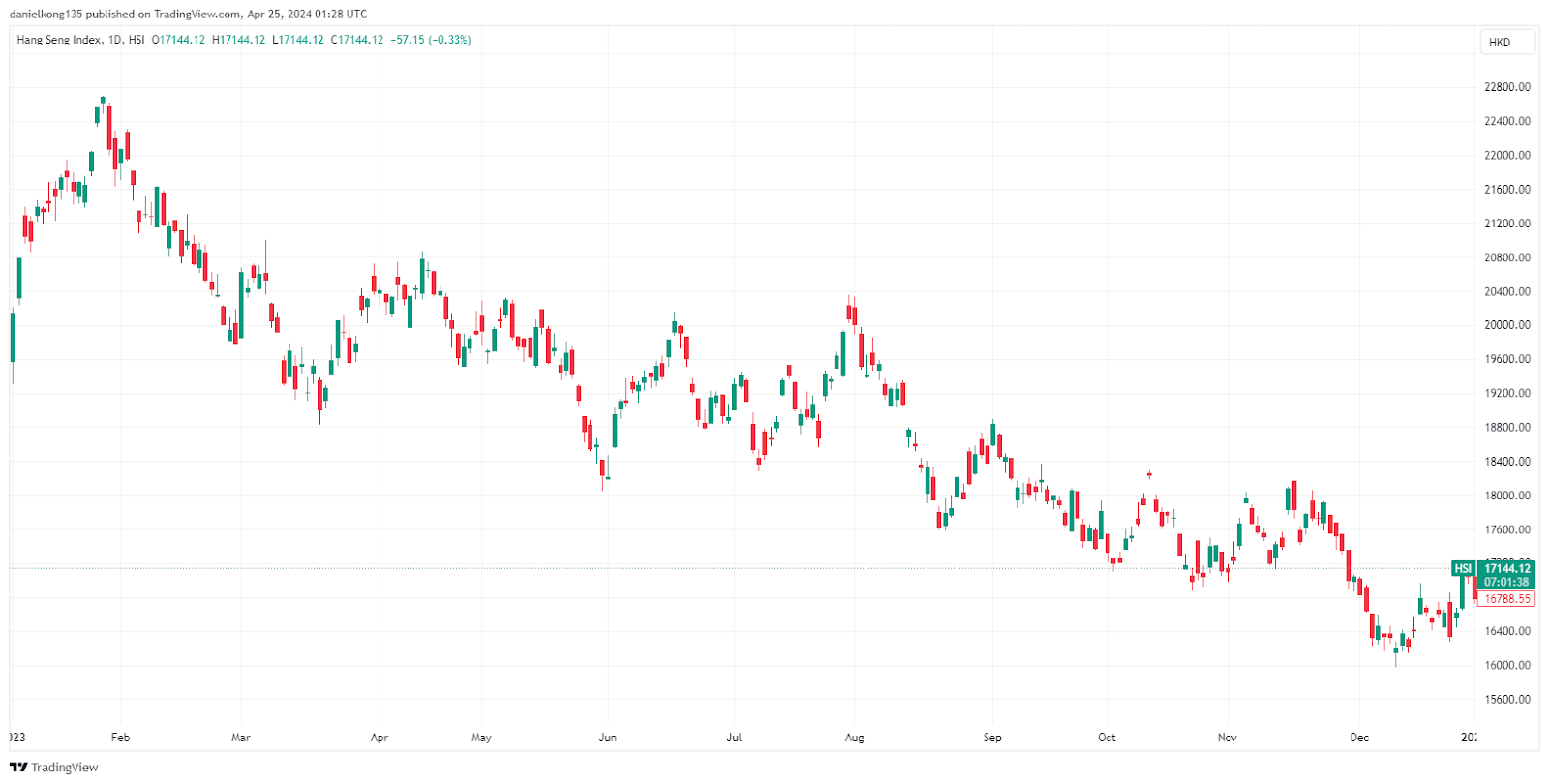
The Hang Seng Index in 2023 exhibited a bearish trend, which is characterised by a series of peaks and troughs that marked its volatility throughout the year. The index started the year on an optimistic note, rallying to early closing highs of 22,688, but faced a series of declines reflecting investor caution amidst economic headwinds.
Market confidence took a hit primarily due to troubles at US regional banks and worries about potential changes in Federal Reserve interest rates. This nervousness grew as concerns about China’s economic health emerged, pushing the Hang Seng Index further down and adding to the year’s overall downward trend. Around the middle of the year, the Hang Seng Index moved back and forth without a clear trend, showing that the market was uncertain and investors had mixed feelings.
As the year progressed, there were spurts of recovery, with the index recovering some of its losses, but these were short-lived as it succumbed to selling pressure, finishing the year without recapturing its early momentum.
In 2024, the Hang Seng Index continued to reflect market uncertainty, with a bearish trend that carried over from 2023. Although occasional bullish rallies offered hope of a turnaround, these upswings were generally followed by downturns that tested lower support levels, suggesting a struggle to sustain upward momentum.
7. FTSE Taiwan RIC Capped Index [5,6]
The FTSE Taiwan RIC Capped Index tracks the performance of larger and medium-sized Taiwanese companies. The size of each company in the index is adjusted based on available shares and reviewed semi-annually. Unlike the FTSE Taiwan Index, which lets larger companies exert greater control over index movements, the capped index limits each company’s influence to 20% of the index’s total value.
Major tech firms like Taiwan Semiconductor Manufacturing (TSMC), MediaTek, Hon Hai Precision Industry, and Quanta Computer are part of this index, which is mostly focused on the tech sector, accounting for 61.5% of its weight.
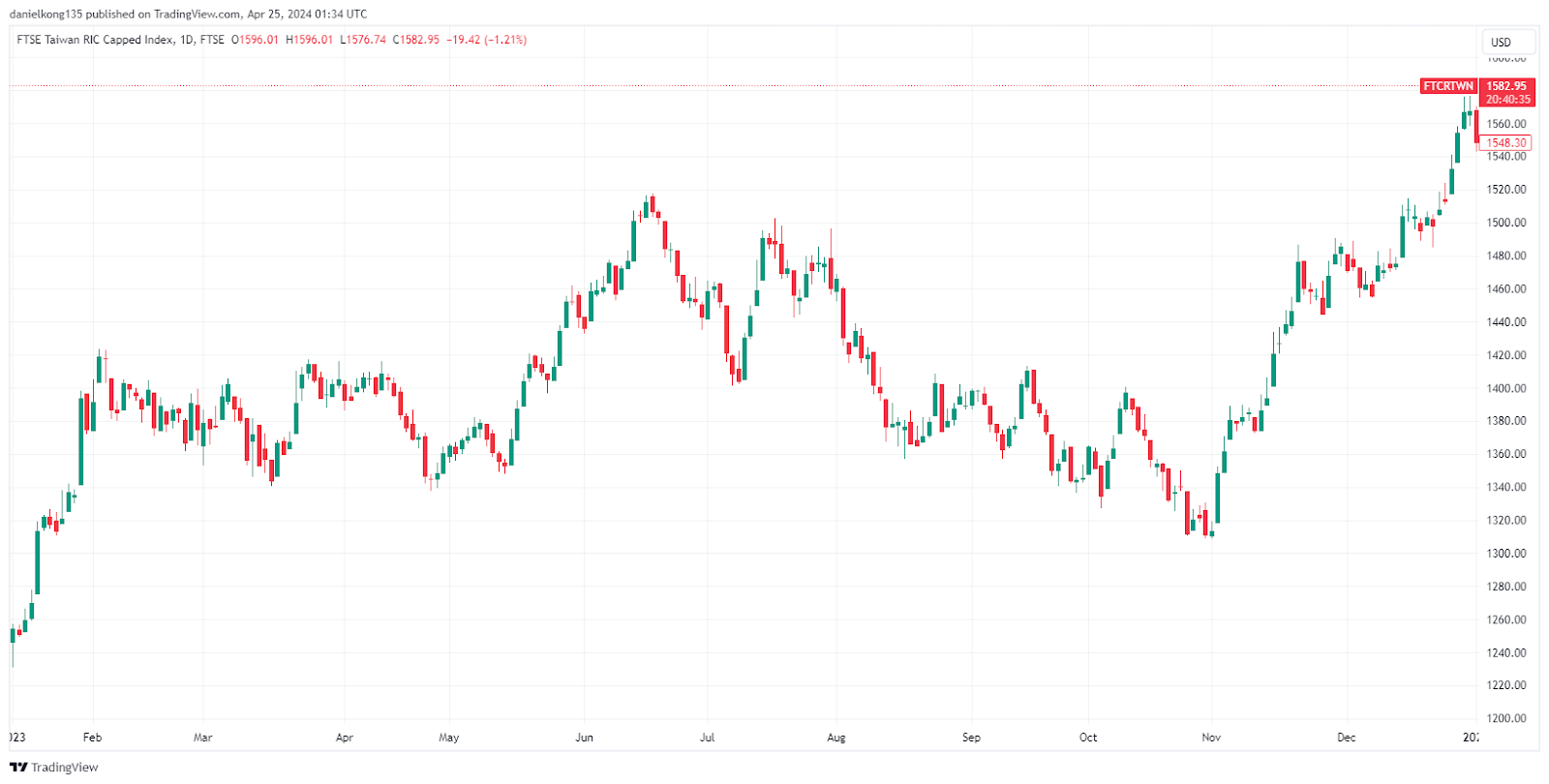
The FTSE Taiwan RIC Capped index chart depicts a year marked by significant ups and downs, highlighting a volatile market. However, in November 2023, the trend turned bullish. The surge in market capitalisation was mainly driven by growth in artificial intelligence (AI) and semiconductor stocks.
Notably, Taiwan Semiconductor Manufacturing (TSMC) saw its market value soar by around NT$3.7 trillion. Similarly, IC designer MediaTek’s market capitalisation increased by NT$640 billion, and Quanta Computer, a leading AI server manufacturer, saw its market cap grow by NT$558.9 billion during the year.
Entering 2024, the FTSE Taiwan RIC Capped Index showed continued strength, as bullish sentiment from the previous year carried over, with investor optimism buoyed by the tech sector’s robust performance. The general upward trend was maintained for some time, suggesting underlying market confidence; however, by April, a sharper decline indicated a shift in investor sentiment.
How to Trade Indices
As mentioned in the earlier part of the article, here is an in-depth coverage of trading Indices using the products below:
Contract for Difference (CFDs)
CFDs allow traders to speculate on the rising or falling prices of indices without owning the underlying assets. These financial instruments are popular due to their flexibility, leverage, and the ability to go long or short.
With CFDs, traders can speculate on the price movements of an index while potentially earning profits from both upward and downward trends. However, it’s important to understand that leverage can magnify both profits and losses. Traders should approach CFDs with a clear strategy and effective risk management in place, staying informed about market conditions that may affect index prices.
Ready to trade indices? Open a live account with Vantage today and discover the potential of taking both long and short positions in indices without having to own the underlying products.
Exchange Traded Funds (ETFs)
ETFs offer a convenient and effective way to gain exposure to an entire index through a single security, traded like a stock on an exchange. ETFs are managed by fund managers who replicate the performance of indices, allowing traders to invest in a broad market segment or a specific sector with ease. ETFs are also known for their cost-efficiency, liquidity, and transparency, which show holdings and performance in real time.
Mutual Funds
Mutual Funds are collective investments that pool money from multiple investors to purchase a diversified portfolio of stocks, bonds, or other securities, including indices. When you invest in a mutual fund that tracks a specific index, you’re essentially buying into a broad representation of that market or sector. Mutual funds are managed by professional fund managers who allocate the fund’s assets and aim to generate capital gains for investors. However, unlike ETFs, mutual funds are typically priced at the end of the day and may come with higher fees, making them less suited for active trading.
Learn all about the similarities and differences between mutual funds and ETFs with our comprehensive article.
Conclusion
Indices represent a critical aspect of the financial markets, providing valuable insights into overall market performance and sector-specific trends. As sophisticated tools, they enable investors and traders to gauge economic health, diversify portfolios, and engage in strategic trading. Trading indices offer a strategic approach for investors seeking diverse exposure and potential trading opportunities.
Navigate the complexities and opportunities of the financial markets with our indices market outlook 2024 to gain a better understanding of indices in 2024.
References
- “S&P 500 Average Return – Investopedia”. https://www.investopedia.com/ask/answers/042415/what-average-annual-return-sp-500.asp. Accessed 2 Jan 2023.
- “DAX PERFORMANCE-INDEX – Yahoo! Finance”. https://finance.yahoo.com/quote/%5EGDAXI/history?p=%5EGDAXI. Accessed 4 Jan 2023.