


 Updated
MCX trading is the buying and selling of commodity futures and options contracts on the Multi Commodity Exchange of India (MCX), the country’s largest commodity derivatives exchange. Rather than buying physical gold, silver, or crude oil, you take a position on where the price of that commodity is heading, then settle the difference.
For traders, MCX is where commodity price discovery happens. It brings bullion, energy, and metals onto a single regulated platform, and it works much like the equity exchanges, only the contracts track raw materials instead of company shares.
This guide explains what MCX trading is, which commodities trade there, how the mechanics work, how to open an account, and how exchange-traded futures differ from commodity Contracts for Difference (CFDs).
Key Points
- MCX trading means dealing in commodity futures and options, contracts whose value tracks assets such as gold, silver, and crude oil, rather than owning the physical commodity itself.
- The Multi Commodity Exchange (MCX) has operated since November 2003, providing a standardised marketplace for trading commodity derivatives such as gold, silver, crude oil, and base metals.
- Trading on MCX requires a SEBI-registered broker and a validated KYC record. Commodity CFDs are a separate route to commodity price exposure and may be available in certain jurisdictions, subject to applicable local laws and regulations.
What Is MCX Trading?
MCX trading is the activity of buying and selling standardised commodity derivative contracts on the Multi Commodity Exchange. These contracts allow traders to take positions on commodities such as gold, silver, crude oil, natural gas, and base metals without directly owning or storing the physical goods.
The exchange began operations in November 2003 and has since grown into a major marketplace for commodity derivatives. By March 2026, MCX had 585 registered members and 32,044 authorised persons, and ranked as the world’s fourth largest exchange by the number of commodity derivative contracts traded, according to Futures Industry Association data [1].
One point often causes confusion. “MCX” can refer to the exchange itself, or to MCX Ltd, the listed company that operates the exchange. When people discuss the “MCX share price”, they usually mean the stock price of that listed company, not the price of gold, crude oil, or any other commodity traded on the exchange. This article focuses on the exchange and the commodity contracts traded on it.
What Commodities Can You Trade on MCX?
Commodities on MCX fall into four broad segments: bullion, base metals, energy, and agricultural products. Each trades as a contract with a fixed lot size, tick size, and expiry set by the exchange.
| Segment | Example Commodities | What Drives Them |
| Bullion | Gold, Silver | Store-of-value demand, currency moves, global rates |
| Base Metals | Copper, Aluminium, Zinc, Lead, Nickel | Industrial demand, construction, manufacturing |
| Energy | Crude Oil, Natural Gas | Supply decisions, geopolitics, seasonal demand |
| Agricultural | Cotton, Mentha Oil, Cardamom, and others | Weather, harvest cycles, domestic policy |
Gold and silver, the bullion segment, draw the heaviest retail interest, and trading gold and silver on MCX is where many newcomers begin. “MCX gold” simply refers to gold futures traded on the exchange, quoted in rupees per 10 grams.
As of late June 2026, MCX gold futures traded around ₹1.44 lakh per 10 grams, with silver near ₹2.22 lakh per kilogram, tracking a global spot gold price of roughly US$4,140 per ounce in early July 2026 [3,4]. Smaller contract sizes such as Gold Mini (100 grams) and Gold Petal (1 gram) let participants trade with less capital.
How MCX Trading Works
MCX trading works through derivative contracts, mainly commodity futures contracts and options on selected commodities. A futures contract is an agreement to buy or sell a set quantity of a commodity at a fixed price on a future date. You do not need to own or store the physical goods; most retail positions are settled in cash for the difference between the entry and exit price, though physical delivery is possible on some contracts.
The direction of a trade is straightforward. If you expect a commodity’s price to rise, you buy (go long); if you expect it to fall, you sell (go short). Your profit or loss depends on how far the price moves, multiplied by the lot size.
Trades are conducted on margin, a deposit that is often a small percentage of the full contract value and lets you control a larger position than your cash outlay. This leverage can magnify both gains and losses, and a move against your position can trigger a margin call that requires additional funds. Commodity prices can also be volatile, swinging sharply on global news.
Say gold futures are trading at ₹1,44,000 per 10 grams and you buy one Gold Mini lot of 100 grams, expecting prices to rise. If the price climbs to ₹1,46,000, that ₹2,000 per 10-gram move works in your favour across the lot; if it falls to ₹1,42,000, the same move works against you.
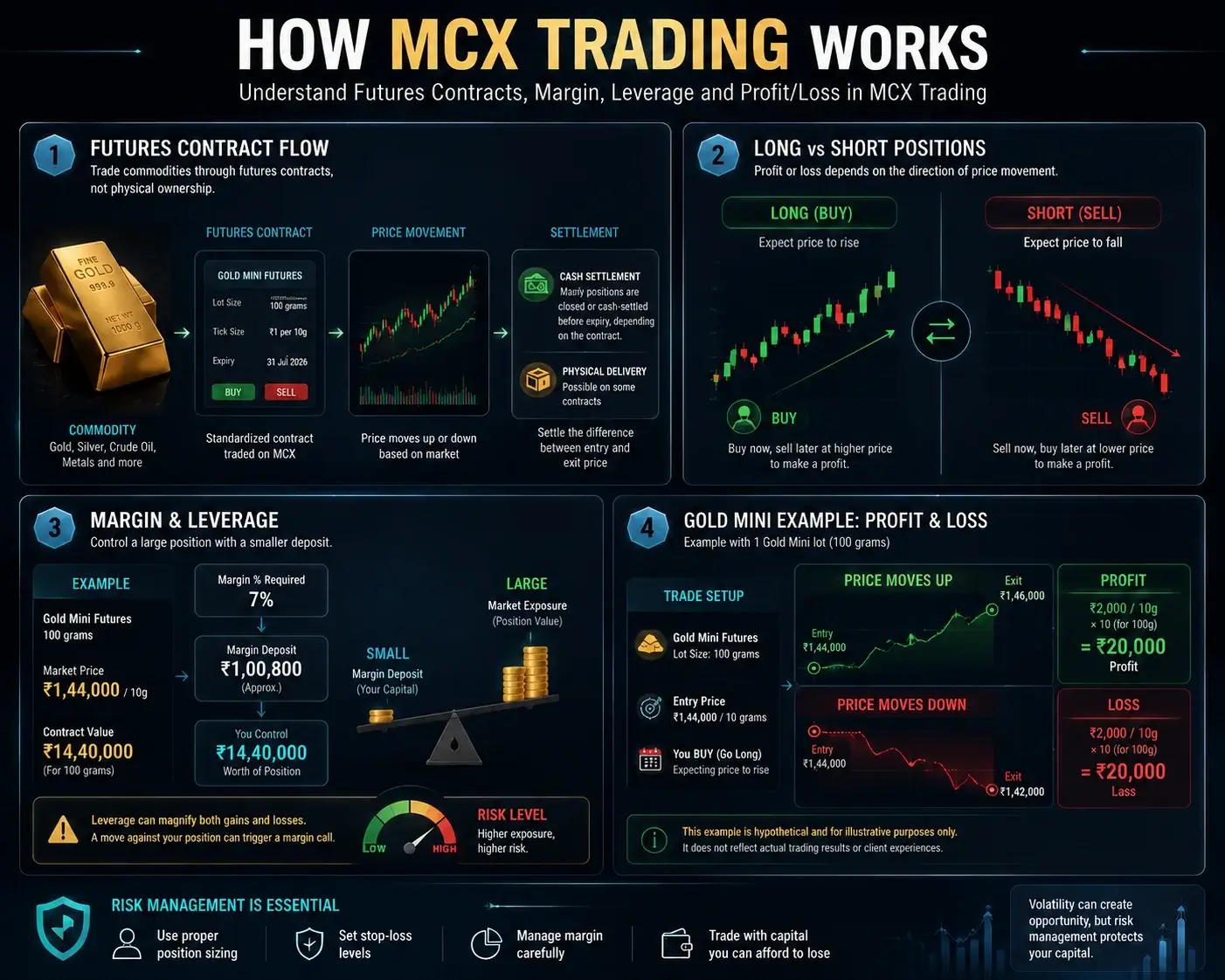
This example is hypothetical and for illustrative purposes only. It does not reflect actual trading results or client experiences.
Because leverage and commodity volatility can amplify losses as easily as gains, risk management, position sizing, stop levels, and committing only capital you can afford to lose, is central to how experienced participants approach the market.
MCX Trading vs the Stock Market
Both MCX and the stock exchanges (NSE and BSE) are regulated marketplaces, but they trade different things and respond to different forces. The stock market deals in company shares, funds, and equity derivatives; MCX deals in commodity futures and options. Understanding where MCX sits relative to equities is often the first thing new traders want to know.
| Feature | MCX (Commodities) | Stock Market (Equities) |
| What you trade | Commodity futures and options | Shares, ETFs, equity F&O |
| Underlying | Raw materials (gold, oil, metals) | Companies |
| Main price drivers | Global supply and demand, currency, geopolitics | Company earnings, sector trends |
| Ownership | No ownership of the physical commodity | Shares represent part-ownership of a company |
Commodity prices tend to react to different forces than shares. Gold often draws demand when markets turn uncertain, while crude oil responds to supply decisions and geopolitics. That relatively low correlation with equities is one reason some traders look at commodities for diversification, though it does not remove risk, and commodity markets carry their own volatility.
How to Start Trading on MCX
Getting started on MCX follows a clear sequence, and it centres on a registered broker that offers the commodity segment.
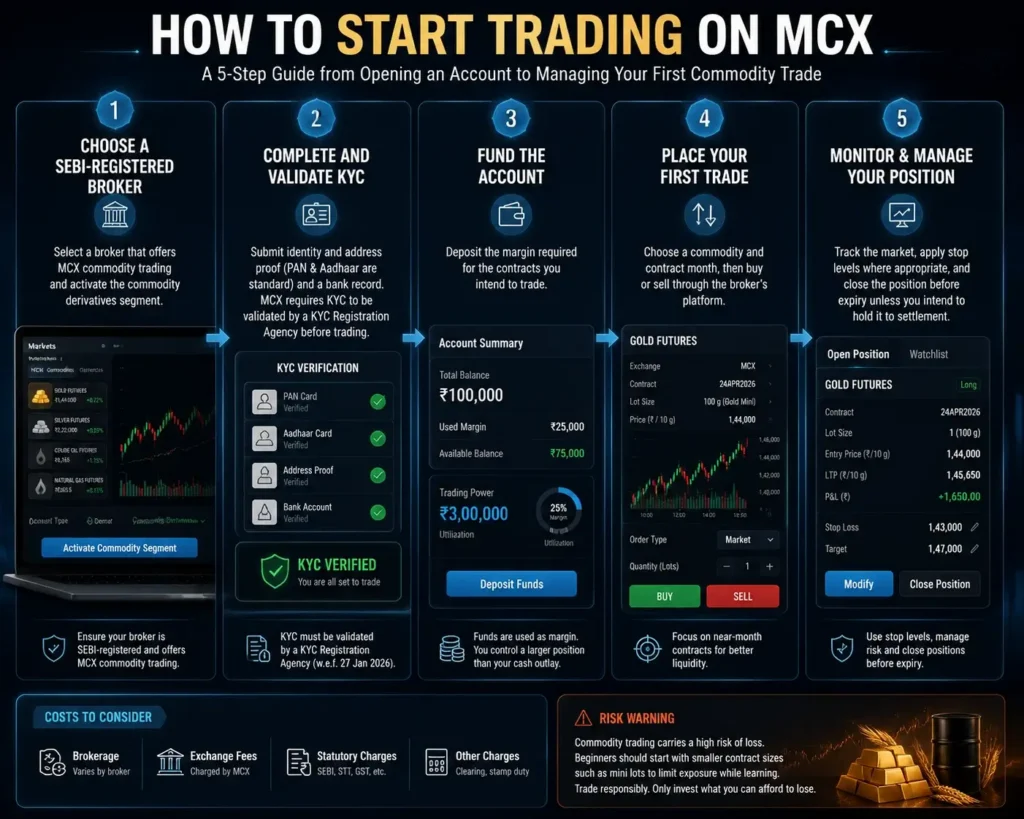
- Choose a registered broker: Select a broker that offers MCX commodity trading and activate the commodity derivatives segment on your account.
- Complete and validate KYC: Submit identity and address proof (PAN and Aadhaar are standard) plus a bank record. From 27 January 2026, MCX requires client KYC to be validated by a KYC Registration Agency before trading is permitted [5].
- Fund the account: Deposit the margin required for the contracts you intend to trade.
- Place a trade: Choose a commodity and contract month, then buy or sell through the broker’s platform, keeping an eye on liquidity in the near-month contract.
- Monitor and manage the position: Track the market, apply stop levels where appropriate, and close the position before expiry unless you intend to hold it to settlement.
Costs to factor in include brokerage, exchange fees, and statutory charges, all of which vary by broker. Commodity trading carries a high risk of loss, and beginners often start with smaller contract sizes such as mini lots to limit exposure while learning.
MCX Futures vs Commodity CFDs
MCX is one way to gain exposure to commodity prices. In some jurisdictions, commodity CFDs are another route. Both allow traders to speculate on price movements, but they differ in structure, access, and regulation.
A CFD is an agreement to exchange the difference in a commodity’s price between opening and closing a position, without owning the underlying asset or holding an exchange-traded contract. Where MCX futures are standardised contracts traded on a domestic exchange, commodity CFDs are traded over-the-counter with a broker. Commodity CFD products may only be available in certain jurisdictions and are subject to applicable local laws and regulations.
| Feature | MCX Futures | Commodity CFDs |
| Where traded | MCX (domestic exchange) | Over-the-counter with a broker |
| Contract type | Standardised futures and options | Contract for Difference |
| Access | Registered broker, validated KYC | Broker account, where available and permitted under applicable laws and regulations |
| Settlement | Cash or physical delivery | Cash difference only |
Both are leveraged products, so both carry a high risk of losing money quickly. Which route fits depends on where a trader is based, the instruments they want, and the regulatory framework that applies, so availability should always be checked for your region. For readers weighing the two structures, the distinction between CFDs and futures is worth understanding before committing capital.
Getting Started with MCX Trading
MCX trading gives traders a regulated, transparent way to take part in commodity markets, from gold and silver to crude oil and base metals, without handling the physical goods. The mechanics rest on futures and options, priced in rupees.
Returns are never assured. Leverage cuts both ways, commodity prices can swing sharply on global events, and every position carries the risk of loss. Whether you access commodities through MCX futures or, where available, through commodity CFDs, the same principle holds: understand the product, size positions carefully, and trade only with capital you can afford to lose.
Frequently Asked Questions
What does MCX stand for?
MCX stands for Multi Commodity Exchange of India Limited. It is a major commodity derivatives exchange based in Mumbai. The exchange lets traders buy and sell futures and options contracts on commodities such as gold, crude oil, and base metals.
What is MCX gold?
MCX gold refers to gold futures and options traded on the Multi Commodity Exchange, quoted in rupees per 10 grams. It lets traders take a position on the price of gold without buying or storing physical bullion. MCX offers several contract sizes, including standard gold, Gold Mini (100 grams), and Gold Petal (1 gram), so participants can choose an exposure that suits their capital.
What is MCX in the share market?
In the share market context, MCX comes up in two ways. First, MCX is the commodity exchange where commodity futures trade, separate from the equity markets where shares are bought and sold. Second, “MCX” is also the ticker for MCX Ltd, the company that operates the exchange and is itself listed on the NSE and BSE. The commodity prices on MCX and the MCX share price are two different things.
How does MCX trading work?
MCX trading works through commodity futures and options, contracts to buy or sell a fixed quantity of a commodity at a set price on a future date. Traders go long if they expect prices to rise and short if they expect a fall, with profit or loss depending on the price move and lot size. Positions are held on margin and can be settled in cash or, on some contracts, by physical delivery. Because margin creates leverage, both gains and losses are magnified, so the risk of loss is significant.
What documents do you need to open an MCX trading account?
To open an MCX commodity trading account, you generally need proof of identity such as a PAN card, proof of address such as Aadhaar or a utility bill, and a bank record like a cancelled cheque or statement. Your broker must also complete and validate your KYC through a KYC Registration Agency. From 27 January 2026, trading on MCX is only permitted once that KYC has been validated.
How is MCX trading different from trading commodity CFDs?
MCX trading uses standardised commodity futures and options traded on a regulated exchange. Commodity CFDs are over-the-counter contracts that track a commodity’s price without an exchange-traded contract or ownership of the asset. Both are leveraged and carry a high risk of loss, and commodity CFD products may only be available in certain jurisdictions and are subject to applicable local laws and regulations.
RISK WARNING: CFDs are complex financial instruments and carry a high risk of losing money rapidly due to leverage. You should ensure you fully understand the risks involved and carefully consider whether you can afford to take the high risk of losing your money before trading.
Disclaimer: The information is provided for educational purposes only and doesn’t take into account your personal objectives, financial circumstances, or needs. It does not constitute investment advice. We encourage you to seek independent advice if necessary. The information has not been prepared in accordance with legal requirements designed to promote the independence of investment research. No representation or warranty is given as to the accuracy or completeness of any information contained within. This material may contain historical or past performance figures and should not be relied on. Furthermore estimates, forward-looking statements, and forecasts cannot be guaranteed. The information on this site and the products and services offered are not intended for distribution to any person in any country or jurisdiction where such distribution or use would be contrary to local law or regulation.
References
- “About Us – MCX” https://www.mcxindia.com/about-us Accessed 8 July 2026
- “Securities and Exchange Board of India (SEBI)” https://www.sebi.gov.in Accessed 8 July 2026
- “Gold Rates & Silver Rates Today – Goodreturns” https://www.goodreturns.in/gold-rates/ Accessed 8 July 2026
- “Gold – Price Data – Trading Economics” https://tradingeconomics.com/commodity/gold Accessed 8 July 2026
- “Circular no. MCX/S&I/018/2026 – MCX” https://www.mcxindia.com/circulars/all-circulars Accessed 8 July 2026