


 Updated
Artificial intelligence has moved from institutional trading floors into the hands of everyday market participants, narrowing the gap between the two.
What once required a quant team, expensive infrastructure, and proprietary data feeds can now be accessed through a browser tab. Yet for all the accessibility, the mechanics of AI stock trading remain poorly understood by the traders using it most.
The global AI trading software market was valued at approximately $13.5 billion in 2025, with projections pointing toward $70 billion by 2034 [1]. That kind of growth does not happen without genuine utility — but it also attracts a great deal of noise.
Understanding how AI actually functions in stock markets, and where its boundaries lie, is increasingly essential for any trader engaging with these tools.
Key Points
- AI stock trading uses machine learning, natural language processing, and algorithmic systems to analyse market data, identify patterns, generate signals, and support automated execution.
- Its main value lies in speed, consistency, market scanning, sentiment analysis, and backtesting, but its outputs remain probabilistic and depend heavily on data quality.
- Key risks include overfitting, limited transparency, weak performance during unusual market events, and correlated automated behaviour, so AI is best viewed as a supporting tool within a defined trading process.
What Is AI Stock Trading?
AI stock trading refers to the use of artificial intelligence (AI) systems to analyse market data, identify trading signals, and execute orders in financial markets.
These systems may use machine learning, natural language processing (NLP), and deep learning to process large volumes of data faster than manual analysis. This can help detect patterns, apply rules-based strategies, and support more consistent trade execution.
The practice sits under the broader umbrella of algorithmic trading, but with an important distinction. Traditional algorithmic trading relies on fixed, pre-programmed rules. AI-driven systems are designed to learn from data and refine their behaviour over time, adapting to changing market conditions rather than following static logic.
At its most fundamental level, AI stock trading uses historical price data, live market feeds, news, and earnings transcripts to identify patterns that may support trading decisions.
How AI Stock Trading Works: The Core Mechanics
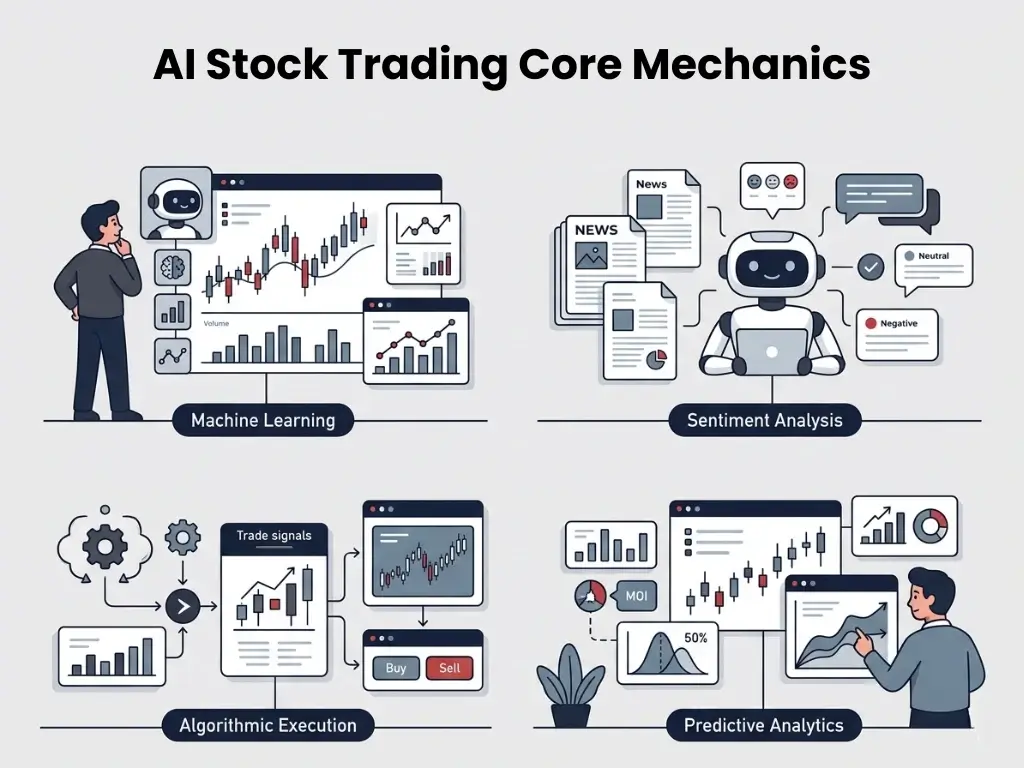
AI trading systems do not operate as single algorithms. They are built from a stack of interconnected technologies, each performing a distinct function within the overall process.
Machine Learning and Pattern Recognition
Machine learning (ML) sits at the centre of many AI trading systems. These algorithms are trained on historical market data, such as price movements, volume, technical indicators, and economic data, to identify patterns linked to future price behaviour.
Different ML methods can support trading analysis. Supervised learning uses labelled data to study past price movements. Unsupervised learning looks for hidden patterns or unusual market behaviour. Reinforcement learning tests actions in a simulated trading environment, using rewards and penalties to refine its approach over time.
Deep learning takes this further by using neural networks to analyse more complex data, including price trends, news text, and earnings call content.
Key features:
- Trained on historical price, volume, and indicator data to identify repeating patterns
- Adapts to new market data through continuous retraining cycles
- Supervised, unsupervised, and reinforcement learning serve different analytical functions
- Deep learning handles complex, multi-source inputs including unstructured text
- Pattern detection operates at scales and speeds beyond manual analysis
Sentiment Analysis and Natural Language Processing
Sentiment analysis uses natural language processing (NLP) and machine learning to assess whether text is positive, negative, or neutral. In trading, AI systems may use market sentiment from news, earnings calls, filings, analyst reports, and social media as an extra data layer alongside technical and fundamental indicators.
These systems can process large volumes of text in real time, giving models broader and faster access to market-related information than manual review alone.
Research on nearly one million US financial news articles found that finance-focused large language models could identify statistically significant predictive signals from news sentiment data. However, sentiment analysis can be affected by noise, especially from social media, so models require ongoing calibration as language and market conditions change.
Key features:
- Processes news, filings, social media, and analyst reports at scale in real time
- Assigns sentiment scores that feed into broader trading models as an additional signal layer
- Particularly effective for event-driven strategies responding to earnings announcements or macro news
- Vulnerable to noise from low-quality or misleading sources if models are not carefully calibrated
Algorithmic and High-Frequency Trading
Algorithmic trading uses pre-programmed rules to execute orders based on market data, price levels, volume, or other measurable conditions. AI can make these rules more adaptive by adjusting parameters as market conditions change.
High-frequency trading (HFT) is a faster, more latency-sensitive form of algorithmic trading. It executes large volumes of orders within milliseconds to act on short-term price differences. AI-driven HFT may analyse several markets at once, combining technical signals with real-time sentiment data.
For retail traders, AI-based algorithmic tools are usually used for automated strategy execution, signal scanning, and rules-based order placement. These tools can help apply a defined strategy more consistently across market hours.
Key features:
- Rules-based execution removes emotional decision-making from the trade entry and exit process
- AI systems can update their parameters in response to changing market conditions
- HFT operates at millisecond latency and is primarily an institutional and proprietary trading domain
- Retail-accessible tools focus on scanning, signal generation, and semi-automated execution
Quantitative Trading and Predictive Analytics
Quantitative trading uses mathematical and statistical models to analyse price behaviour, identify potential opportunities, and manage portfolio risk. AI expands this by detecting non-linear patterns across large datasets, which traditional models may not capture as easily.
In AI trading systems, predictive analytics may combine technical indicators, such as moving averages, Relative Strength Index (RSI), Bollinger Bands, and Moving Average Convergence/Divergence (MACD), with fundamental metrics and alternative data.
Instead of giving fixed buy or sell signals, these models usually produce probability-based outputs, such as ranked opportunities with confidence scores. This reflects statistical tendencies, not certainty.
Key features:
- Combines technical indicators, fundamental data, and alternative inputs within statistical models
- Outputs probabilistic signals rather than binary trade instructions
- Deep learning handles non-linear relationships that traditional statistical models cannot capture
- Backtesting against historical data allows strategies to be validated before live deployment
- Past backtesting performance does not guarantee future results
How Traders Use AI Trading Tools in Practice
AI stock trading tools are now available across a wide spectrum of use cases, from professional-grade algorithmic systems to accessible retail platforms designed for non-technical users.
| Use Case | What AI Does | Example of How It May Be Used |
| Market scanning | Screens thousands of instruments for pattern-based signals, ranked by confidence score. | A trader may use an AI screener to identify shares showing unusual price movement, rising volume, or technical patterns such as breakouts, pullbacks, or moving average crossovers. |
| Sentiment monitoring | Tracks news and social media sentiment in real time, flagging significant shifts for specific instruments. | An equity trader may use AI to monitor whether market sentiment around a company has turned more positive or negative after earnings, product announcements, analyst notes, or regulatory updates. |
| Strategy backtesting | Tests defined rule sets against historical data to evaluate theoretical performance. | A systematic trader may test whether a moving average strategy would have behaved differently across bull markets, bear markets, and high-volatility periods. |
| Automated execution | Executes orders automatically when predefined conditions are met, connected to a brokerage account. | A rules-based trader may set an AI-assisted system to place an order only when price, volume, and volatility conditions are all met. The trader still defines the rules and risk limits. |
| Portfolio risk analysis | Models portfolio-level risk under different market scenarios using historical and simulated data. | A longer-term investor may use AI to assess how a portfolio could react to higher interest rates, falling equity markets, or sector-specific weakness. |
| Research assistance | Summarises earnings reports, regulatory filings, and market commentary to speed up information review. | An analyst may use AI to extract key points from an earnings call transcript, compare them with previous quarters, and highlight changes in management tone or guidance. |
Across all of these use cases, the most effective approach is one that uses AI as a tool within a defined trading process rather than as a replacement for one.
AI can compress the time and cognitive load required to analyse data and execute decisions — but the strategic framework, risk parameters, and accountability for outcomes remain with the trader.
Potential Advantages of AI in Stock Trading
AI tools offer several characteristics that can genuinely improve the consistency and efficiency of a trading process. These potential advantages are context-dependent — they depend on the quality of the tools, the data they operate on, and how they are used.
| Potential Advantage | What It Means in Practice | Important Caveat |
| Speed and execution | AI systems can process signals and execute orders in milliseconds, faster than manual execution allows. | Speed alone does not generate edge — the underlying strategy still determines outcomes. |
| Consistency | Rules-based execution removes emotional bias from trade decisions, applying the same criteria across all conditions. | Consistency in execution of a poor strategy does not improve results. |
| Data processing scale | AI can simultaneously analyse thousands of instruments, indicators, and news sources in real time. | Data volume is not a substitute for data quality — garbage in, garbage out. |
| Backtesting capability | Historical strategy validation allows traders to assess theoretical performance before risking capital. | Backtesting performance is not indicative of future results and is subject to overfitting. |
| Emotion reduction | Automated execution reduces the impact of fear, greed, and hesitation on individual trade decisions. | Removing emotion does not remove risk — all trading involves the possibility of loss. |
The most consistent theme across these potential advantages is process improvement rather than outcome guarantee. AI trading tools can make the execution of a strategy more efficient, consistent, and data-informed — but they do not alter the fundamental uncertainty that is inherent to financial markets.
Key Limitations and Risks of AI Stock Trading
Understanding where AI trading tools fall short is as important as understanding what they can do. Traders who treat AI systems as predictive oracles rather than analytical tools are more likely to take on risks they do not fully understand.
Overfitting and Historical Bias
Overfitting happens when a machine learning model learns the noise in past data rather than patterns that may continue over time. A model may perform well in backtesting but fail in live markets if the conditions it learned from no longer apply.
This risk is especially relevant in financial markets, where price behaviour can shift due to monetary policy, geopolitical events, and market structure changes. AI trading tools therefore require regular review and recalibration, rather than static deployment.
Black Swan Events and Model Limitations
AI models are trained on historical data, so they may struggle with events outside their training range. These include sudden geopolitical shocks, severe market disruptions, or sharp policy changes.
During these periods, models based on calmer market conditions may produce inaccurate signals. This is a limitation shared by many systematic strategies, but it is important because AI models can appear highly reliable after strong backtesting results.
Transparency and Explainability
Many advanced AI trading models, especially deep learning systems, operate like ‘black boxes’. They can generate outputs without clearly showing how the result was reached. This makes it harder to assess why a trade failed, identify weak points, or adjust the model effectively.
Systemic Risk and Correlated Behaviour
If many traders use similar AI-driven strategies, their systems may generate the same signals at the same time. This can intensify price movements, especially during stressed market conditions.
The 2010 Flash Crash shows how this can happen. On 6 May 2010, the Dow Jones index fell by almost 9% within minutes before recovering much of the decline. US regulators later linked the disruption to a $4.1 billion sell order executed through an automated strategy, which triggered further selling and heavy high-frequency trading activity.
In around 20 minutes, 2 billion shares worth $56 billion changed hands, with some trades executed at extreme prices before markets stabilised [2].The event is often discussed alongside other stock market crashes in history, as it shows how market structure, liquidity, and automated trading can interact during periods of stress.
It also highlights a key risk in automated markets. When liquidity weakens and many systems react in the same direction, price movements can become faster, sharper, and harder to predict.
Understanding AI’s Role in Your Trading Process
AI has become a practical part of modern trading. It can process large volumes of market data, apply rules consistently, and identify patterns faster than manual analysis.
However, AI stock trading systems do not predict markets with certainty. They work by identifying statistical tendencies from historical data and applying them to new market conditions. When those conditions shift, especially during unusual or volatile periods, their outputs may become less reliable.
This is why AI is best viewed as a supporting tool, rather than a shortcut. It can improve the speed and consistency of a defined trading process, but it does not replace strategy, risk management, or human oversight.
Frequently Asked Questions
What is AI stock trading?
AI stock trading uses artificial intelligence systems to analyse market data, generate trade signals, and, in some cases, execute orders. These systems may use machine learning, natural language processing, and deep learning to process price data, news, earnings reports, and other market inputs.
How does AI make trading decisions?
AI trading systems look for patterns in historical and real-time data. Inputs may include price movements, volume, technical indicators, macroeconomic data, news, and social media sentiment.
The system then produces an output, often as a signal or confidence score. This may inform a trader’s decision or trigger an automated order, depending on how the system is set up. The quality of the output depends heavily on the data used to train and update the model.
Can AI predict stock market movements accurately?
No AI system can predict stock market movements with consistent accuracy. AI models identify statistical tendencies based on past data, but markets are influenced by many unpredictable factors.
These may include geopolitical events, policy decisions, earnings surprises, and sudden shifts in investor sentiment. Some AI models may produce useful signals in specific conditions, but past performance is not indicative of future results. Market uncertainty always remains.
What are the main risks of using AI for stock trading?
The main risks include overfitting, poor data quality, limited transparency, and weak performance during unusual market events. A model may perform well in backtesting but fail when live market conditions change.
Some advanced AI systems also operate like black boxes, making it difficult to see how decisions are made. At a broader market level, similar AI-driven strategies may react in the same direction at the same time, which can intensify volatility.
Is AI stock trading suitable for beginners?
Some AI trading platforms are built with user-friendly interfaces, which can make them more accessible to beginners. Still, accessibility does not reduce trading risk.
A trader still needs to know how the instrument works, what the tool is doing, and how risk may affect their account balance. AI tools are best viewed as support for a defined trading process, not a replacement for trading knowledge or risk awareness.
How is AI trading different from traditional algorithmic trading?
Traditional algorithmic trading follows fixed rules. For example, if a defined condition is met, the system executes a trade.
AI trading is more adaptive. It can learn from data, update its parameters, and adjust its outputs as market conditions change. This flexibility is the key difference, but it also introduces risk. If the model learns from noisy or misleading data, its live performance may weaken.
What role does sentiment analysis play in AI stock trading?
Sentiment analysis uses natural language processing to assess the tone of text sources such as news articles, earnings calls, filings, analyst reports, and social media posts.
In AI stock trading, this sentiment data can become an extra signal alongside technical and fundamental analysis. For example, a sudden shift in market tone may influence how a model ranks a stock or sector. However, sentiment data can be noisy, especially on social media, so it is rarely used in isolation.
RISK WARNING: CFDs are complex financial instruments and carry a high risk of losing money rapidly due to leverage. You should ensure you fully understand the risks involved and carefully consider whether you can afford to take the high risk of losing your money before trading.
Disclaimer: The information is provided for educational purposes only and doesn’t take into account your personal objectives, financial circumstances, or needs. It does not constitute investment advice. We encourage you to seek independent advice if necessary. The information has not been prepared in accordance with legal requirements designed to promote the independence of investment research. No representation or warranty is given as to the accuracy or completeness of any information contained within. This material may contain historical or past performance figures and should not be relied on. Furthermore estimates, forward-looking statements, and forecasts cannot be guaranteed. The information on this site and the products and services offered are not intended for distribution to any person in any country or jurisdiction where such distribution or use would be contrary to local law or regulation.
Reference
- “AI Trading Platform Market Size, Share and Trends 2025 to 2034 – Precedence Research” https://www.precedenceresearch.com/ai-trading-platform-market Accessed 28 April 2025
- “The 2010 ‘flash crash’: how it unfolded – The Guardian” https://www.theguardian.com/business/2015/apr/22/2010-flash-crash-new-york-stock-exchange-unfolded Accessed 28 April 2025