


The global foreign exchange (forex) market reached a daily turnover of $9.6 trillion in April 2025—a 28% increase in just three years—according to the Bank for International Settlements (BIS) Triennial Central Bank Survey of Foreign Exchange and OTC Derivatives Markets Activity (April 2025)1. Against that backdrop, forex copy trading has grown from a niche strategy into a widely used and increasingly popular approach for traders who want market exposure without needing to build a trading strategy entirely from scratch.
Forex copy trading works by automatically replicating the live trades of an experienced signal provider directly in your own account. Every time the provider opens or closes a position, the same action fires in yours — proportionally scaled to your allocated capital. The process runs without manual input, though you remain in control of who you follow, how much you allocate, and when you stop.
This guide explains how forex copy trading works, what to look for when choosing a trader to copy, how to manage risk, and how to get started. Take note that past performance is not a guarantee of future results, and all trading involves risk. That said, understanding the mechanics can help you copy trade forex with more confidence and clarity.
Key Points
- Copied trades fire in your account in real time, proportional to your allocation. However, slippage, execution timing, and spread differences could mean your results differ from the signal provider’s.
- Lead trader selection is the critical variable. A provider’s drawdown history, consistency, and trading style matter more than headline return figures.
- Copy trading does not eliminate risk—leverage still applies, losses compound proportionally, and a lead trader who drifts from their strategy can affect your account before you react.
What Is Forex Copy Trading?
Forex copy trading is a form of social trading in which a copier’s account is linked to a signal provider’s account on the same brokerage platform. When the signal provider (also known as a lead trader) opens a long position on EUR/USD, an equivalent trade (scaled to your allocation) automatically opens in your account. When they close it, so does your position.
The copy trading mechanism removes the need for the copier to analyse charts, place orders, or time the market. It’s particularly relevant in forex, where its 24-hour trading window and fast-moving major currency pairs like EUR/USD, GBP/USD, and USD/JPY demand constant attention. Forex accounts for the largest share of global financial market turnover, and copy trading brings that market within reach for traders who cannot monitor it continuously.
It’s worth being clear on what copy trading is not:
- It’s not passive income.
- It’s not a guarantee of returns.
- It’s not an approach that removes you from responsibility for your account.
With forex copy trading, you’re choosing who to copy, how much to allocate, and when to stop.
Forex Copy Trading vs. Manual Forex Trading: What’s the Difference?
In manual forex trading, you build and execute your own strategy:
- You decide which currency pairs to trade, when to enter, where to place stops, and when to exit.
- Your account’s performance is a direct reflection of your own analysis and discipline.
In copy trading, those decisions sit with the signal provider. Your role shifts:
- You’re selecting a signal provider.
- You’re setting your allocation.
- You’re monitoring the provider’s ongoing performance.
- You’re deciding when conditions have changed enough to stop copying.
Both approaches require effort, but the nature of that effort is different:
- Manual trading gives you full control but demands full commitment.
- Copy trading gives you exposure to a provider’s strategy but requires you to understand what you’re copying well enough to stop if it deteriorates.
Forex Copy Trading vs. Signal Services vs. Mirror Trading
Forex copy trading, signal services, and mirror trading are three methods that are related but distinct. Understanding the differences can help you choose the right approach for your trading style:
| Feature | Copy Trading | Signal Services | Mirror Trading |
| Execution | Automated, real-time | Manual or semi-auto | Fully automated |
| Follows individual trader | Yes | Yes (alerts only) | No — follows strategy algorithm |
| Position sizing control | Proportional or fixed lots | User decides | Predefined ratios |
| Transparency | Full trade history visible | Alert-based, limited | Strategy rules published |
| Flexibility | Stop copying at any time | Ignore signals freely | Locked to strategy rules |
As you can see, signal services alert you to potential trade setups but leave execution to you. Mirror trading replicates a predefined algorithm, not a live individual trader. Copy trading sits between them: It’s automated like mirror trading to a certain extent, but follows a real person’s live decisions.
How Does Forex Copy Trading Work?
When you start copying a signal provider, the platform links your copy trading account to theirs. Your selected copy mode and capital allocation determines the proportion of each trade that appears in your account.
Copier vs. signal provider in forex copy trading
A signal provider manages their own account, executes their own trades, and shares those trades with its copiers. On Vantage’s copy trading platform, providers must meet eligibility requirements — including a minimum deposit of USD500 — before their trades become visible to copy traders.
A copier selects one or more signal providers and allocates capital to each. The platform handles trade replication automatically. Copiers can stop copying at any time.
What Happens When You Copy a Trade
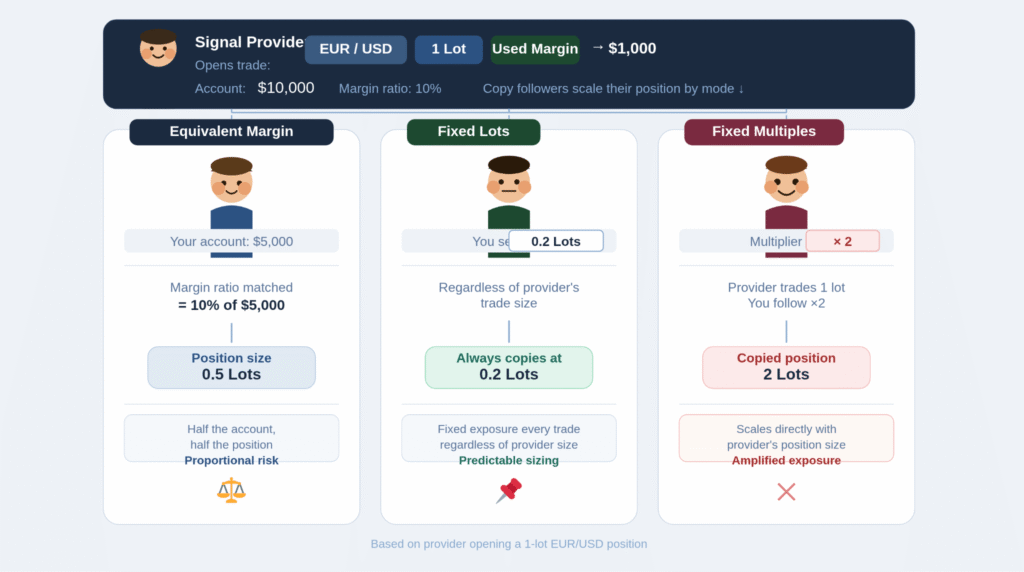
When a signal provider opens a 1-lot EUR/USD position, your account executes a proportionally equivalent trade based on your allocation and copy mode. Vantage offers three copy modes:
- Equivalent Used Margin: Your position size mirrors the provider’s relative to their margin usage.
- Fixed Lots: Every copied trade uses a fixed lot size you define, regardless of what the provider trades.
- Fixed Multiples: Your position is a set multiple of the provider’s.
In practice, your fill price will usually differ slightly from the provider’s. Spreads, slippage, and the milliseconds between their execution and yours all introduce small differences. These are normal and expected — but they can compound over time, so it’s worth factoring them into your performance expectations.
How to Choose a Forex Trader to Copy
The decision of who to copy is where most copiers either set themselves up for a reasonable experience or create problems from the start. A provider’s headline return figure is not necessarily the most reliable metric as it tells you what happened, not whether it was achieved sustainably.
Here are five factors to consider when choosing a forex trader to copy:
1. Track Record and Time Period
When evaluating a forex trader to copy, look for a minimum of 6–12 months of verified trading history. Short track records — even impressive ones — don’t tell you enough. A signal provider who has traded through a volatile period such as a central bank policy shift or a major geopolitical event could give you more information about how they manage risk under pressure.
Verify that the data shown reflects live trading and not a demo account. Platforms that display detailed trade logs, including individual entry and exit times, give you more confidence in the numbers.
2. Drawdown and Risk Level
Maximum drawdown is one of the most important risk metrics when evaluating a signal provider. It shows the largest peak-to-trough decline in account equity. A provider who returned 80% but experienced a 70% drawdown to get there took on extreme risk — and could repeat it.
Meanwhile, a drawdown below 20–30% generally indicates a provider is managing risk conservatively. Above 40%, treat it as a signal to dig deeper into their strategy before copying.
3. Trading Style and Currency Pairs Traded
Some signal providers trade only major currency pairs such as EUR/USD and GBP/USD. Others trade minor and exotic pairs. Make sure you understand what you’re copying and are comfortable with what you’d be exposed to.
Trading style also matters: A short-term trader who executes many trades over a short period per day generates more spread costs and more execution differences than a swing trader who holds positions for several days. Both can be effective, but the cost profile is very different.

4. Consistency vs. Short-Term High Returns
A lead trader posting consistent mid-range returns over 12 months is more informative than one with three exceptional months and three months of losses. Consistency suggests the returns come from a repeatable strategy rather than concentrated bets or luck.
Be especially cautious of providers showing very high returns over short periods. In forex copy trading, that often indicates the use of:
- High leverage
- A lack of stop-losses
- A strategy that will eventually unwind sharply
5. Transparency, Fees, Platform Data
Legitimate copy trading platforms display each signal provider’s full trade history, average hold time, preferred forex pairs, and number of current copiers. Also, remember to review the profit-sharing fee before you start — on Vantage Markets, this is set by the signal provider and can be up to 50% of returns.
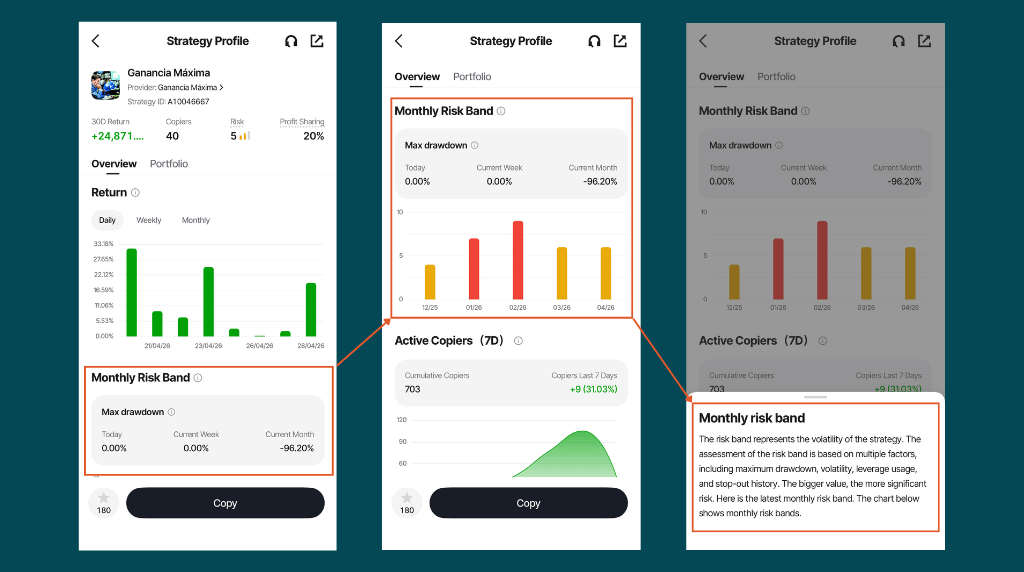
The Vantage App clearly highlights individual signal providers’ strategy profile, return history, monthly risk band, and other notable risk metrics for evaluating forex copy traders.
Interested to learn more about finding the right lead trader for you? Read Vantage Markets’ detailed guide on “How to Choose Your Signal Provider for Copy Trading”.
How to Manage Risk When Copy Trading Forex
Copy trading does not bypass risk management—it relocates it. Instead of managing positions directly, you’re managing which signal providers you copy, how much you allocate, and how you respond to the provider’s performance changes.
Ahead, we share five tips to consider when implementing your risk management strategies for forex copy trading.
1. Start With Capital You Can Afford to Risk
As a general rule of thumb, start with an amount whereby the full loss would not damage your financial position. This applies to all trading and is especially important in forex copy trading, where the mechanism can feel passive but the risk is entirely real.
What’s more, if you’re forex trading via contracts for difference (CFDs), which typically involves leverage, this can amplify losses as well as potential gains.
2. Use Position Sizing and Copy Allocation Carefully
Allocating too large a proportion of your total capital to a single signal provider concentrates your risk. A drawdown that looks manageable on paper—say, 25%—can translate to a significant actual loss if your entire account is allocated there.
Here’s what most experienced copy traders do:
- Allocate a defined portion to each provider, and
- Keep some capital in reserve
This can give copiers room to add to allocations that are performing well or absorb a drawdown without their account balance going to zero.
3. Diversify Across Traders, Not Just Currency Pairs
Following three providers who all trade EUR/USD with similar strategies gives you much less diversification than following three providers with different approaches and different forex pairs.
Also, correlation matters: If all the providers you follow decide to short GBP during the same news event, you would experience concentrated risk regardless of how many lead traders are on your list.
4. Review Regularly and Stop Copying When Conditions Change
Copy trading requires ongoing attention. Check your signal providers’ performance regularly — at least weekly. If a provider begins taking larger positions, switches currency pairs, or shows a deteriorating equity curve, those are signals to reassess.
Waiting too long to stop copying a provider that has drifted from their original strategy is one of the most common and costly mistakes copiers make, especially for beginners.
5. Keep Realistic Expectations
Copy trading does not produce consistent returns, and no signal provider performs well in all market conditions. A strategy that works well during trending markets may struggle when conditions turn ranging.
As such, set expectations based on verified historical data, not promotional materials — and remember that past performance is not indicative of future results.
Costs and Practical Factors in Forex Copy Trading
The true cost of forex copy trading is the sum of several components, not just the performance fee. Understanding each one helps you evaluate whether a provider’s net return is worth following.
| Cost Type | What to Know |
| Spread | Paid on every copied trade Varies by pair and account type EUR/USD typically 0.1–1.0 pips depending on account type and copy trading platform |
| Overnight financing (swap) | Charged or credited on positions held past rollover Swap-free accounts available where eligible. |
| Performance/profit-sharing fee | Set by each Signal Provider (up to 50% of returns on Vantage) Deducted at settlement |
| Minimum copy allocation | Dependent on copy trading provider Larger allocations allow for better proportional sizing |
| Execution differences | Slippage and slight timing gaps can mean your entry/exit price differs from the provider’s |
A practical point that’s often overlooked: A signal provider who trades frequently in wide-spread pairs generates higher spread costs for their copiers. Always review the net return — after spreads, swaps, and performance fees — rather than the gross amount.
Is Forex Copy Trading Suitable for Beginners?
Forex copy trading is more accessible to beginners than building and executing a forex strategy from scratch. The learning curve could be potentially shorter, the time commitment might be lower, and novice traders don’t need to interpret charts or read economic calendars to get started.
However, greater accessibility is not the same as low risk.
The forex market uses leverage, varies by jurisdiction, account type, and client classification, and may range from 1:30 to 1:500. This means that both returns and losses are magnified relative to your margin. A leveraged product that moves against you can result in losses exceeding your initial deposit.
Beginners who try copy trading without understanding drawdown, leverage, and trader selection often make two predictable mistakes:
- Following providers based on short-term headline returns.
- Allocating too much capital to too few providers.
With sufficient knowledge and preparation, both mistakes can be avoided.
The upside of copy trading is that it can also serve as a learning tool. To build practical market knowledge alongside real-time copy trading activity, take the time to review a provider’s trade logs:
- Which pairs they traded
- When they entered and exited
- How they sized their positions
That effort can help speed up understanding in a way that simply reading about trading does not.
How to Start Forex Copy Trading With Vantage
If you’re interested in forex copy trading via CFDs, eligible clients may consider opening a live account with Vantage Markets, subject to local availability and regulatory requirements.
As a multi-asset CFD broker regulated by the Vanuatu Financial Services Commission (VFSC), its copy trading platform has been recognised as ‘Best-in-Class Social Copy Trading’ by Forexbrokers.com in 2025 and 2026,* and ‘Most Trusted Broker Global 2025’ by the International Business Magazine Awards 2025.*
The broker has also been recognised by third parties and enables forex traders to become Signal Providers should they meet a minimum deposit of USD500 and demonstrate extensive trading experience. Vantage’s Signal Providers can set a profit-sharing ratio of up to 50%, with settlement daily, weekly, or monthly. Find out more about how you can become a Vantage Signal Provider here.
*Awards awarded to Vantage by independent third parties. Further details and terms and conditions available on request. Past performance is not indicative of future results.
Frequently Asked Questions About Forex Copy Trading
What is copy trading in forex?
Forex copy trading is a method by which a copier’s account automatically replicates the trades of a selected signal provider in real time. When the provider opens or closes a position in a currency pair, the same trade — proportionally scaled to your allocation — executes in your account. The process is automated, but you can choose who to copy and control your allocation.
How does forex copy trading work?
You select a signal provider through a copy trading platform, allocate capital, and choose a copy mode (e.g., proportional, fixed lots, or fixed multiples). The platform links your account to the provider’s. Every trade they execute automatically replicates in yours. Differences in fill price, spread, and timing mean your exact results will differ from the provider’s — but the direction and structure of each trade are the same.
Can you make returns from forex copy trading?
Some copiers do generate account balance gains through forex copy trading, but it carries significant risk. Returns depend on which providers you copy, market conditions, and costs including spreads, swap fees, and performance fees. Past performance of any provider is not a guarantee of future results. In addition, CFD trading involves leverage, which amplifies both gains and losses, and you may lose more than you deposit.
What are the risks of copying forex traders?
The primary risks of copying forex traders include but are not limited to: copying a provider who takes on excessive leverage or doesn’t use stop-losses; over-allocating to a single provider; not monitoring the lead trader’s performance and failing to stop copying when a strategy deteriorates; and execution differences — slippage and timing gaps that can increase your loss relative to the provider’s. Furthermore, leverage is a double-edged tool in forex as it can work in your favour or against you.
How do you choose forex traders to copy?
To choose which forex traders to copy, consider key metrics such as verified track record length (minimum six to twelve months), maximum drawdown, trading style, and the currency pairs they trade. Consistent mid-range returns over time are more reliable than high returns over a short period. Review the full trade log — not just headline figures — before allocating your capital. Last but not least, always check the profit-sharing fee structure, as this affects your net return.
What are the fees and charges for forex copy trading?
Costs include spreads on every copied trade, overnight financing (swap) charges where positions are held past rollover, and any performance or profit-sharing fee set by the signal provider.
On Vantage, there are no additional platform management fees as forex copy traders pay standard spreads and commissions based on their account type, plus any profit-sharing fee agreed with the provider.
References
- “Bank for International Settlements. Triennial Central Bank Survey of Foreign Exchange and OTC Derivatives Markets Activity, April 2025. https://www.bis.org/statistics/rpfx25_fx.htm.
RISK WARNING: CFDs are complex financial instruments and carry a high risk of losing money rapidly due to leverage. You should ensure you fully understand the risks involved and carefully consider whether you can afford to take the high risk of losing your money before trading.
Disclaimer: The information is provided for educational purposes only and doesn’t take into account your personal objectives, financial circumstances, or needs. It does not constitute investment advice. We encourage you to seek independent advice if necessary. The information has not been prepared in accordance with legal requirements designed to promote the independence of investment research. No representation or warranty is given as to the accuracy or completeness of any information contained within. This material may contain historical or past performance figures and should not be relied on. Furthermore estimates, forward-looking statements, and forecasts cannot be guaranteed. The information on this site and the products and services offered are not intended for distribution to any person in any country or jurisdiction where such distribution or use would be contrary to local law or regulation.