


 Updated
The forex market is the largest financial market in the world, with average daily trading reaching $9.6 trillion in April 2025, according to the BIS Triennial Central Bank Survey [1]. With this scale comes significant price movement, especially when currency pairs respond to interest rate decisions, inflation data, geopolitical events, and shifts in market sentiment.
Forex risk management helps traders plan how much exposure they take on before entering a position. It includes practical steps such as setting position sizes, managing leverage, using stop-loss orders, monitoring correlated currency pairs, and reviewing how each trade may affect the overall account balance.
Key Points
- Position sizing — including percentage-based approaches such as the 1% rule — is one of the most practical ways to keep potential losses within a defined limit before a position is opened.
- Currency correlation is a commonly overlooked risk factor: holding multiple long positions in pairs like EUR/USD, GBP/USD, and AUD/USD may not diversify exposure if all three respond to the same US dollar movement.
- Risk management in forex operates at two levels — at the individual trade level through stop-losses and position sizing, and at the portfolio level through monitoring overall leverage, correlation, and exposure across all open positions.
What Is Risk Management in Forex?
Forex risk management is the process of identifying, assessing, and limiting potential losses from currency price movements. It helps traders control how much of their account balance is exposed on each trade and across multiple open positions.
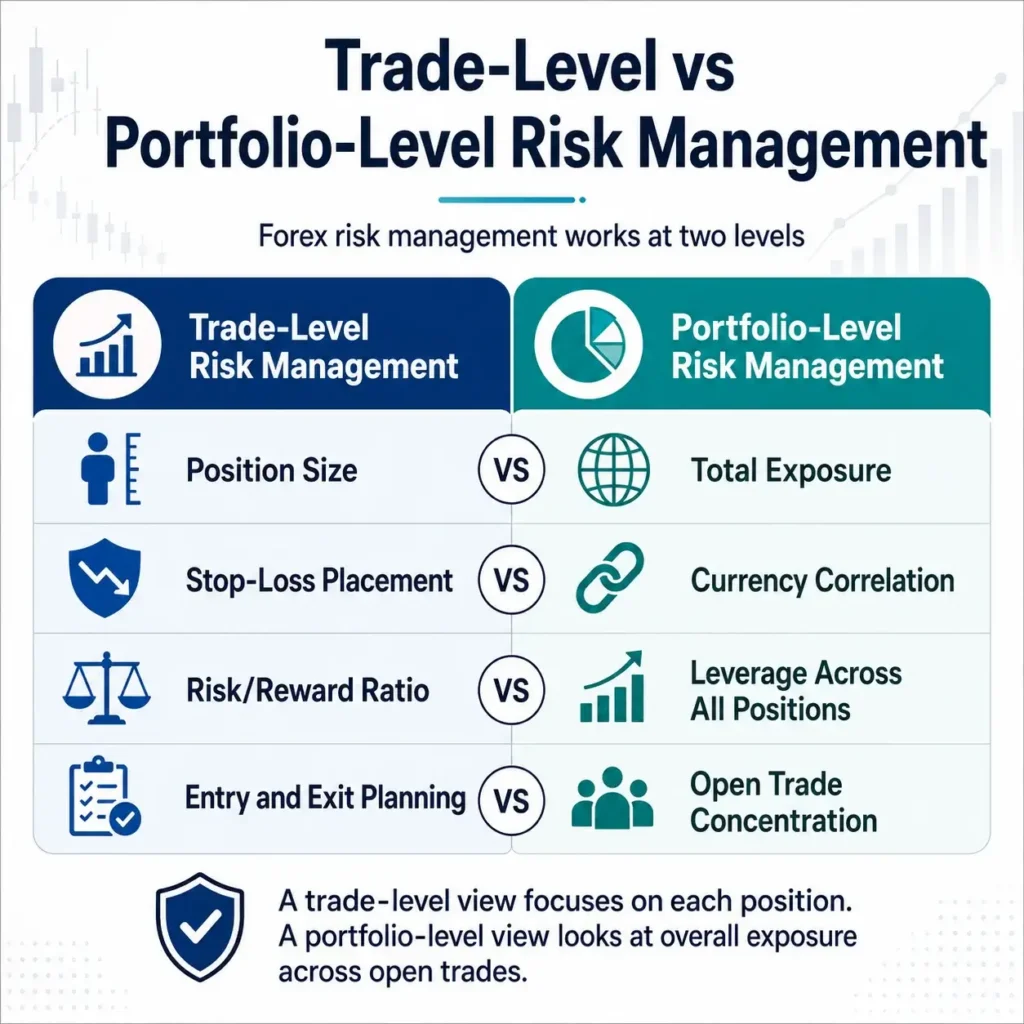
In practice, risk management in forex operates at two levels.
- At the trade level, it involves setting clear entry and exit points, sizing positions appropriately, and using stop-loss orders to limit exposure on individual trades.
- At the portfolio level, it involves monitoring overall exposure across open positions, managing correlation between currency pairs, and controlling leverage.
Types of Forex Risk
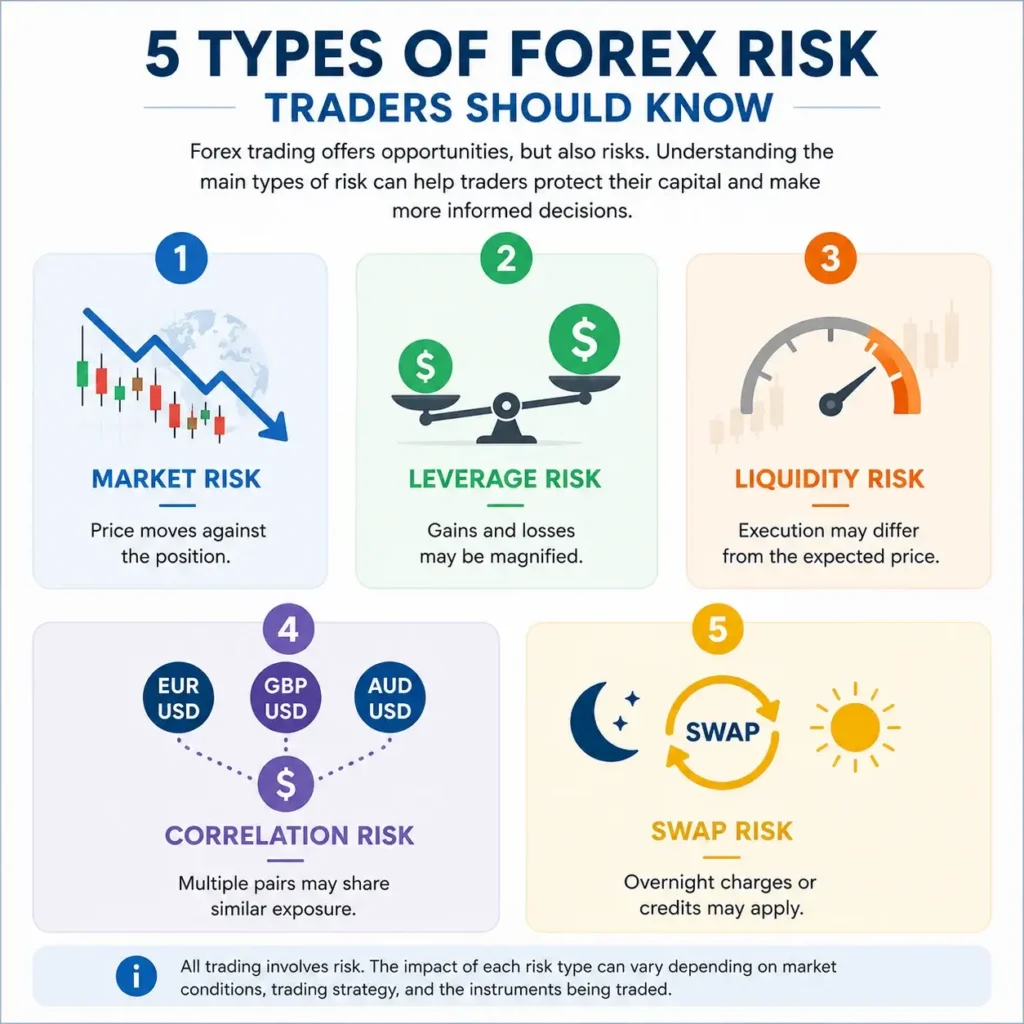
Understanding the different categories of risk in forex trading is the first step in managing them effectively. Each type operates differently and may require a distinct approach.
Market Risk
Market risk is the potential for losses resulting from adverse movements in exchange rates. It is the most fundamental risk in forex trading and affects every open position. Market risk is driven by macroeconomic data releases, central bank decisions, geopolitical events, and shifts in market sentiment — many of which occur without warning.
Traders may manage market risk through position sizing, stop-loss orders, and avoiding high-exposure positions around major scheduled announcements such as central bank rate decisions or non-farm payrolls releases.
- Affects every open forex position
- Driven by economic data, central bank decisions, and geopolitical events
- Managed primarily through position sizing and stop-loss placement
- Heightened around scheduled high-impact announcements
Leverage Risk
Leverage risk is the potential for magnified losses when trading on margin. Because forex is traded using borrowed capital, a relatively small move in price can produce a disproportionately large gain or loss relative to the trader’s actual deposit.
For example, at 30:1 leverage, a trader controlling a position worth $30,000 has only deposited $1,000 of their own capital. A 1% adverse move in that position — $300 — represents a 30% loss on the trader’s actual funds. At higher leverage ratios, the same dynamic applies with greater intensity.
A margin call may occur when a position moves far enough against a trader that the available margin falls below the broker’s required threshold. At that point, the broker may automatically reduce or close positions to prevent the account balance falling below zero.
- Magnifies both gains and losses relative to the initial deposit
- Higher leverage ratios increase the speed at which losses compound
- A margin call may result in automatic position closures
- Managed through appropriate position sizing and keeping leverage low relative to account size
Liquidity Risk
Liquidity risk arises when a trader cannot execute a trade — or exit a position — at the intended price due to insufficient market depth. In the major pairs such as EUR/USD or GBP/USD, liquidity is generally high during active trading sessions, and slippage tends to be minimal.
In minor and exotic pairs, or during periods of low volume such as public holidays or the transition between sessions, spreads may widen and execution prices may differ from those expected. This is particularly relevant when trading currencies not widely used in global transactions.
- More common in exotic or low-volume currency pairs
- Spreads may widen during off-peak hours and around scheduled events
- Slippage may occur even in major pairs during periods of sharp market movement
- Managed by trading major pairs during active sessions and avoiding illiquid periods for large positions
Currency Correlation Risk
Currency correlation risk occurs when a trader holds multiple positions that share the same underlying exposure. Major currency pairs involving the US dollar — such as EUR/USD, GBP/USD, and AUD/USD — often move in the same direction in response to USD-driven news.
A trader holding long positions across all three is not necessarily diversified; they may in effect be running multiple versions of the same trade. Correlation is not fixed. Relationships between pairs may shift during periods of risk-off sentiment, when commodity-linked currencies tend to move together, or during sharp USD moves. Monitoring correlation between open positions may help traders identify unintended exposure.
| Currency Pair | Correlated Pair | Typical Relationship | Risk Considerations |
| EUR/USD | GBP/USD | Positive — both quoted against the US dollar | Holding both in the same direction may increase exposure to US dollar movements. |
| EUR/USD | USD/CHF | Negative — may move in opposite directions | Holding both may create offsetting price movements, which can affect the overall trade outcome. |
| AUD/USD | NZD/USD | Positive — both linked to commodity-sensitive economies | Holding both in the same direction may increase exposure to broader risk sentiment and commodity-linked moves. |
| USD/JPY | USD/CHF | Positive — both include traditional safe-haven currencies | Holding both in the same direction may increase exposure to changes in risk sentiment and US dollar movements. |
Overnight and Swap Risk
Overnight risk — also known as swap or rollover risk — arises when a position is held open past the end of the trading day. Brokers charge or pay a swap rate based on the interest rate differential between the two currencies in a pair.
For traders holding positions across multiple sessions, swap costs may quietly erode potential returns, particularly in high-interest-rate-differential pairs. In some cases, a trader may receive a swap credit rather than pay a charge — this depends on the direction of the trade and the interest rate differential at the time.
- Applies to any position held open overnight
- Charge or credit depends on the interest rate differential and trade direction
- Can erode profitability on longer-term positions in high-differential pairs
- Managed by being aware of swap rates before holding positions for extended periods
Position Sizing and the 1% Rule
After identifying the main types of forex risk, the next step is to decide how much exposure to take on each trade. This is where position sizing becomes important.
Position sizing refers to the process of determining how much of an account balance is exposed on a single trade. It is one of the most practical risk management decisions because it helps keep potential losses within a defined limit before a position is opened.
Many traders use a percentage-based approach. As a general reference point, some traders use 1% to 2% of account equity per trade, although the appropriate figure varies depending on individual circumstances, risk tolerance, and trading style.
Worked Example: The 1% Rule
The example below shows how the 1% rule may be used to calculate position size. It is hypothetical and for illustrative purposes only.

In this example, a $10,000 account with a 1% risk limit would place $100 at risk on a single trade. With a 30-pip stop-loss and an estimated pip value of $10 per pip on a standard lot, the position size would be approximately 0.33 lots. A position size calculator can help traders work through these calculations before entering a trade.
Risk/Reward Ratio in Forex Trading
After position size is calculated, traders may also assess the risk/reward ratio of a trade. This compares the potential loss with the potential return, helping traders decide whether the planned trade structure is proportionate to the amount being placed at risk.
For example, a trade with a 50-pip stop-loss and a 100-pip take-profit target has a risk/reward ratio of 1:2. This means the potential return is twice the amount at risk, before spreads, commissions, slippage, swap charges, and other trading costs.
| Risk/Reward Ratio | Win Rate Required to Break Even | Notes |
| 1:1 | 50% | The potential loss and potential return are equal before trading costs. |
| 1:2 | 34% | A lower break-even win rate may be required, but losses can still occur. |
| 1:3 | 25% | The potential return is higher than the amount at risk, but the target may be harder to reach. |
| 1:0.5 | 67% | A higher win rate may be needed because the potential loss is larger than the potential return. |
Stop-Loss Order Types
A stop-loss order automatically closes a trade when price reaches a predefined level, limiting the potential loss on that position. Stop-loss orders are one of the most widely used forex risk management tools, and different types serve different purposes.
| Stop-Loss Type | How It Works | Best Suited To |
| Standard stop-loss | Closes the position at the specified price level | Most trade types; straightforward risk control |
| Trailing stop-loss | Moves the stop level in the direction of a winning trade, locking in gains | Trending markets where capturing a move is the goal |
| Guaranteed stop-loss | Closes at the exact specified level regardless of slippage or gapping. An additional charge or wider spread typically applies, and availability varies by broker and instrument. | High-volatility events or illiquid conditions |
Standard stop-losses are subject to slippage — if price gaps through the stop level due to a sudden news event, the position may close at a worse price than intended. Guaranteed stop-losses address this, but are typically available only on certain instruments and may carry an additional charge.
Stop-loss placement is typically based on market structure — identifying a level at which the original trade premise would no longer be valid. Common placements include beyond a key support or resistance level, or beyond the high or low of the preceding price swing.
Diversification in Forex Risk Management
Diversification in forex means spreading exposure across currency pairs with different market drivers, rather than holding several positions that may react to the same event. For example, EUR/USD, GBP/USD, and AUD/USD are all quoted against the US dollar, so holding them in the same direction may increase exposure to USD-related movements.
Diversification may help reduce concentration risk, but it does not remove market risk. During periods of broad market stress, correlations between currency pairs may change or move closer together, which can reduce the effect of diversification. It is usually considered alongside position sizing, rather than as a replacement for it.
- Spreads exposure across pairs with different market drivers.
- Helps reduce reliance on one currency or market theme.
- Correlated pairs may still carry similar exposure.
- Correlations can change during volatile market conditions.
- Works alongside position sizing and leverage control.
Impact of Global Economic Events on Forex Risk
Stop-losses can help define risk before a trade is placed, but market conditions may still affect execution — particularly around major economic events, where currency pairs may move sharply, spreads may widen, and slippage may occur.
Central bank decisions, inflation reports, employment data, and geopolitical developments can all influence forex volatility. Traders commonly use an economic calendar to identify high-impact events and review whether open positions may be exposed to sudden price movements, price gaps, or changes in liquidity.
Managing Risk Around Weekends and News Events
Two scenarios that may increase gap risk are weekends and major news events. Gap risk occurs when the market opens or moves significantly above or below a previous price level, which may cause stop-loss orders to execute at a different price from the level requested.
Weekend gaps can occur because the forex market closes for most retail participants on Friday evening and reopens on Sunday evening. If a major geopolitical event, central bank announcement, or economic development happens over the weekend, the market may reopen at a different price from Friday’s close.
News-driven gaps may also occur during regular trading hours when a high-impact release causes price movement that exceeds available liquidity. Events such as non-farm payrolls, central bank rate decisions, inflation reports, and major geopolitical announcements can increase this risk. Some traders may review their position size or exposure before these events, although this does not remove the risk of adverse price movements.
Developing Forex Risk Management Strategies
Forex risk management becomes more practical when individual tools are organised into a clear strategy. This means setting risk limits, choosing a suitable trading style, and reviewing common behaviours that may increase exposure.
Setting Clear Goals and Risk Parameters
A clearly defined risk framework is the foundation of consistent risk management. Before placing any trade, it may be useful to establish the maximum percentage of account equity to risk per trade, a maximum daily or weekly loss limit beyond which trading stops, and the minimum risk/reward ratio acceptable for a trade to be considered.
These parameters should be written down and followed consistently. The purpose is not to prevent losses — that is impossible — but to ensure losses remain within bounds that can be recovered from, and to remove the need to make discretionary risk decisions under pressure.
Choosing a Trading Strategy That Fits Your Risk Tolerance
Different trading strategies carry different risk profiles. Day trading involves opening and closing positions within a single session, avoiding overnight swap risk but requiring active monitoring during market hours.
Swing trading holds positions for several days to capture medium-term moves, accepting overnight exposure in exchange for potentially larger reward targets. Position trading involves longer-term views based on fundamental analysis, with wider stops and lower trade frequency.
The appropriate style depends on time availability, tolerance for overnight risk, and the ability to monitor positions during active sessions. Aligning trading styles with these factors may reduce the tendency to make reactive decisions that compromise risk management.
Common Forex Risk Management Mistakes
Understanding common risk management errors may help traders identify and address weaknesses in their own approach before they compound into significant losses.
| Mistake | Why It Increases Risk |
| Over-leveraging positions | Magnifies losses relative to capital; small adverse moves become disproportionately damaging |
| Not using a stop-loss | Removes the automatic limit on loss; a single runaway trade can damage the entire account |
| Increasing risk after losses | Often driven by the desire to recover quickly; tends to accelerate losses rather than reverse them |
| Trading multiple correlated pairs | Creates unintended concentration; apparent diversification across pairs may not reduce risk if correlations are high |
| Ignoring swap costs on longer holds | Accumulating daily charges erode profitability, particularly in high-differential pairs held over weeks |
| Abandoning the trading plan during volatility | Discretionary risk decisions made under pressure often violate pre-set parameters and extend losses |
Forex Risk Management Tools
After identifying key risks, traders may use different tools to monitor exposure before, during, and after a trade. These tools support position sizing, margin tracking, event planning, and post-trade review.
| Tool | Purpose | How It Helps |
| Stop-loss orders | Limit loss on individual trades | Sets a predefined exit level if the market moves against the position. |
| Take-profit orders | Lock in gains at a target level | Defines where a trade may close if the market moves in favour of the position. |
| Position size calculator | Calculate correct lot size based on risk tolerance and stop distance | Helps estimate lot size based on account balance, risk limit, and stop-loss distance. |
| Economic calendar | Track scheduled high-impact events | Highlights events that may affect volatility, spreads, or liquidity. |
| Correlation matrix | Show relationships between currency pairs | Helps identify whether open positions may share similar market exposure. |
| Margin monitor | Track available margin in real time | Shows how much margin remains as open positions move. |
| Trading journal | Record all trades with entry/exit rationale and outcome | Helps traders review whether they followed their risk plan. |
| Charting platforms | Technical analysis and risk visualisation | Allows traders to visualise stop-loss, take-profit, and support or resistance levels. |
The Role of a Trading Journal in Risk Management
A trading journal records the key details of each trade, such as the currency pair, trade direction, entry price, stop-loss level, position size, risk percentage, exit price, and outcome. It may also include a short note on why the trade was placed and whether it followed the original risk plan.
This record can help traders review patterns in their decision-making over time—such as adjusting stops under pressure, increasing position size after a winning or losing period, or trading during sessions with weaker results. These observations can also support the wider process of developing a trading plan, as traders compare their planned approach with their actual behaviour.
Past performance recorded in a journal does not indicate future results, but the review process can support more consistent risk management habits.
Psychological Aspects of Forex Risk Management
The psychological dimension of risk management is frequently underestimated. A trader may have a technically sound risk framework — appropriate position sizes, clear stop levels, defined loss limits — and still deviate from it under the influence of fear or overconfidence. This is where trading psychology becomes important, as emotions can affect how consistently a trader follows their planned risk rules.
Fear of loss may cause a trader to exit a trade prematurely, before the stop or target is reached, locking in smaller losses or smaller gains than the trade setup justified. Conversely, overconfidence after a winning period may lead to increasing position sizes beyond the risk framework, concentrating exposure at a point when a losing period may statistically follow.
Maintaining consistent risk parameters regardless of recent performance is one of the more difficult aspects of sustained trading. Viewing each trade as one instance in a large series of outcomes — rather than as an isolated, critical event — may help reduce the emotional weight placed on individual results. Regularly reviewing a trading journal with a focus on process rather than profit and loss can support this perspective.
Practising Forex Risk Management on a Demo Account
A demo trading account allows traders to practise risk management without risking real capital. It can help build familiarity with stop-losses, position sizing, exposure management, leverage, and margin within a broker’s platform.
However, demo trading does not fully reflect the emotional pressure of using real funds. Many traders use demo accounts for strategy testing and platform familiarisation, while recognising that live trading conditions may differ significantly from simulated environments.
Building a Long-Term Approach to Forex Risk Management
Forex risk management is not a checklist applied once before trading begins. It is an ongoing discipline — reviewing positions, checking correlations, monitoring leverage, and assessing whether the risk framework is being followed consistently.
Forex risk management is not a checklist applied once before trading begins. It is an ongoing discipline — reviewing positions, checking correlations, monitoring leverage, and assessing whether the risk framework is being followed consistently. Applying structured risk management practices may support more consistent decision-making over time, though it does not eliminate the risk of loss.
Frequently Asked Questions
What is risk management in forex trading?
Risk management in forex trading refers to the strategies and processes a trader uses to identify, assess, and limit potential losses. It includes decisions around position sizing, leverage, stop-loss placement, and the management of correlation between open positions. Effective risk management does not eliminate losses — all trading involves risk — but it aims to keep those losses proportionate and recoverable.
What is the 1% rule in forex risk management?
The 1% rule is a position sizing guideline where a trader risks no more than 1% of their account equity on any single trade. With a $10,000 account, this means a maximum loss per trade of $100.
The rule is intended to help limit the impact of consecutive losing trades, which can occur in any trading approach, so they do not cause severe damage to the overall account. As a general reference point, some traders use a figure between 1% and 2%, though the appropriate amount varies by individual circumstances.
How do you manage risk in forex?
Managing risk in forex involves several practical steps: setting a clear position size before entering each trade, placing a stop-loss order at a level that reflects your maximum acceptable loss on the trade, assessing the risk/reward ratio to ensure the potential return is proportionate to the risk, monitoring open positions for correlation, and using an economic calendar to anticipate high-volatility events. At the portfolio level, it also involves tracking overall leverage and reviewing exposure across all open positions.
What is leverage risk in forex trading?
Leverage risk is the potential for amplified losses that arises from trading on margin. In forex, traders can control positions worth significantly more than their initial deposit. At 30:1 leverage, a 1% adverse move in a full-sized position translates to a 30% loss on the capital deposited. While leverage may also magnify gains, it also increases the potential for rapid and significant losses, particularly for traders who do not actively manage position sizes and margin levels.
How does currency correlation affect forex risk?
Currency correlation describes the tendency of certain pairs to move in the same or opposite direction. Traders holding multiple positions in highly correlated pairs — such as EUR/USD and GBP/USD — may effectively be running the same trade multiple times, concentrating their exposure to a single underlying move.
Monitoring correlations across open positions may be used to identify unintended risk concentration. It is worth noting that correlations are not fixed and may shift during periods of market stress.
What are common forex risk management mistakes?
Common mistakes include using too much leverage for the account size, not setting a stop-loss on every trade, increasing risk after a losing period to try to recover quickly, and trading several correlated pairs without considering total exposure.
Other errors include ignoring swap costs on positions held overnight for longer periods and abandoning a pre-set risk framework during volatile markets. These mistakes may reduce account balance gradually over time, rather than causing one sudden large loss.
RISK WARNING: CFDs are complex financial instruments and carry a high risk of losing money rapidly due to leverage. You should ensure you fully understand the risks involved and carefully consider whether you can afford to take the high risk of losing your money before trading.
Disclaimer: The information is provided for educational purposes only and doesn’t take into account your personal objectives, financial circumstances, or needs. It does not constitute investment advice. We encourage you to seek independent advice if necessary. The information has not been prepared in accordance with legal requirements designed to promote the independence of investment research. No representation or warranty is given as to the accuracy or completeness of any information contained within. This material may contain historical or past performance figures and should not be relied on. Furthermore estimates, forward-looking statements, and forecasts cannot be guaranteed. The information on this site and the products and services offered are not intended for distribution to any person in any country or jurisdiction where such distribution or use would be contrary to local law or regulation.
Reference
- “Global FX trading hits $9.6 trillion per day in April 2025 and OTC interest rate derivatives surge to $7.9 trillion: Triennial Survey – BIS” https://www.bis.org/press/p250930.htm Accessed 13 May 2026