


 Updated
When comparing forex trading vs futures, it helps to start with one key distinction. Forex trading refers specifically to buying and selling currencies, while futures are standardised contracts used across a range of markets, including forex, indices, commodities, and shares.
In this comparison, the focus is on how each market is used to take a view on currency price movements. While both can be used for that purpose, they operate differently. Forex is typically traded over the counter through brokers, whereas futures are traded on centralised exchanges using standardised contracts.
These structural differences can affect pricing transparency, cost visibility, flexibility, market access, and how positions are managed in live trading conditions.
Key Points
- Forex offers more flexibility for smaller accounts, while futures use standardised contracts that may require more starting capital.
- Futures provide more centralised pricing and clearer cost visibility, while forex pricing and spreads can vary between brokers.
- Forex typically trades 24/5 without fixed expiry, while futures follow exchange hours and contracts may need to be rolled over.
Key Differences Between Forex and Futures
In forex vs futures trading, the main distinction is how each market is structured and how that structure affects pricing, costs, flexibility, and execution. Forex is typically traded over the counter through brokers, while futures are traded on centralised exchanges using standardised contracts.
This can shape everything from how transparent prices appear to how positions are sized and managed. The below outlines the main differences between the two markets:
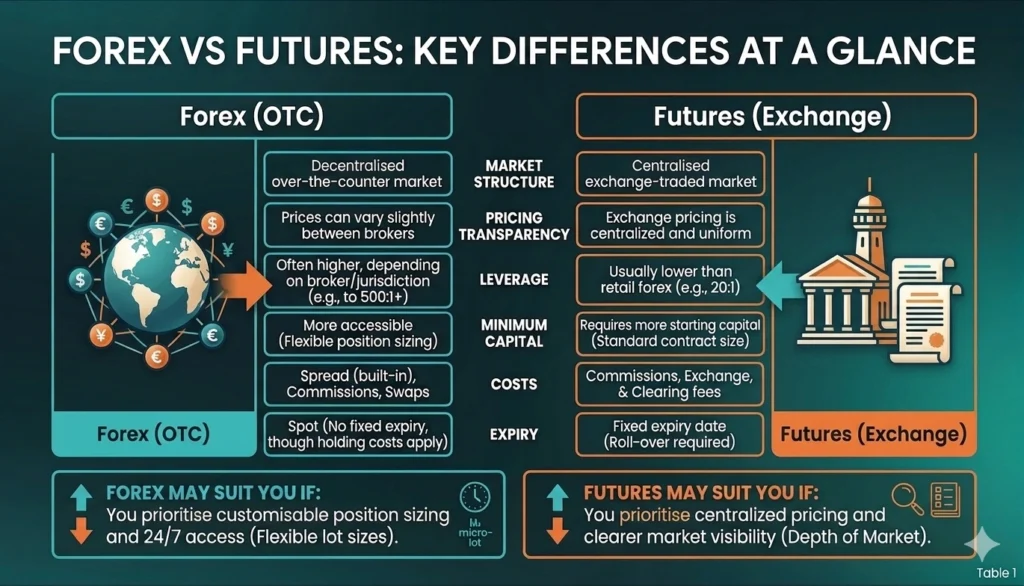
These differences matter because they affect how traders experience the market day to day. Forex may appeal to those who want flexible position sizing and round-the-clock access, while futures may suit those who prioritise centralised pricing and clearer market visibility.
Neither market is inherently better in every situation, which is why comparing the two can help traders make a more informed starting point.
What is Forex Trading
To understand what is forex, it helps to start with the basics.
Forex trading is the global market for buying and selling currencies. Rather than trading through a centralised exchange, forex operates over the counter. It runs through a global network of banks, financial institutions, governments, and individual traders.
This is one of the most actively traded financial markets in the world. Prices move constantly as supply and demand change. Economic data, central bank decisions, and geopolitical events can also influence the market.
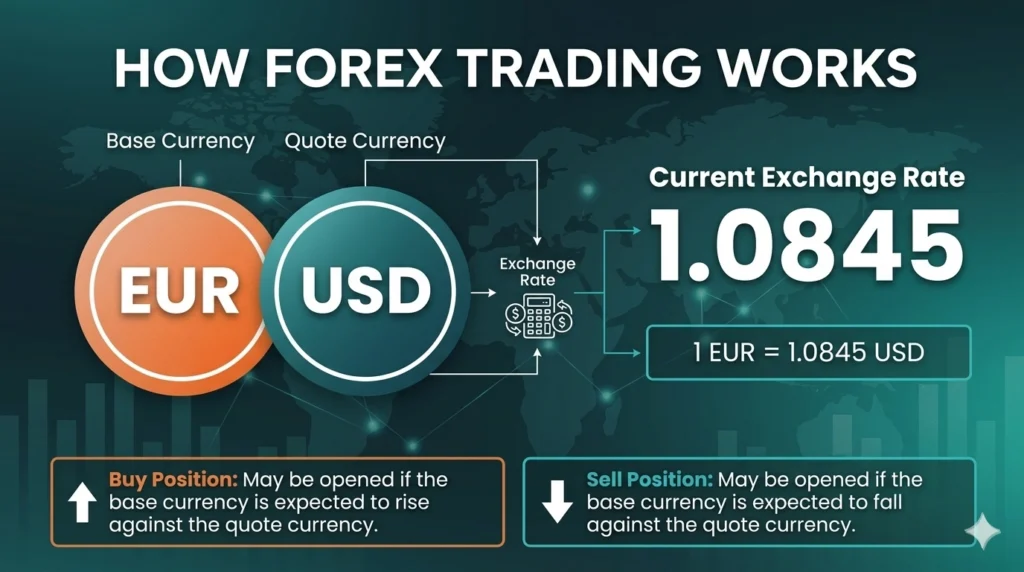
In simple terms, forex trading means exchanging one currency for another. This is done through a currency pair, such as EUR/USD or GBP/USD. The first currency is called the base currency. The second is the quote currency.
If a trader expects the base currency to rise against the quote currency, they may open a buy position. If they expect it to fall, they may open a sell position. This means traders are looking at the relative value between two currencies, rather than the price of one currency on its own. For a more detailed overview, see Vantage’s guide on what is forex.
What is Futures Trading
To understand what are futures, it helps to start with the basics.
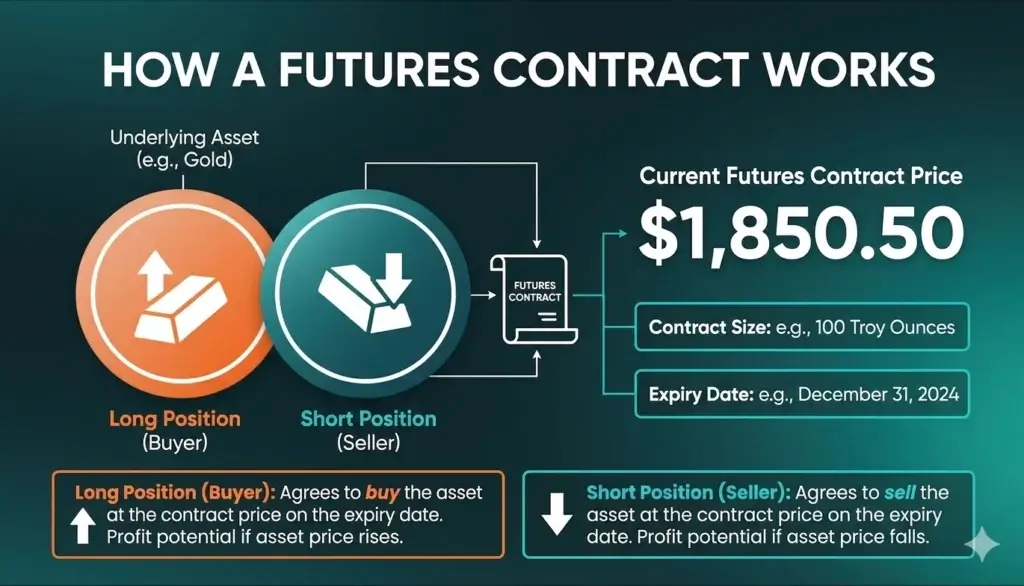
Trading futures involves buying or selling a standardised contract based on an underlying asset. That asset could be a currency, commodity, index, bond, or another financial instrument. A futures contract sets the price of the trade in advance, while the contract itself is tied to a future settlement date.
Unlike spot forex, futures are traded on exchanges. Each contract comes with set specifications, such as contract size, tick size, and expiry. This makes the market more standardised, but also less flexible than markets where position sizes can be adjusted more freely.
In simple terms, trading futures means taking a view on whether the price of the underlying market will rise or fall. If a trader expects prices to move higher, they may take a long position. If they expect prices to move lower, they may take a short position. Because futures contracts expire, traders also need to manage contract dates and, in some cases, roll positions forward. For a more detailed overview, see Vantage’s guide on what are futures.
Differences Between Forex and Futures Trading
When comparing forex and futures trading, the differences become clearer once you look beyond the headline features. The way trades are executed, how costs are charged, and how market access works can all shape the trading experience.
Trade Execution
In forex, trades are typically executed through brokers in a decentralised over-the-counter market. This gives traders more flexibility in position sizing, especially for smaller accounts.
In futures, trades are executed on a centralised exchange using standardised contracts. This can make pricing and order flow easier to follow, but it also means traders have less flexibility when it comes to contract size.
Spread
In forex, trading costs are often built into the spread, although commissions may also apply depending on the provider.
In futures, costs are usually more itemised. Traders may need to account for the spread, brokerage, and exchange-related fees. This means the cost structure can be more transparent, even if it appears less simple at first glance.
To learn more about how spreads work in forex trading, read our article on What Is Spread in Forex Trading.
Overnight Charges
In spot forex, positions do not usually have a fixed expiry. However, holding trades overnight may lead to swap or financing charges.
In futures, contracts come with expiry dates. There is usually no equivalent daily overnight charge in the same way, but traders may need to roll their positions if they want to stay in the market beyond the contract period.
Liquidity and Trading Hours
Both markets are highly active, but they work differently. Forex is known for very high liquidity in major currency pairs with average daily turnover reaching $9.6 trillion in April 2025, according to the BIS and typically operates 24 hours a day, five days a week [1].
Traders who want to understand how this forex trading sessions schedule works across regions can learn more here.
Futures also offer strong liquidity in major contracts, with the added advantage of exchange-based trading. However, trading hours depend on exchange schedules and contract sessions rather than a fully decentralised 24/5 market.
These distinctions can be easier to compare at a glance, as summarised in the table below.
| Aspect | Forex Trading | Futures Trading |
| Trade execution | Broker-based, over-the-counter, with flexible sizing | Exchange-based, standardised contracts, with fixed sizing |
| Spread and costs | Costs often built into the spread | Costs usually separated into spread, brokerage, and exchange fees |
| Overnight charges | May include swap or financing charges | No equivalent daily charge, but contracts may need rolling |
| Liquidity and trading hours | High liquidity in major pairs, typically 24/5 | Strong liquidity in major contracts, but tied to exchange hours |
Which Should You Choose?
When comparing forex trading vs futures trading, the better fit often depends on how much capital you are starting with. While both markets offer access to price movements, account size can affect flexibility, position sizing, and how easily risk can be managed.
If You Are Starting With $100
For very small accounts, forex may be the more accessible option. This is mainly because forex trading often allows smaller position sizes and lower entry barriers.
With futures, standardised contract sizes and margin requirements can make it harder to participate with limited capital. Even if access is possible through smaller contracts, there may still be less room to manage risk comfortably in a $100 account.
If You Are Starting With $1,000
At this level, traders may have more flexibility, but the choice still depends on priorities. Forex may continue to appeal to those who want flexible sizing, higher leverage, and lower capital requirements.
Futures may become more relevant for traders who value exchange-based pricing and a more standardised market structure. However, contract size and margin requirements can still be an important consideration, especially when managing smaller positions.
If You Are Starting With $10,000+
With a larger account, the decision becomes less about access and more about preference. Forex may still suit traders who value flexibility and broad market access.
Futures may appeal more to those who prioritise centralised pricing, standardised contracts, and a more structured trading environment. At this level, traders may also have more room to manage contract sizing, fees, and rollover considerations.
There is no single answer for everyone. In forex trading vs futures trading, smaller accounts may lean towards forex for flexibility, while larger accounts may have more freedom to choose based on trading style, cost structure, and market preference.
Choosing Between Forex and Futures
When comparing forex trading vs futures, there is no single market that is better for every trader. The more useful question is which market better matches your capital, trading style, and preference for flexibility or transparency.
Forex may suit traders who want lower entry barriers, flexible position sizing, and 24/5 market access, while futures may appeal more to those who value centralised pricing, standardised contracts, and a more transparent exchange-based market structure.
In general, futures often offer clearer pricing, whereas forex tends to provide more flexibility for smaller accounts, and overall costs can vary depending on how and when trades are placed.
Ultimately, the forex trading vs futures decision is less about which market is universally better and more about which one fits your needs more closely. For traders trying to choose between the two, understanding how each market works is the best starting point before deciding where to focus.
Ready to start forex trading? Open a live account with Vantage today.
FAQ
Is it better to trade futures or forex?
When comparing forex or futures, there is no single market that is better for everyone. Forex is often the more accessible starting point for smaller accounts because position sizes tend to be more flexible and the upfront capital required can be lower.
Futures may suit traders who prefer exchange-traded markets, more standardised pricing, and, in some jurisdictions, different regulatory or tax treatment. In the end, the better choice depends on your capital, trading style, and the type of market structure you are more comfortable using.Do you need $25,000 to day trade futures?
Do you need $25,000 to day trade futures?
No, the $25,000 rule does not apply to standard futures accounts. That threshold comes from FINRA’s pattern day trader rule, which applies to traders or investors who execute four or more day trades within five business days using a margin account, where the minimum equity requirement is $25,000.
Futures follow a different margin framework, which is why some traders find them more accessible, especially when using a micro contract. Even so, lower margin does not reduce risk, so account size and risk management still matter.
Is $100 enough to start forex?
Yes, $100 can be enough to start forex in practical terms, especially where a broker allows micro-lot or unit-based trading. For example, with Vantage, traders can open an account with a minimum deposit of $50, which makes forex more accessible from a starting capital perspective.
However, the bigger issue is not market access but risk control. With a very small balance, spreads and normal price swings can take up a much larger share of the account, which can make position sizing and risk management harder from the start.
Why are people switching from forex to futures?
Some traders move from forex to futures because futures are traded on centralised exchanges, which can provide more uniform pricing and a more standardised trading environment. This can appeal to traders who want less reliance on broker-based pricing and a market structure that feels more transparent.
In some jurisdictions, futures may also offer more favourable tax treatment. That said, forex can still appeal to traders who want lower entry barriers, flexible position sizing, and broader access for smaller accounts.
RISK WARNING: CFDs are complex financial instruments and carry a high risk of losing money rapidly due to leverage. You should ensure you fully understand the risks involved and carefully consider whether you can afford to take the high risk of losing your money before trading.
Disclaimer: The information is provided for educational purposes only and doesn’t take into account your personal objectives, financial circumstances, or needs. It does not constitute investment advice. We encourage you to seek independent advice if necessary. The information has not been prepared in accordance with legal requirements designed to promote the independence of investment research. No representation or warranty is given as to the accuracy or completeness of any information contained within. This material may contain historical or past performance figures and should not be relied on. Furthermore estimates, forward-looking statements, and forecasts cannot be guaranteed. The information on this site and the products and services offered are not intended for distribution to any person in any country or jurisdiction where such distribution or use would be contrary to local law or regulation.
References
- “OTC foreign exchange turnover in April 2025 – BIS” https://www.bis.org/statistics/rpfx25_fx.htm Accessed 1 April 2026