


 Updated
Price chasing is a common trading error, as it often leads to late entries and poor pricing. Limit orders in forex trading address this by allowing traders to set a price level in advance rather than reacting after the move has already started.
For those new to the term, a limit order is an instruction to execute an order at a specific price or better. The trader sets the price, places their order, and waits for the market to reach that level. However, the order may not be filled if the price never trades at that level, and fast price gaps can sometimes skip the order entirely.
In this article, you will learn what a limit order is in the financial markets, how buy and sell limit orders work in forex trading, their potential benefits and risks as well as a step-by-step guide on how to place a limit order on a trading platform.
What Is a Limit Order in Forex?
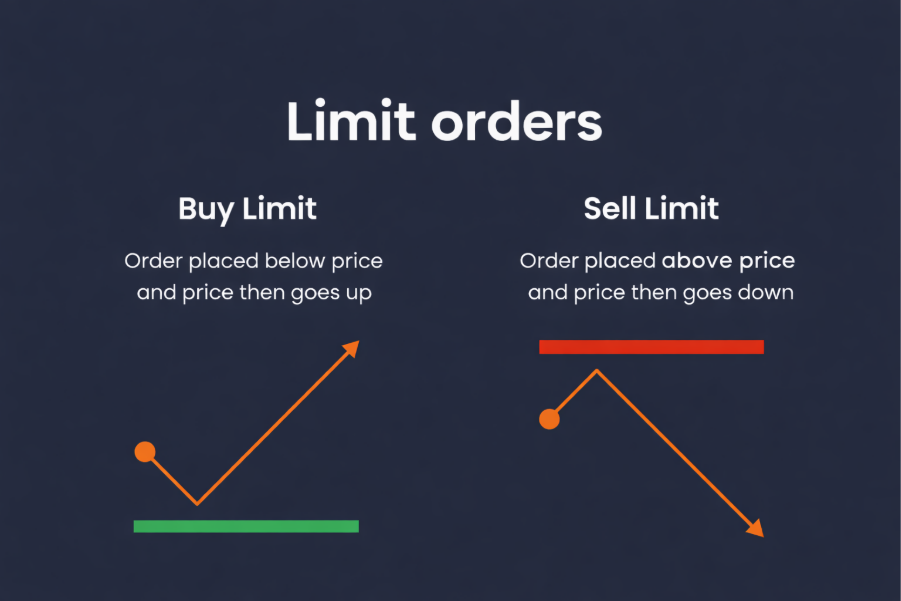
A limit order is a type of pending order that is activated only when the market reaches a specified price level.
Unlike a market order, which executes immediately at the best available price, a limit order focuses on price control. The concept is linked to the reality of how quotes operate in real time, as changes in liquidity and spread can make or break whether an order gets filled and at what speed.
Limit orders are often discussed alongside other order types, such as entry orders, stop-loss orders, and take-profit orders. Together, these tools help indicate where a trade may begin and where it may end on a price chart.
What Is a Buy Limit Order in Forex?
A buy limit order is placed below the current market price. It activates when the market falls to the specified limit level and can be filled at that price or at a better (lower) price.
Buy limits are often illustrated in educational materials to show how an order could be placed when a price retraces to a support level or technical retracement zone.
Related Article: The Basics of Support & Resistance
What Is a Sell Limit Order in Forex?
| Order | Placement | Triggered When | Common Scenarios |
| Buy Limit | Below the current price | Price trades down to the limit level | Buy a pullback at support |
| Sell Limit | Above current price | Price trades up to the limit level | Sell a rally at resistance |
A sell limit is a pending order placed above the current market price. It’s triggered when the market rises to the limit level and trades at that price or higher.
Sell limits are commonly illustrated in trading education to show how an order could be placed when price rallies into a resistance level, a prior supply zone, or an area where traders anticipate selling pressure.
How a Buy Limit Order Works in Forex Trading
As mentioned earlier, a buy limit order is placed below the current market price and designed to help forex traders enter into a position if the market pulls back to a specified level. Rather than buying immediately, the order remains pending until the price reaches the limit level. If the market trades at that level or better, the order may be filled.
In practice, buy limits are often linked to a support retest. A support area is a price zone where buying interest has previously appeared.
As a result, buy limits are often mentioned alongside entry, stop-loss, and take-profit levels. These levels help illustrate where a trade may begin, where risk may be capped, and where a potential exit may occur.
Example: Pullback Into a Support Retest
Assume EUR/USD trades at 1.1000 after a steady climb. A prior swing low formed near 1.0940, after which the price bounced. Later, the price pulls back towards that same zone.
For illustration, a buy limit could be placed at 1.0945 to demonstrate how a pending order works. If the market drops to that level, the order may be filled. Hypothetical stop-loss and take-profit levels might be illustrated at 1.0915 and 1.1020, respectively.
Note: These examples are for illustrative purposes only and do not constitute trading advice.
How a Sell Limit Order Works in Forex
To jog your memory, a sell limit order is placed above the current market price and designed to help forex traders enter a sell position if the market rises to a specified level.
Instead of selling immediately, the order remains pending until the price reaches the limit level. If the market trades at that level or higher, the order may be filled. In practice, sell limits are often linked to a resistance retest. A resistance area is the price zone where selling interest has previously appeared.
When price returns to that zone, some traders watch for signs of rejection. A sell limit allows the entry to wait at that level rather than chasing the price after the move has already started.
Related Article: A Complete Guide to Supply and Demand: How to Use It
Example: Rally Into a Resistance Retest
Assume GBP/USD trades at 1.2500 after a recent drop. Earlier on the chart, the price bounced down from a resistance area near 1.2580.
Later, the price rallies back towards that same zone. For educational purposes, a sell limit could be illustrated at 1.2575 to demonstrate how a pending order works. If the market reaches that level, the order may be filled.
Hypothetical stop-loss and take-profit levels might be shown at 1.2610 and 1.2470, respectively.
Note: These examples are for illustrative purposes only and do not constitute trading advice.
When to Use Buy Limit vs. Sell Limit Orders
In foreign exchange markets, buy limit and sell limit orders are common pending entries. They remain in the market until the price reaches a specified level. A limit order is designed to fill at the stated price or better.
A buy limit is set at a price at or below the chosen level. A sell limit is set at a price at or above the chosen level. Because price may not return to the specified level, a limit order may not be filled.
Take note that order terminology and execution rules can vary by trading platform and provider. With these basics in mind, the next sections outline practical use cases and common considerations when using limit orders.
When to Use a Buy Limit
Buy limits typically focus on entering during pullbacks. Here are four scenarios in which a trader may consider using a buy limit order:
- Buy the Dip in an Uptrend: Price is forming higher highs and higher lows. If the market is expected to pull back before continuing upwards, a buy limit may be placed near a prior support level.
- Retest of a Breakout: Price breaks above resistance and later pulls back. A buy limit may be set near the former resistance zone, which can sometimes act as new support.
- Fibonacci Pullback Entry: After a strong upward move, price may retrace to a Fibonacci level. A buy limit can be placed around common retracement areas between 38.2% and 61.8%.
- Mean Reversion to Value: Price may temporarily spike above its short-term ‘fair’ value. A buy limit placed near a moving average or Volume Weighted Average Price (VWAP) area may help illustrate how traders approach potential value zones.
Next, let’s look at how sell limits could be used in the context of forex trading.
When to Use a Sell Limit
Sell limits apply the same logic in the opposite direction—waiting for price to rally before entering a short position. Here are four common scenarios in which a sell limit order could be used:
- Sell the Rally in a Downtrend: Price is forming lower highs and lower lows. A sell limit may be placed near a prior resistance level if the market rallies.
- Retest of a Breakdown: Price breaks below support and later rebounds. A sell limit can be set near the former support zone, which may now act as resistance.
- Fibonacci Pullback Entry: After a sharp decline, price often retraces to a Fibonacci level. A sell limit may be placed around 38.2%–61.8% retracement levels.
- Fade an Overbought Push Into Supply: Price moves into a known supply or resistance area. A sell limit allows the entry to wait at that level rather than chasing the move.
Although limit orders can help control entry price, there are situations where they may be less suitable due to how markets move and how orders are executed. Next, we’ll look at the specific circumstances to avoid limit orders.
When to Avoid Limit Orders
After chart analysis, order choice can influence execution quality.
A limit order is designed for price control, yet the fill is not guaranteed. In contrast, a market order prioritises execution speed at the best available price, highlighting the trade-off between speed and precision.
Limit orders may be less suitable when immediate execution matters. This can occur around major economic releases, when prices can move quickly and skip levels. In such cases, the market may move away from the limit before it is reached, leaving the order unfilled.
They can also behave less predictably during thin liquidity periods, such as holidays, market rollovers, or quiet trading sessions. Wider bid–ask spreads and fewer resting orders may increase the chances of missed or partial fills.
Strong directional moves present another challenge. When price moves rapidly in one direction, a limit level may be left behind, especially if the goal is market participation rather than waiting for a specific price improvement.
Limit order vs Market order vs Stop order
| Order Type | Main Goal | Key Trade-Off |
| Limit Order | Better prices | May not fill |
| Market Order | Fast execution | Price can slip |
| Stop Order | Trigger price | Can trigger in spikes |
A limit order is an instruction to buy or sell a security at a specified price or better. On the other hand, a market order refers to an instruction to buy or sell a security immediately at the best available price.
Meanwhile, a stop order is an instruction to buy or sell a security once its price reaches a specified level known as the stop price. Usually, when the stop price is reached, the order is typically converted to a market order and executed at the next available price.
How to Place a Limit Order
Although trading platforms may look different, the basic steps for placing a limit order are generally similar. Most platforms follow a standard order ticket process where traders select the market, choose the order type, and define the price level.
- Open the Trading Screen: On most platforms, this is labelled ‘Trade’, ‘New Order’, or simply the order ticket.
- Choose the Market or Symbol: Select the currency pair or instrument from the watchlist.
- Pick the Order Side: Most order tickets allow traders to choose between ‘Buy’ and ‘Sell’.
- Select ‘Limit’ for the Order Type: On some platforms, this may appear under ‘Pending Order’ or ‘Advanced Order’ settings.
- Enter the Limit Price: This is the price level at which the order will activate and attempt to fill.
- Enter the Trade Size: The size is typically displayed in lots, units, or contracts, depending on the platform.
- Check Estimated Costs and Spread: Many order tickets display the spread and any applicable fees before the order is placed.
- Add Optional Risk Levels: Some order forms allow traders to set both stop-loss and take-profit levels within the same ticket.
- Select the Timing Option: Common choices are ‘Good Till Cancelled (GTC)’ or a specific expiration date.
- Review the Order Summary: Most platforms display the order side, size, price level, and any attached stop-loss or take-profit settings.
- Place the Order and Confirm: The order will usually appear as ‘Pending’ until the market reaches the specified price level.
- Monitor, Modify, or Cancel if Needed: On most platforms, pending orders can be adjusted or cancelled from the ‘Open Orders’ or ‘Positions’ tab.
Limit orders are typically used for planned entries at specific price levels. If the market never reaches the specified price, the order may remain unexecuted.
Related Article: 30 Forex Terms All Traders Should Know
What Are the Benefits of Using Limit Orders?
Limit orders are often discussed in trading education because they allow traders to define price levels in advance. Instead of reacting to market moves in real time, traders can plan entries or exits around specific chart levels.
- Price Control at the Order Ticket: A limit order sets the highest buy price or the lowest sell price. This defines the worst price the order can accept. In fast markets, that control can help reduce unwanted slippage.
- More Structured Trade Planning: A fixed entry price makes the distance to a stop-loss easier to measure. As a result, potential risk and reward can be estimated before entry. This can also support clearer record-keeping in a trading journal.
- Less Need to Watch Every Tick: Limit orders can wait at a chosen level for hours or even days. This can suit planned setups around support and resistance zones, and may reduce the urge to react to every price swing.
- Useful for Exits, Not Just Entries: Limit orders are also commonly used to set take-profit targets. This keeps exits tied to pre-marked chart levels. Many investor education resources often describe limit orders in this way.
While these advantages can support structured trade planning, limit orders also come with several risks that traders should understand.
What Are the Major Risks of Using Limit Orders?
Although limit orders provide price control, they also introduce execution risks because the order will only fill if the market reaches the specified level.
- Failure-to-Execute Risk: The most significant risk is that the market may never reach the intended price. As a result, a trade may never open, or a take-profit order may never close the position.
- Partial Fills: In highly volatile or low-liquidity markets, an order may be filled only partially. This can leave traders with a smaller position than initially planned.
- Market Gapping: If the market gaps through the limit price (which can happen during weekends or major news events), the order may not be executed at all. In some cases, it may be executed at a less favourable price than if the transaction had occurred when markets were open.
- False Reversals: Price may briefly break through the limit level and trigger the order, only to reverse shortly afterwards. This can result in entries just before the market moves in the opposite direction.
Understanding these potential risks can help traders decide when a limit order is appropriate and when another order type may be more suitable.
Related Article: 10 Risk Management Techniques to Use in Trading Now
FAQs
Q: How does a buy limit order differ from a market order?
A: A buy limit sits below the current price and only fills at the limit price or better. On the other hand, a market order is immediately filled at the best available price.
Q: Which online broker supports limit orders?
A: To see which online brokers support limit orders, it’s best to check on the brokerage platform directly.
Q: Is market order or limit order better for beginners?
A: Market orders are often easier to understand because they focus on immediate execution. Limit orders focus on price control, although they can remain unfilled.
Q: What are the risks of using limit orders in volatile markets?
A: Volatility can increase the likelihood of missed fills, partial fills, or rapid price movements through the specified level. Wider bid-ask spreads may also influence when a price level is considered ‘touched’ on the quote, which can affect whether the order is executed.
Q: What happens if my limit order price is never reached?
A: The order stays pending until it is cancelled or expires, depending on its time setting.
No position opens if the market never trades at the limit level.