


 Updated
When members of Congress began disclosing their stock trades in 2012, something unexpected happened. Retail investors started tracking (and attempting to copy) the portfolio moves of politicians like Nancy Pelosi, whose family’s disclosures drew widespread attention for well-timed trades in major companies. In fact, their timely options trades in companies like Nvidia and Apple generated significant returns by as much as over $3 million1. These results are exceptional and are not representative of typical trading or copy trading outcomes. Most traders do not achieve similar results, and trading outcomes vary significantly, with losses also possible.
It’s no wonder that dedicated trackers, apps, and social media accounts emerged, all built around the idea that if you can see what a skilled or well-positioned trader is doing, why not follow their lead?
And that’s what led to the creation of copy trading mobile apps like InsiderWave that enable retail traders to track and copy “every publicly disclosed stock trade made by members of Congress, top-performing investors, and other influential market participants”2. But is copy trading really profitable in this manner? Well, when the InsiderWave founder copied Pelosi’s trades, he allegedly grew his initial capital of $38,000 to millions of dollars in just two years3.
This market phenomenon has contributed to the perception that copy trading can be profitable for some traders.
However, a more accurate answer would be that copy trading is only as profitable as the strategy you follow, the price you pay to follow it, and the risk controls you use along the way. Read on to find out more about the hidden factors that can dilute a copier’s returns.
First Up, What Is Copy Trading?
The official definition of copy trading is a form of online imitative trading where one trader (also known as the copier or follower) replicates the trades of another trader (otherwise referred to as the lead trader or signal provider) in real time. When the lead trader opens, modifies, or closes a position, those actions are automatically mirrored—usually, proportionally—in the follower’s account.

According to the Financial Conduct Authority (FCA) in the UK, copy trading “typically involves setting a proportion of funds to execute the trades of the copied trader from the allotted funds”4.

As a copy trader, you don’t need to spend time analysing charts, following economic calendars, or developing and testing different trading strategies to see which is most effective in generating returns.
With copy trading, one seems to be able to choose a lead trader whose style suits their risk appetite—and let the system do the work. But, is it really true that copy trading is profitable for everyone? Keep scrolling for the answer in the next section.
Can I Make Money by Copy Trading?
Here’s what most retail traders want to know: Yes, it’s possible to make money through copy trading, but profitability is never guaranteed.
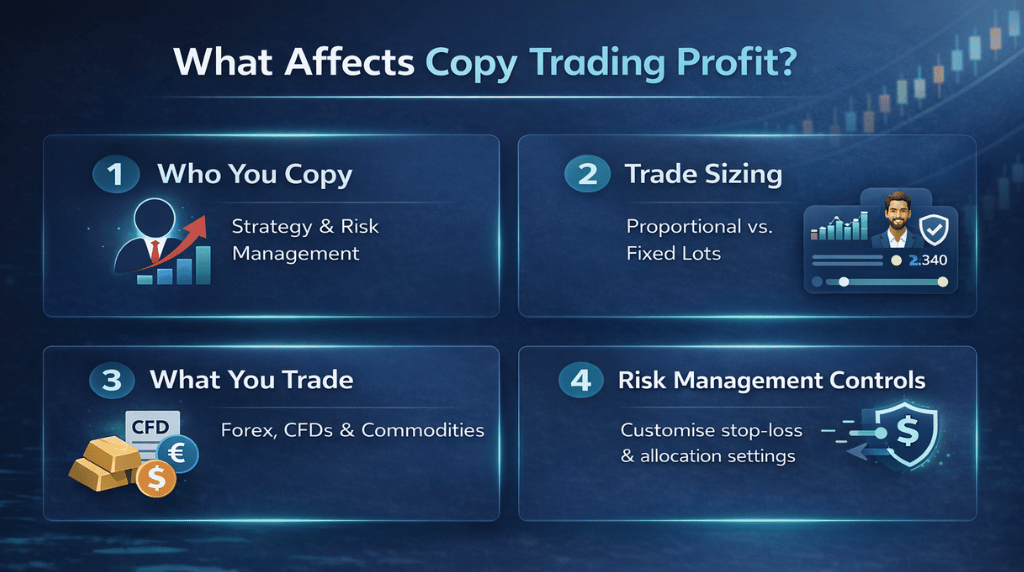
In fact, one of the most common mistakes is treating copy trading like passive income on autopilot, when trading outcomes still depend on the following factors:
- Who You Copy: The lead trader’s strategy, consistency over time, drawdown profile, and approach to risk management all matters. Bear in mind that strong past returns alone do not guarantee similar future results.
- How You Size Your Trades: Your outcomes can vary depending on whether trades are copied proportionally, by fixed lots, or by a customised adjusted allocation method. For example, Vantage Markets offers three different copy modes for its Copy Trading Account—equivalent used margin, fixed lots, and fixed multiples—to cater to different trading preferences.
- What Instruments Are Being Traded: Forex pairs, contracts for difference (CFDs), gold, and other instruments can carry different levels of volatility, leverage, spreads, and overnight financing costs, depending on the broker, product type, and jurisdiction.
- Execution Timing and Slippage: There can be a delay between when a lead trader’s order is executed and when the same trade is replicated in a follower’s account. In fast-moving markets, slippage does matter as even small delays can lead to price differences that affect performance.
In its May 2025 Final Report on online imitative trading practices, the International Organisation of Securities Commissions (IOSCO) noted that imitative trading strategies like copy trading is “predominantly associated with short-term, potentially higher-risk trading strategies, often involving more complex or potentially volatile financial products, such as foreign exchange”, all of which “can expose retail investors to significant risks, including losses from leveraged products and erosion of returns due to high transaction fees from frequent trading”5.
For those who are interested to know if social trading is indeed profitable on Vantage’s copy trading platform, we’d like to highlight that Signal Providers and Copiers on the platform have generated cumulative trading results across all accounts, which include both profits and losses. Individual outcomes vary significantly depending on strategy, market conditions, and risk exposure.

So, Is Copy Trading Profitable for Beginners?
Copy trading is often marketed as beginner-friendly, and there are practical reasons for that. That’s because this type of trading approach can lower the operational barrier to entry, given that one does not need to build a trading strategy from scratch, place every order manually, or analyse charts full-time just to get started.
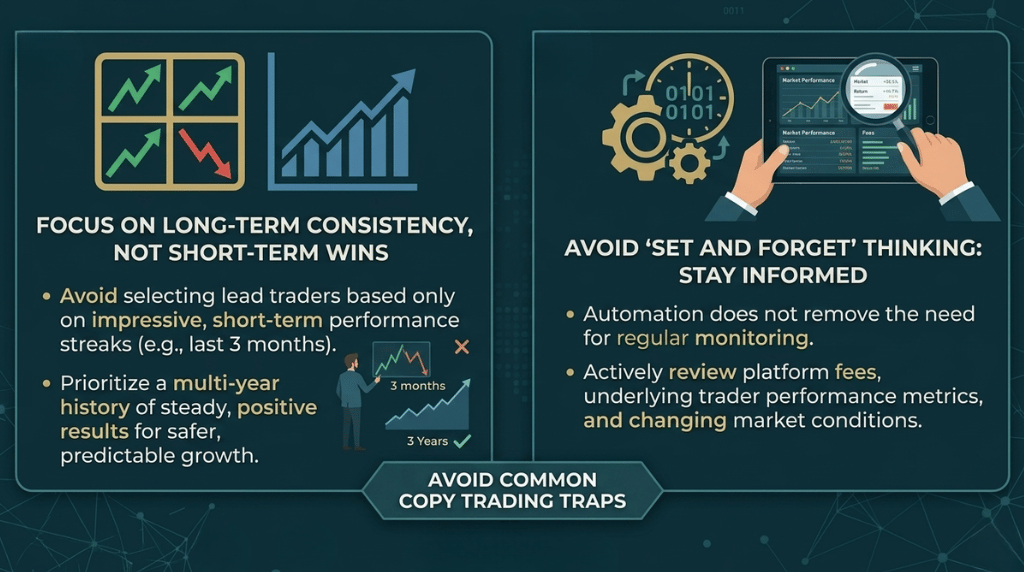
That said, beginner-friendly doesn’t mean it guarantees profits. For new traders, copy trading profitability often depends less on access to the platform itself and more on whether they can avoid common mistakes, such as:
- Selecting lead traders based on short-term performance rather than longer-term consistency.
- Misunderstanding what drawdown means and how deeply their capital can decline before a strategy recovers.
- Allocating too much capital to a single signal provider, which can concentrate risk rather than diversify it.
- Assuming that automation removes the need to monitor performance, costs, and ever-changing market conditions.
IOSCO’s report acknowledged that copy trading strategies may make investing seem simple for retail traders and investors— particularly those with limited time, no desire to follow markets actively, or lack financial literacy.
However, the regulator of the world’s futures and securities also cautioned that this apparent simplicity could lead investors to copy strategies that are not aligned with their financial situation, their capacity to bear losses, or their investment objectives, including their risk tolerance.
In other words, copy trading can be considered as starting point by beginners, but it should not be seen as a shortcut to profit-taking. Treat copy trading as a tool for guided market participation rather than a guaranteed, hands-off way to generate returns.
For a fuller assessment of the safety and legitimacy of copy trading platforms, see our guide on “Is Copy Trading Safe and Legit?“.
What Is the Success Rate of Copy Trading?
Contrary to popular misconception, there is no single, universally agreed industry-wide “success rate” for copy trading. Results vary widely by trading platform, product type, market conditions, and—most importantly—the lead trader being copied.
That skepticism is echoed in the broader trading literature. Studies published on ScienceDirect examining copy trading behaviour on platforms like eToro suggested that social trading features can influence investor activity6. Yet, increased activity does not automatically translate to increased returns.
In other words, more copying, more clicking, and more trades don’t necessarily equate to a higher success rate7.
What Research Further Tells Us About Copy Trading Performance
Several consistent findings emerge from the academic literature on copy trading performance include:
| What the Research Shows | What It Means For Copiers |
| Seeing strong peer returns can increase trading activity | More activity does not automatically mean better outcomes. For copiers, short-term performance visibility can influence behaviour in ways that may not improve net returns. |
| Social signals and platform cues can influence who gets copied | Copier decisions are not driven by performance alone. Rankings, visible popularity, and other social cues typically found on leaderboards can shape who attracts followers. |
| Follower results can differ from lead-trader results because costs and execution matter | Even if the lead trader performs well, a copier’s net return can still be lower after factoring in spreads, swaps, slippage, and execution differences. |
Is It True That 90% of Traders Lose Money? IOSCO Reveals the Reality of Copy Trading
The “90% of traders lose money” claim is widely repeated online, but it’s not a precise, universally verified statistic for copy trading specifically.
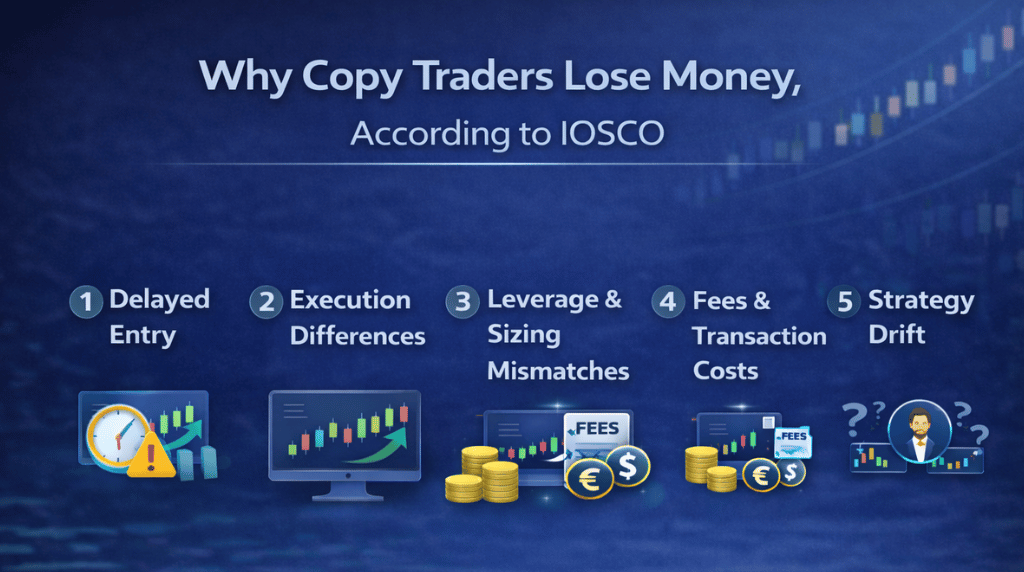
A more accurate point is this: Even when a lead trader is profitable, a follower may still earn much less—or lose money altogether. Based on IOSCO’s 2025 report, here are five key reasons why that’s a possible reality of copy trading:
- Delayed Entry: By the time a signal is transmitted, processed, and executed in a follower’s account, the price may have moved. In high-volatility conditions, this slippage can be significant.
- Execution Differences: The lead trader may access tighter spreads, different liquidity, or faster execution than followers on the same platform.
- Leverage and Sizing Mismatches: Followers may apply different leverage levels or position sizes than the lead trader, meaning their actual exposure—and therefore their gain or loss—can diverge substantially from the leader’s.
- Fees and Transaction Costs: Each replicated trade incurs spread costs, swap fees, and potentially commission charges. Frequent trading strategies that look profitable at the leader level may produce negative net returns for followers once all costs are accounted for.
- Strategy Drift: Lead traders may change their approach over time, shifting to different instruments, higher leverage, or different time horizons, without clearly communicating this to followers.
The following section provides information about Vantage’s copy trading features for general educational purposes.
Is Copy Trading With Vantage Profitable?
Copy trading with Vantage can be profitable—but it is not profitable by default. As with any platform, outcomes depend on how you use it, not just access to it.
What Factors Affect Profitability on Vantage?
The same core variables apply on Vantage as they do elsewhere:
- Who you copy
- How trades are sized
- What products are being traded
- The level of risk taken
- Trading costs and execution conditions
These factors ultimately determine whether your results align with—or diverge from—the signal provider you follow.
What Does Vantage Provide to Support Copy Traders?
Vantage provides the infrastructure to help copy traders make more informed decisions.
For example, its copy trading app allows users to:
- Compare signal providers
- Review key performance metrics
- Assess risk indicators such as drawdown
- Choose from different copy modes based on how trades are replicated
This level of transparency can make it easier to evaluate whether a strategy fits your objectives.
Are There Fees for Copy Trading on Vantage?
Vantage does not charge management or subscription fees for copy trading. Followers can copy multiple signal providers, and profit-sharing typically applies only when predefined conditions are met.
However, standard trading costs such as spreads and swaps still apply to all copied trades and can affect net returns.
Can Vantage Guarantee Profits?
What Vantage cannot do—and what no copy trading platform can do—is guarantee profitable outcomes. A follower can still lose money if they:
- Copy an unsuitable strategy
- Allocate too much capital
- Underestimate drawdown
- Use excessive leverage
- Overlook trading costs
Copy trading simplifies execution, but it does not remove market risk.
The best way to assess whether copy trading on Vantage works for you is to explore it for yourself—with realistic expectations, a defined risk budget, and a clear understanding of what you are copying and why.
Learn more about Copy Trading features on Vantage →
Frequently Asked Questions (FAQs)
Can you make passive income from copy trading?
Copy trading can feel passive because trades are executed automatically, but it should not be treated as fully hands-off income.
Your results still depend on who you copy, how much risk you take, and how often you review performance. Lead traders can change strategies, increase risk, or experience drawdowns, which means ongoing monitoring is still required.
In practice, copy trading may reduce the time spent executing trades, but it doesn’t eliminate the need for oversight or risk management.
Is copy trading more profitable than manual trading?
Copy trading is not inherently more profitable than manual trading. Profitability depends on factors such as strategy quality, risk management, market conditions, and trading costs—not whether trades are copied or placed manually.
For some investors, copy trading can provide access to more experienced traders, while others may achieve better results through their own strategies. Neither approach guarantees profits, and both methods carry risk.
Why do some copy traders lose money even when the lead trader is profitable?
Follower results can differ from the lead trader’s performance for several reasons. These include execution delays, differences in spreads and liquidity, varying leverage or position sizing, and trading costs such as spreads and swap fees.
In addition, frequent trading strategies can accumulate costs quickly, and even small differences in entry price (slippage) can impact overall returns. As a result, a profitable lead trader doesn’t automatically translate into profitable outcomes for its followers.
How much can you realistically make from copy trading?
There is no fixed or guaranteed return from copy trading.
Your results will depend on the strategy you follow, the level of risk involved, market conditions, and the costs associated with trading. Some traders may generate positive returns over time, while others may experience losses—especially during periods of volatility or drawdown.
A more realistic approach is to focus on risk-adjusted performance and consistency rather than expecting a specific level of profit.
Do I have to pay tax on copy trading?
In most jurisdictions, profits from copy trading are subject to tax, but the exact treatment depends on your country of residence and local tax regulations. For example, gains may be treated as capital gains or trading income, depending on how your activity is classified. Losses may also be treated differently across jurisdictions.
It’s important to check your local tax rules or consult a qualified tax professional to understand your obligations.
RISK WARNING: CFDs are complex financial instruments and carry a high risk of losing money rapidly due to leverage. You should ensure you fully understand the risks involved and carefully consider whether you can afford to take the high risk of losing your money before trading.
Disclaimer: The information is provided for educational purposes only and doesn’t take into account your personal objectives, financial circumstances, or needs. It does not constitute investment advice. We encourage you to seek independent advice if necessary. The information has not been prepared in accordance with legal requirements designed to promote the independence of investment research. No representation or warranty is given as to the accuracy or completeness of any information contained within. This material may contain historical or past performance figures and should not be relied on. Furthermore estimates, forward-looking statements, and forecasts cannot be guaranteed. The information on this site and the products and services offered are not intended for distribution to any person in any country or jurisdiction where such distribution or use would be contrary to local law or regulation.
References
- “Pelosi discloses sales of Nvidia and Apple shares, purchase of Alphabet and Amazon – Fox Business” https://www.foxbusiness.com/politics/nancy-pelosi-sells-nvidia-apple-buys-alphabet-amazon Accessed on 14 April 2026.
- “Invest Like The Top 1% – InsiderWave” https://insiderwave.app/ Accessed on 14 April 2026.
- “’Join Them’—Apps Copying Pelosi And Polymarket Insiders Go Viral – Forbes” https://www.forbes.com/sites/boazsobrado/2026/02/01/join-them-apps-copying-pelosi-and-polymarket-insiders-go-viral/ Accessed on 14 April 2026.
- “Copy trading – FCA” https://www.fca.org.uk/firms/copy-trading Accessed on 14 April 2026.
- “Online Imitative Trading Practices: Copy Trading, Mirror Trading, Social Trading – IOSCO” https://www.iosco.org/library/pubdocs/pdf/IOSCOPD793.pdf Accessed on 14 April 2026.
- “The effects of community-based signals on investment decisions in copy trading – ScienceDirect” https://www.sciencedirect.com/science/article/pii/S2214804322000234 Accessed on 14 April 2026.
- “Losing by learning? A study of social trading platform – Ideas” https://ideas.repec.org/a/eee/finlet/v28y2019icp171-179.html Accessed on 14 April 2026.