


 Updated
Currency pairs in forex trading are grouped into three categories—majors, minors, and exotics—based on trading volume, liquidity, and the economic weight of the two currencies involved. The 16 pairs below span all three groups, from EUR/USD, the world’s most traded pair, to higher-volatility exotics such as GBP/ZAR.
Retail traders typically access these price movements through Contracts for Difference (CFDs), speculating on exchange rate changes without owning either currency. OTC forex turnover reached $9.6 trillion per day in April 2025, up 28% from $7.5 trillion three years earlier, according to the Bank for International Settlements’ 2025 Triennial Survey[1].
Each pair behaves differently depending on the central bank policy, trade flows, and risk sentiment behind its two currencies.
The following examples are for illustrative purposes only and do not represent actual trading recommendations.
Key Points
- Learn how currency pairs are structured and how they function as the foundation of forex trading.
- Discover the 16 most actively traded major, minor, and exotic forex pairs, including what influences their price movements.
- Explore real-world examples, central bank policies, and economic drivers to better understand currency pair behaviour in global markets.
What Is Forex Trading?
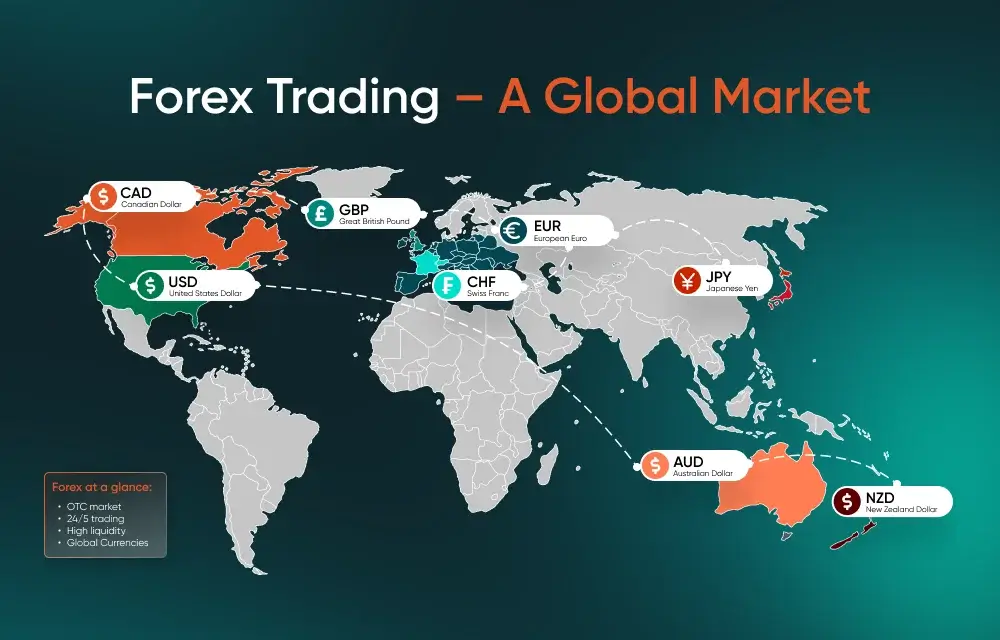
Forex trading, or foreign exchange trading, involves the exchange of one currency for another with the aim of profiting from changes in their relative value. It is conducted over the counter, meaning trades take place directly between parties, typically through online platforms.
As the world’s largest financial market, forex offers traders the opportunity to access global currencies 24 hours a day, five days a week.
Learn more in our detailed forex trading guide.
How to Read Currency Pairs
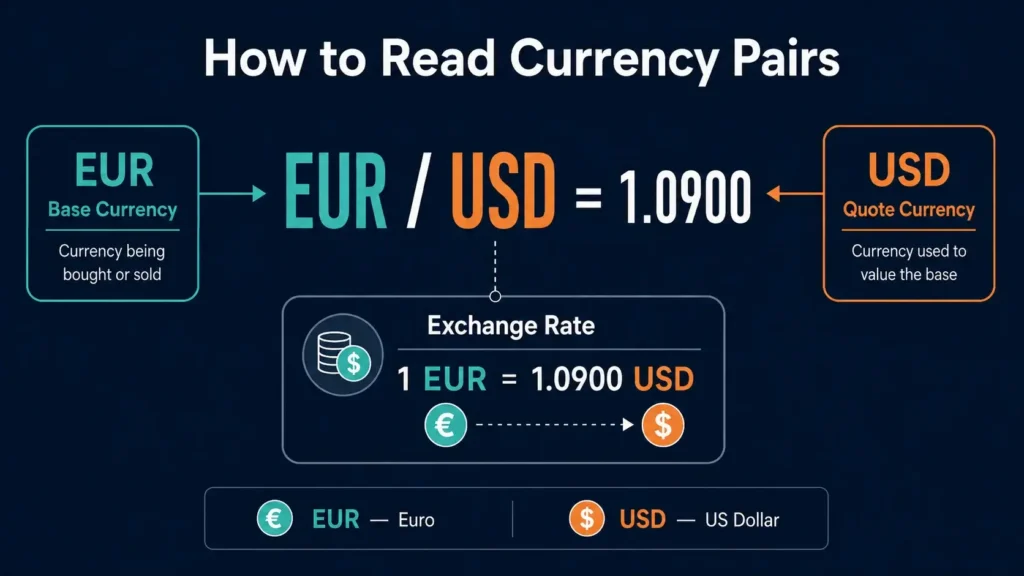
All currencies have a three-letter International Organization for Standardisation (ISO) currency code. This normally consists of the first two letters representing the country and the third being the actual currency.
For instance, USD is the US dollar, the euro is EUR.
What Is the Base and Quote Currency?
In any currency pair, the first currency listed is the base currency and the second is the quote currency. The quote currency shows how many units are needed to buy one unit of the base currency.
Using EUR/USD as an example:
- The first currency is known as the base currency, which is the Euro (EUR).
- The second currency in this pair (the USD) is known as the quote currency.
If the quoted price reads $1.2042, this means that 1.2042 US dollars is needed to buy one euro.
What Is a Position in Forex Trading?
A ‘position’ refers to a trade that has been opened in the market. There are two primary types of positions:
Long Position
This is when a trader buys the base currency and sells the quote currency, expecting the base currency to appreciate in value.
Example: Going long on EUR/USD if you believe the euro will rise against the dollar.
Short Position
This is when a trader sells the base currency and buys the quote currency, anticipating that the base currency will weaken.
Example: Going short on GBP/USD if you expect the pound to fall in value against the dollar.
These concepts are foundational for understanding how forex trading works and interpreting live price quotes effectively.
How Currency Pairs Work
In the forex market, currencies are always traded in pairs.
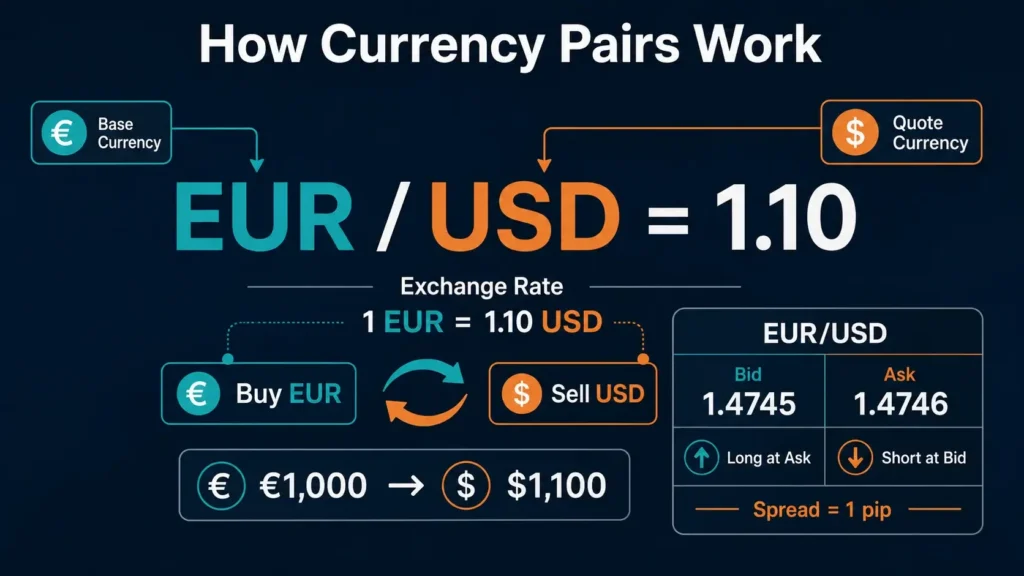
This means that every transaction involves simultaneously buying one currency and selling another. The goal is to benefit from changes in the exchange rate between the two currencies—either from one strengthening (appreciating) or the other weakening (depreciating).
When you see a currency pair such as EUR/USD, it represents how much of the quote currency (USD) is needed to buy one unit of the base currency (EUR).
Example:
Suppose you exchange €1,000 into US dollars for a holiday when the exchange rate is €1 = $1.10, giving you $1,100. If the rate later shifts to €1 = $1.00, and you convert your money back to euros, you would now receive €1,100—a €100 gain.
This gain occurred because the euro weakened while the US dollar strengthened. This is the basic principle behind currency trading: Capitalising on fluctuations in exchange rates.
The Bid, the Ask, and the Spread
Currency pairs are always quoted with two prices:
- Bid Price: The price at which the market (or broker) is willing to buy the base currency.
- Ask Price: The price at which the market is willing to sell the base currency.
| Currency Pair | Bid Price | Ask Price |
| EUR/USD | 1.4745 | 1.4746 |
In this case:
- A trader looking to go long (buy EUR, sell USD) would do so at the ask price of 1.4746.
- A trader looking to go short (sell EUR, buy USD) would do so at the bid price of 1.4745.
The difference between the bid and ask price is known as the spread. In this example, the spread is 1 pip (0.0001), which represents the trading cost and reflects market liquidity.
Spread size varies by pair: highly liquid majors such as EUR/USD typically carry some of the tightest forex spreads, while exotic pairs with thinner trading volume tend to carry wider ones. Spreads can also fluctuate with the trading session, often widening outside the main London and New York overlap when fewer participants are active.
Major Currency Pairs

| Currency Pair | Description |
| EUR/USD | Policy divergence (Fed vs ECB). Fell below parity in 2022 for the first time in 20 years. |
| GBP/USD | Moves with UK politics & economy. Brexit and budget news often trigger sharp swings. |
| USD/JPY | Interest rate gap (Fed vs BoJ). Popular for carry trades when US rates rise. |
| USD/CHF | Safe-haven Swiss franc. Strengthens during uncertainty, weakens when risk appetite improves. |
| AUD/USD | Tied to commodities, especially iron ore & gold. Acts as proxy for Asia-Pacific growth. |
| USD/CAD | Oil-linked Loonie. Higher crude prices boost CAD, falling oil weakens it. |
| NZD/USD | Export-driven Kiwi. Dairy prices and RBNZ policy heavily shape performance. |
Major currency pairs are the most frequently traded pairs in the forex market. They always include the US dollar (USD) and one of the world’s other leading currencies. Known for their high liquidity and tight spreads, these pairs are popular among traders of all experience levels.
The US dollar sat on one side of 89.2% of all global FX trades in April 2025, with the euro and Japanese yen the next most-used currencies at 28.9% and 16.8% of turnover respectively, while sterling’s share slipped to 10.2% [1]. These shifts in relative weight feed directly into how the seven major pairs below tend to behave.
1. EUR/USD
The EUR/USD is the most traded currency pair in the world, reflecting the exchange rate between the euro (the official currency of the eurozone) and the US dollar (the world’s primary reserve currency).
Due to the economic size and influence of both regions, this pair dominates global forex volume and its deep liquidity, relatively low transaction costs, and consistently tight bid-ask spreads make it one of the most accessible and cost-efficient pairs to trade.
Monetary policy divergence remains one of the key drivers of EUR/USD.
For example, in 2022 to 2023, the pair experienced significant volatility as the US Federal Reserve aggressively raised interest rates to combat inflation, while the European Central Bank responded slower. This widening policy gap caused the euro to weaken substantially, with the pair falling below parity (1.00) for the first time in 20 years [2].
Traders should also be aware of how the pair reacts to major economic data releases.
US Non-Farm Payrolls (NFP) and Eurozone inflation figures often catalyse short-term price swings. Additionally, EUR/USD tends to show strong reactions during overlapping trading sessions—particularly London and New York hours—when volume and liquidity peak.
2. GBP/USD
The GBP/USD pair, often referred to as ‘Cable’, represents the exchange rate between the British pound and the US dollar. Historically rooted in transatlantic financial transactions, this pair is known for its wider daily ranges and greater sensitivity to political and economic news, making it one of the top currency pairs to trade in forex.
Besides reacting to monetary policy changes from the Bank of England (BoE) and the US Federal Reserve, GBP/USD often responds sharply to market sentiment around the UK economy—including key data such as employment figures, retail sales, and inflation reports.
Events such as Brexit negotiations, UK budget announcements, or leadership changes have also previously triggered notable price swings in this currency pair.
3. USD/JPY
When Googling “best currency pairs to trade in forex”, one might come across the USD/JPY currency pair, which compares the US dollar with the Japanese yen—and is one of the most actively traded pairs in the Asia-Pacific region. It’s susceptible to interest rate differentials between the US Federal Reserve and the Bank of Japan (BoJ)—a key driver of its price movements.
Japan’s long-standing ultra-low or even negative interest rates make the yen a preferred funding currency for carry trades, where investors borrow in yen to invest in higher-yielding currencies like the US dollar.
When US interest rates increase while Japan maintains low or near-zero rates, it creates a favourable interest rate differential. This environment encourages traders to consider long positions on USD/JPY, aiming to benefit not only from the interest earned on the rate gap but also from any potential strengthening of the US dollar against the yen.
This was especially evident during 2022 to 2023, when aggressive rate hikes by the Fed—contrasted with the BoJ’s continued dovish stance—drove the pair to multi-decade highs.
However, carry trades come with risk. During heightened market uncertainty or geopolitical stress, traders often unwind their positions, triggering sharp yen appreciation.
As a result, the yen also functions as a safe-haven currency, strengthening when global risk appetite declines—such as during the early phases of the COVID-19 pandemic or major geopolitical conflicts.
4. USD/CHF
As one of the most traded forex pairs, the USD/CHF tracks the exchange rate between the US dollar and the Swiss franc, commonly referred to as the ‘Swissie’. The Swiss franc is widely regarded as a safe-haven currency, underpinned by Switzerland’s long-standing political neutrality, robust financial system, and low inflation environment.
As a result, USD/CHF often reacts to shifts in global risk sentiment—with the franc strengthening during market uncertainty and weakening when investor confidence improves. This pair is also influenced by monetary policy divergence between the Swiss National Bank (SNB) and the US Federal Reserve.
For example, if the Fed is tightening while the SNB maintains accommodative policies, USD/CHF may rise as capital flows favour the higher-yielding dollar. Conversely, dovish signals from the Fed or unexpected SNB intervention—such as currency market stabilisation efforts—can lead to rapid reversals.
5. AUD/USD
Commonly referred to as the ‘Aussie’, the AUD/USD currency pair represents the exchange rate between the Australian dollar and the US dollar.
As one of the top 20 most traded currency pairs, the AUD/USD is closely tied to the commodity markets, as Australia is a major exporter of iron ore, gold, coal, and liquefied natural gas. When commodity prices rise—particularly iron ore and gold—the AUD often strengthens, while falling prices can weigh on the currency’s value.
Interest rate differentials between the Reserve Bank of Australia (RBA) and the US Federal Reserve also play a key role in shaping the pair’s direction.
For example, when the RBA adopts a more hawkish stance than the Fed, AUD/USD may climb as investors seek higher yields. Due to Australia’s close trade links with China, AUD/USD is also often viewed as a proxy for Asia-Pacific’s economic health and broader global risk appetite.
6. USD/CAD
The USD/CAD currency pair compares the US dollar with the Canadian dollar, often referred to as the ‘Loonie’. It’s heavily influenced by movements in crude oil prices, as oil is one of Canada’s most significant exports.
When oil prices rise, the Canadian dollar tends to strengthen due to increased revenue and investment inflows. When prices fall, the CAD often weakens, causing USD/CAD to rise. In addition to commodities, the pair is sensitive to domestic economic data, including employment reports, CPI inflation, and GDP figures from both Canada and the US.
Monetary policy divergence between the Bank of Canada (BoC) and the US Federal Reserve can also significantly impact the currency pair. For example, if the BoC adopts a more hawkish tone while the Fed pauses rate hikes, the Canadian dollar may gain strength against the US dollar.
In 2016, oil prices slumped to decade lows, with WTI crude falling below $30 per barrel amid global oversupply concerns and weakening demand. As a result, the Canadian dollar came under significant pressure, and USD/CAD spiked to 1.46, meaning it took 1.46 Canadian dollars to buy one US dollar—the pair’s highest level in over a decade [3].
7. NZD/USD
The NZD/USD currency pair measures the value of the New Zealand dollar against the US dollar.
Often referred to as the ‘Kiwi’, this pair is influenced by New Zealand’s export-driven economy, particularly its reliance on dairy products, which account for a significant portion of national exports. As such, fluctuations in global dairy prices, along with broader commodity trends, can strongly impact the NZD’s performance.
In addition to trade dynamics, monetary policy from the Reserve Bank of New Zealand (RBNZ) plays a key role. The RBNZ was among the first central banks to adopt inflation targeting and has historically maintained relatively higher interest rates than many of its counterparts, making NZD/USD one of the most traded forex pairs in carry trade strategies—especially during stable market periods.
Minor Currency Pairs
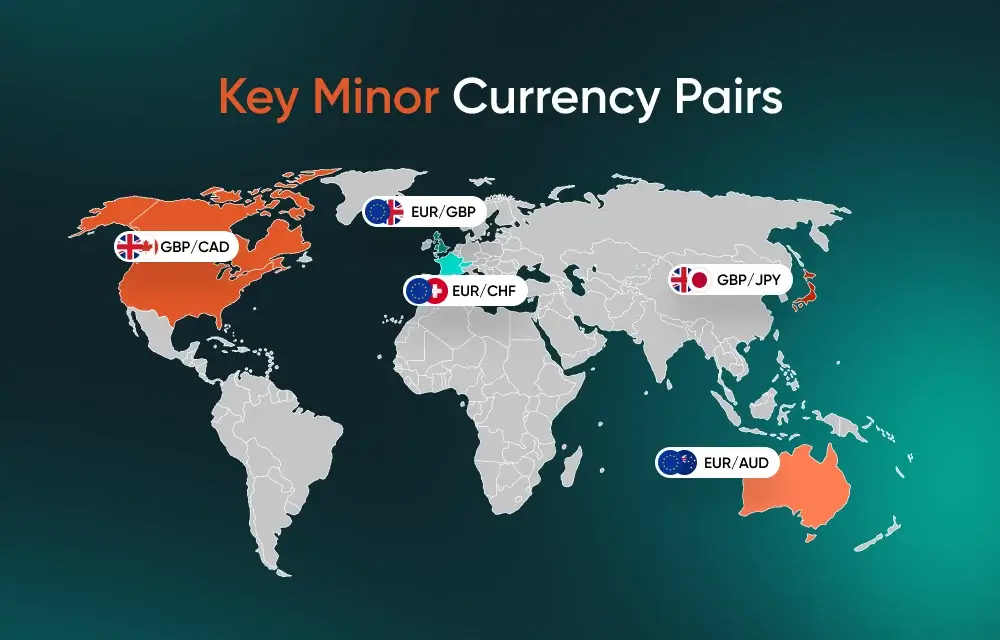
| Currency Pair | Description |
| EUR/GBP | Tracks relative strength of EU vs UK. Moves on ECB & BoE policy, Brexit trade talks, and political shifts. Often less volatile than majors. |
| GBP/JPY | One of the most volatile crosses. Driven by BoE–BoJ rate differentials, risk sentiment, and safe-haven flows. Popular with technical traders. |
| EUR/AUD | Reflects Europe’s services vs Australia’s resources. Commodities like iron ore, coal, and gold heavily shape AUD, and thus EUR/AUD. |
| GBP/CAD | Balances UK’s financial economy against Canada’s resource-driven one. Oil prices, OPEC+ moves, and energy demand are major drivers. |
| EUR/CHF | Closely tied economies, but Swiss franc acts as safe haven. SNB interventions, eurozone confidence, and shocks can move this pair sharply. |
Minor currency pairs, also known as cross-currency pairs, do not include the US dollar but feature other major global currencies such as the euro, pound, or yen. While less liquid than major pairs, minor pairs still offer substantial trading opportunities and are influenced by regional economic trends and central bank policies.
8. EUR/GBP
The EUR/GBP currency pair reflects the value of the euro relative to the British pound.
For those looking to compare the relative economic strength of the eurozone versus the United Kingdom without direct exposure to the US dollar, EUR/GBP is a commonly followed cross-currency pair. Movements in this pair are often more subdued compared to others, making it suitable for traders who prefer lower volatility and more range-bound behaviour.
While the pair is influenced by interest rate expectations from the European Central Bank (ECB) and the Bank of England (BoE), it also reacts strongly to evolving political developments. In particular, the post-Brexit trade and regulatory discussions between the UK and EU continue to influence sentiment and direction.
In essence, any buzz around financial services alignment, customs cooperation, and trade frameworks can cause fluctuations in the pair—even in the absence of major economic data.
9. GBP/JPY
The GBP/JPY pair is one of the most volatile currency crosses in the forex market, combining the British pound’s sensitivity to news with the Japanese yen’s role as a global safe haven. Its high volatility has made it one of the more actively followed currency pairs among traders interested in shorter-term price movements and wider trading ranges.
This forex currency pair is heavily influenced by changes in interest rate differentials between the BoE and the Bank of Japan (BoJ), as well as fluctuations in market sentiment. When investors are optimistic, the yen often weakens and GBP/JPY rises. During market uncertainty, capital may flow into the yen, sending the pair’s valuation lower.
10. EUR/AUD
The EUR/AUD currency pair pits the euro against the Australian dollar, offering traders a lens into the contrasting dynamics of a service-based European economy and a commodity-dependent Australia.
As previously mentioned, the Australian dollar is closely tied to the export performance of key raw materials—particularly iron ore, coal, and gold—which means global commodity price fluctuations often influence the EUR/AUD.
Case in point: A surge in iron ore prices—driven by increased demand from China—can boost the Australian dollar, pushing EUR/AUD lower. Conversely, a drop in gold prices or weakening demand for natural resources may weigh on the AUD, causing the pair to rise.
11. GBP/CAD
The GBP/CAD currency pair tracks the exchange rate between the British pound and the Canadian dollar, offering insight into the economic interplay between a service-oriented UK and a resource-driven Canada. One of the major influences on the Canadian dollar is the price of crude oil—as Canada is one of the world’s largest oil exporters.
As a result, GBP/CAD is often reactive to changes in global energy demand, OPEC+ decisions, and oil price volatility. For instance, a sharp rise in crude oil prices—triggered by supply cuts or geopolitical tensions—can strengthen the Canadian dollar, causing GBP/CAD to fall.
Conversely, falling oil prices due to oversupply or slowing global demand can weaken CAD, pushing the pair higher.
12. EUR/CHF
The EUR/CHF currency pair reflects the close financial and geographical relationship between the eurozone and Switzerland.
While this forex pair tends to move within relatively narrow ranges due to strong economic ties, it can react sharply to shifts in eurozone confidence or unexpected market shocks. The Swiss franc’s reputation as a safe-haven currency means that during periods of political or financial stress, capital often flows into the franc—causing EUR/CHF to fall.
Traders often use this pair to gauge risk sentiment within Europe, particularly when seeking low-volatility setups or looking for early signals of market tension in the region. Central bank interventions, particularly from the Swiss National Bank (SNB), can also have an outsized impact due to Switzerland’s history of managing franc strength.
Exotic Currency Pairs
| Currency Pair | Description |
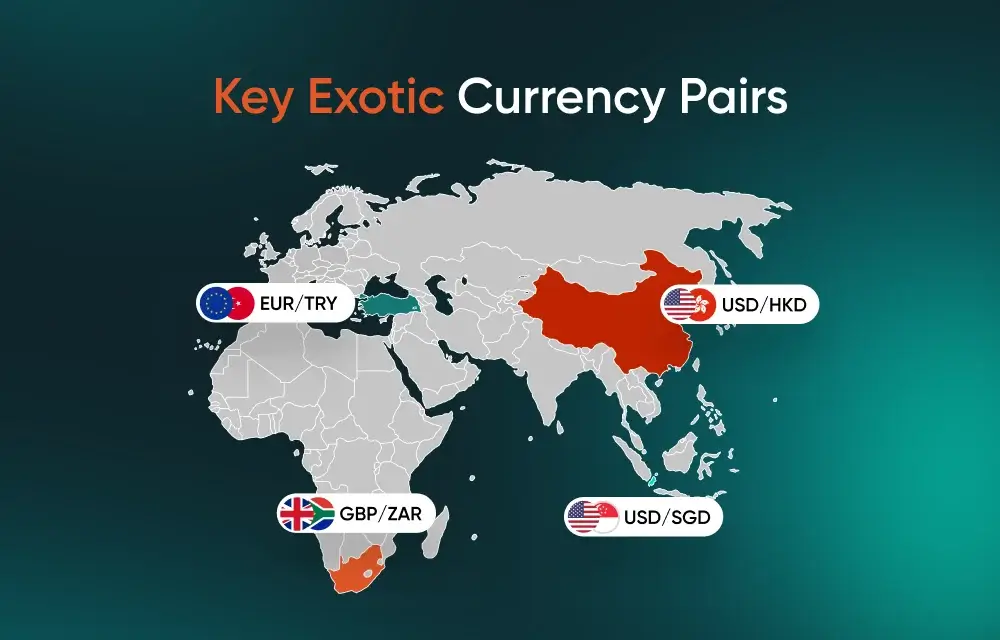
| USD/SGD | Reflects Singapore’s trade-heavy economy. Unique as MAS controls policy via exchange-rate band, not interest rates. Seen as a regional resilience gauge. |
| USD/HKD | Managed peg at 7.75–7.85 by HKMA. Normally stable, but US rate shifts or capital flows can pressure the band, triggering intervention. |
| EUR/TRY | High-volatility cross. Turkish lira reacts sharply to inflation, politics, and central bank credibility. Popular for momentum-driven trades. |
| GBP/ZAR | Pound vs resource-linked rand. Moves with global demand for gold, platinum, and other minerals. One of the more volatile emerging pairs. |
Next, let’s explore exotic currency pairs and the four commonly traded ones.
If you’re new to the term, exotic currency pairs consist of a major currency traded against the currency of an emerging or smaller economy. Compared to major or minor pairs, these exotic pairs tend to have lower liquidity, wider spreads, and higher volatility.
While they carry greater risk, they can also present unique opportunities for traders who understand the economic and geopolitical dynamics of the regions involved.
13. USD/SGD
The USD/SGD is a forex currency pair that reflects the exchange rate between the US dollar and the Singapore dollar, with Singapore being a key financial and trade hub in Asia. The pair is typically influenced by regional trade flows, economic data from both countries, and global risk sentiment, given Singapore’s export-oriented economy.
What makes this pair unique is the Monetary Authority of Singapore’s (MAS) approach to monetary policy. Instead of using interest rates, MAS manages the SGD by adjusting the exchange rate within a controlled band, making currency policy a central tool [4]. As a result, USD/SGD often serves as an indicator of Southeast Asia’s economic resilience and Singapore’s external trade strength.
14. USD/HKD
The USD/HKD is an exotic currency pair that represents the exchange rate between the US dollar and the Hong Kong dollar, managed under a currency peg system.
The Hong Kong Monetary Authority (HKMA) maintains this peg within a strict band of 7.75 to 7.85, providing stability and minimising short-term volatility [5]. As a result, this pair typically shows limited price fluctuations during normal market conditions.
However, external factors such as US interest rate changes, capital outflows, or geopolitical tensions can exert pressure on the peg. When this occurs, the HKMA may intervene to maintain stability, which can briefly introduce volatility. Some traders follow USD/HKD closely as an indicator of regional monetary resilience and capital flow dynamics in Asia.
15. EUR/TRY
The EUR/TRY currency pair compares the euro with the Turkish lira, offering high volatility due to the contrast between the euro’s relative stability and the lira’s exposure to emerging market risks.
The Turkish lira is highly sensitive to both internal and external factors such as inflation, political instability, and central bank credibility—often resulting in sharp and unpredictable price movements. As a result, EUR/TRY is often monitored by traders interested in high-volatility market conditions.
The euro side of the pair offers some degree of stability, given that it’s anchored by the economic weight and monetary policy of the European Central Bank (ECB). As a result, EUR/TRY is frequently used to trade on regional geopolitical developments, including tensions in the Middle East or shifts in EU-Turkey relations.
That being said, traders should always exercise caution, as the pair’s volatility not only present large potential gains but also elevates risks.
16. GBP/ZAR
GBP/ZAR—the rate between the British pound and the South African rand—is an exotic currency pair that’s known for its high volatility and exposure to commodity market fluctuations.
Given that South Africa is a leading exporter of gold, platinum, and other minerals, the rand is particularly sensitive to global demand and pricing in the resource sector. As a result, shifts in commodity prices can drive significant movements in GBP/ZAR.
Matching Currency Pairs to Your Trading Style
Understanding currency pairs is the foundation for navigating the forex market, where traders buy and sell global currencies based on economic trends, interest rate policies, and geopolitical events. The 16 pairs covered in this guide span the full spectrum—from the deep liquidity of EUR/USD and the other six majors, through minor pairs like EUR/GBP and AUD/NZD, to higher-volatility exotics such as USD/TRY and GBP/ZAR—and each one responds to a different mix of monetary policy, trade flows, and risk sentiment.
There’s no single pair that suits every trader. The more useful question is which pair’s behaviour matches your trading style, risk tolerance, and the time you have available to follow the market—a distinction explored further in the FAQs below.
Frequently Asked Questions
What Is a Currency Pair?
A currency pair shows the exchange rate between two currencies, made up of a base currency and a quote currency. The first currency listed is the base currency, and the second is the quote currency, which shows how many units are needed to buy one unit of the base currency. EUR/USD, for example, shows how many US dollars are needed to buy one euro.
How Many Currency Pairs Are There in Forex?
There is no fixed number, since any two of the world’s roughly 180 currencies can theoretically form a pair. In practice, trading activity concentrates around a smaller group: the seven major pairs, a wider set of minor (cross) pairs, and a long tail of exotic pairs involving emerging-market currencies.
How Many Major Currency Pairs Are There?
Most classifications recognise seven major currency pairs, all of which include the US dollar paired with another leading global currency: EUR/USD, USD/JPY, GBP/USD, USD/CHF, AUD/USD, USD/CAD, and NZD/USD. These pairs typically carry the highest liquidity and some of the tightest spreads in the forex market.
What Is the Difference Between Major, Minor, and Exotic Currency Pairs?
Major pairs always include the US dollar and tend to have the highest liquidity and tightest spreads. Minor pairs, also called cross pairs, combine two major currencies without the US dollar, such as EUR/GBP. Exotic pairs combine a major currency with an emerging-market currency and typically carry lower liquidity, wider spreads, and higher volatility.
Why Trade Currency Pairs?
Forex offers traders exposure to some of the most liquid and diverse financial instruments in the world. The market sees over $9.6 trillion in daily turnover [1], which supports tight spreads and efficient execution. Retail traders can access it with low minimum deposits, often using leverage, which can magnify both gains and losses, and can diversify across different economies while trading around the clock across major trading sessions, from London to New York to Tokyo.
How Do You Choose Which Currency Pairs to Trade?
The right pair often depends on your trading style, risk tolerance, and market outlook. Swing traders often favour GBP/USD or AUD/USD for wider ranges and clearer technical patterns, while position traders may look to longer-term macro themes in pairs such as USD/CAD or EUR/CHF. It’s generally easier to start with one or two pairs, build familiarity with their behaviour, and expand from there as experience grows.
Which Currency Pairs Are Best for Beginners?
Beginners are often encouraged to prioritise currency pairs that combine stability, high liquidity, and low trading costs. EUR/USD is the most liquid pair with extensive data and news coverage, USD/JPY is known for consistent trends and relatively lower volatility, and GBP/USD offers more movement for those ready for slightly higher risk. These pairs tend to react predictably to economic releases, helping new traders learn without being overwhelmed by the erratic price swings often seen in exotic pairs.
Which Currency Pairs Are Most Volatile?
Exotic pairs such as EUR/TRY and GBP/ZAR tend to show higher volatility, often linked to inflation, political risk, and lower trading volume in the underlying currencies. Among majors and minors, pairs involving the Japanese yen, such as GBP/JPY, can be more volatile than US dollar pairs like EUR/USD, since yen pairs are sensitive to shifts in risk sentiment as well as interest rate differentials. Volatility can create opportunity, but it also raises the risk of larger and faster price swings.
What Are Some Other Currency Pairs Worth Watching?
While this guide focuses on 16 widely traded pairs, some traders expand their watchlist further to pairs such as USD/CNH, EUR/JPY, AUD/JPY, USD/SEK, and USD/NOK. These represent a mix of major, minor, and exotic currencies with different levels of volatility, liquidity, and trading cost. Understanding their correlations and economic drivers—such as interest rates, trade balances, and commodity prices—can help in deciding whether they fit alongside the core 16 pairs covered in this guide.
What Should You Look for When Choosing a Broker to Trade Currency Pairs?
Factors traders commonly consider include the spread and other trading costs on the pairs they plan to trade, the range of major, minor, and exotic pairs on offer, the broker’s regulatory status in their jurisdiction, and the trading platforms available. Execution speed and the quality of risk management tools, such as stop-loss orders, are also often factored in. This is general information only and does not constitute a personal recommendation.
How Can You Start Trading Currency Pairs?
Retail traders typically access currency pairs as forex CFDs through platforms such as MetaTrader 4 (MT4), MetaTrader 5 (MT5), ProTrader, and the Vantage App, each offering charting tools and real-time pricing for tracking price movement across major, minor, and exotic pairs. Educational resources, market analysis, and webinars are also available to support traders working through these concepts, regardless of experience level.
RISK WARNING: CFDs are complex financial instruments and carry a high risk of losing money rapidly due to leverage. You should ensure you fully understand the risks involved and carefully consider whether you can afford to take the high risk of losing your money before trading.
Disclaimer: The information is provided for educational purposes only and doesn’t take into account your personal objectives, financial circumstances, or needs. It does not constitute investment advice. We encourage you to seek independent advice if necessary. The information has not been prepared in accordance with legal requirements designed to promote the independence of investment research. No representation or warranty is given as to the accuracy or completeness of any information contained within. This material may contain historical or past performance figures and should not be relied on. Furthermore estimates, forward-looking statements, and forecasts cannot be guaranteed. The information on this site and the products and services offered are not intended for distribution to any person in any country or jurisdiction where such distribution or use would be contrary to local law or regulation.
References
- “OTC foreign exchange turnover in April 2025 – BIS” https://www.bis.org/statistics/rpfx25_fx.htm Accessed 16 Oct 2025
- “Currency Pair: EUR/USD (Euro/U.S. Dollar) Definition and History – Investopedia” https://www.investopedia.com/terms/forex/e/eur-usd-euro-us-dollar-currency-pair.asp. Accessed on 20 May 2025.
- “Trading the USD/CAD Currency Pair – Investopedia” https://www.investopedia.com/terms/forex/u/usd-cad-us-dollar-canadian-dollar-currency-pair.asp. Accessed on 20 May 2025.
- “Understanding Inflation & Monetary Policy – Monetary Authority of Singapore” https://www.mas.gov.sg/monetary-policy/economics-edu-inflation/inflation/how-does-mas-carry-out-monetary-policy. Accessed on 20 May 2025.
- “Hong Kong’s central bank intervenes to maintain currency peg – Reuters” https://www.reuters.com/world/asia-pacific/hong-kongs-central-bank-intervenes-maintain-currency-peg-2025-05-06/. Accessed on 20 May 2025.