


 Updated
Herd mentality in finance is the tendency for investors to follow the decisions of a larger group rather than rely on their own analysis. In practice, it means buying an asset because everyone else is buying, or selling because everyone else is selling — often driven by the fear of missing out (FOMO) rather than research.
This behaviour shows up in almost every major market boom and bust, from speculative bubbles to sudden sell-offs. Recognising when the crowd is driving a move, rather than the fundamentals, can help you understand the risks involved and question decisions that feel obvious only because others are making them.
This article explains what herd mentality is, why it happens, the market events it has shaped, and the approaches some traders use to think more independently.
Key Points
- Herd mentality is a behavioural bias where investors copy the crowd — buying into rallies and selling into declines — instead of acting on their own analysis.
- It has contributed to major market events, including the dot-com crash, the 2008 housing collapse, the 2021 GameStop squeeze, and India’s 1992 securities-scam bull run.
- No approach removes market risk, but independent research, a written trading plan, awareness of biases, and diversification are commonly used to reduce the pull of the crowd.
What Is Herd Mentality?
Herd mentality, also called herd behaviour, is a psychological pattern where individuals adopt the beliefs and actions of the majority within a group. In financial markets, it describes investors who buy or sell an asset largely because others are doing so, rather than after their own analysis.
The bias is well documented in behavioural finance. In a study for the International Monetary Fund, economists Sushil Bikhchandani and Sunil Sharma described how “information cascades” can form, where investors set aside their own information and imitate the choices of those who acted before them [1]. Once enough people follow, the crowd’s direction can start to look like a signal in itself.
Several factors tend to feed herd behaviour: the fear of missing out (FOMO) on a rising market, incomplete or uneven information, the influence of well-known commentators, social-media buzz, and simple momentum as prices keep moving one way.
Historical Examples of Herd Mentality in Financial Markets
Herd behaviour has played a role in some of the most dramatic booms and busts in market history. Four examples show how it can build and then unwind.
The Dot-Com Bubble (1995–2000)
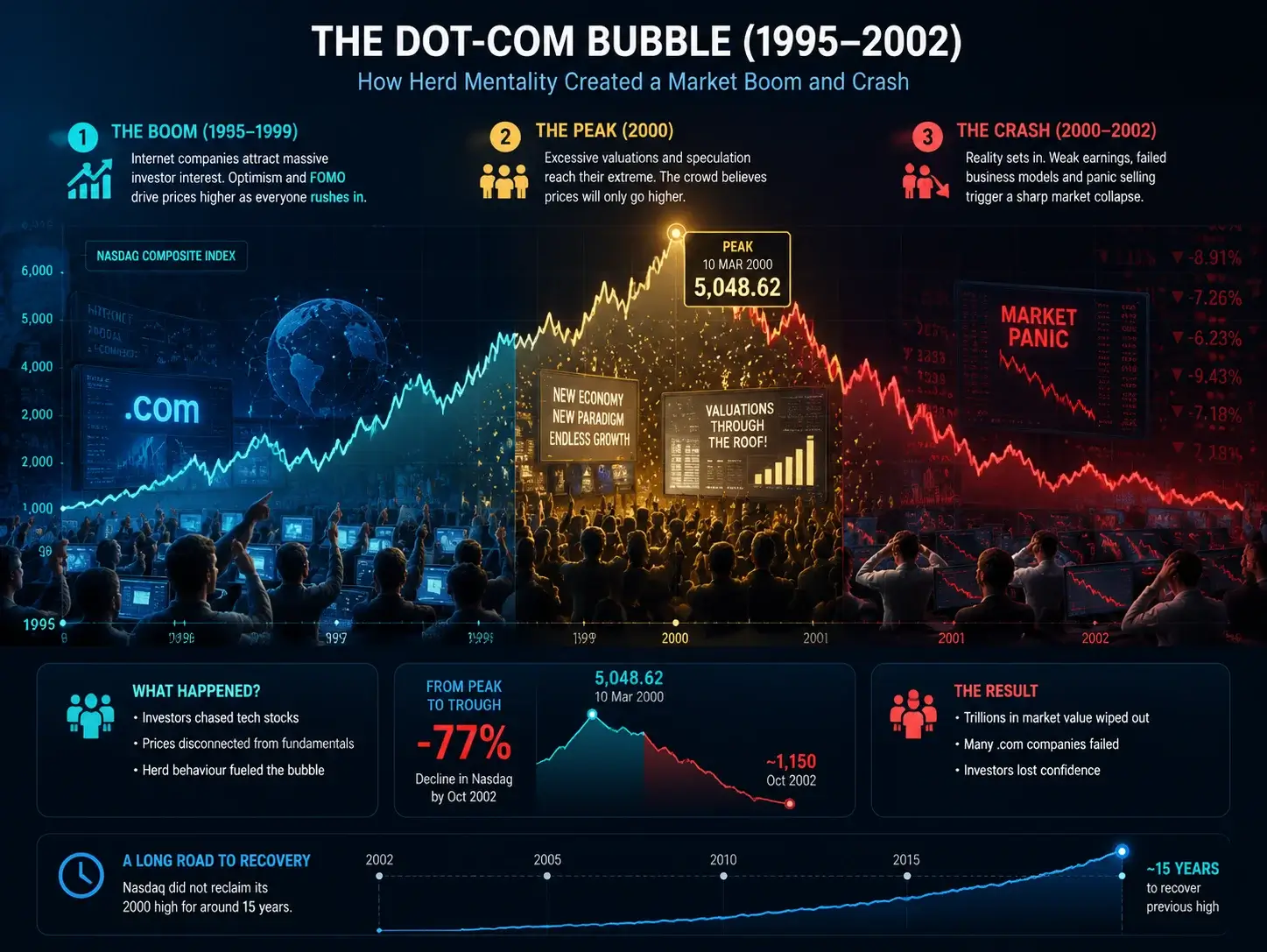
During the late 1990s, enthusiasm for internet companies drove a speculative boom in technology shares. The Nasdaq Composite index rose sharply as investors assumed almost any business with a “.com” name would succeed, pushing valuations far above what earnings could justify.
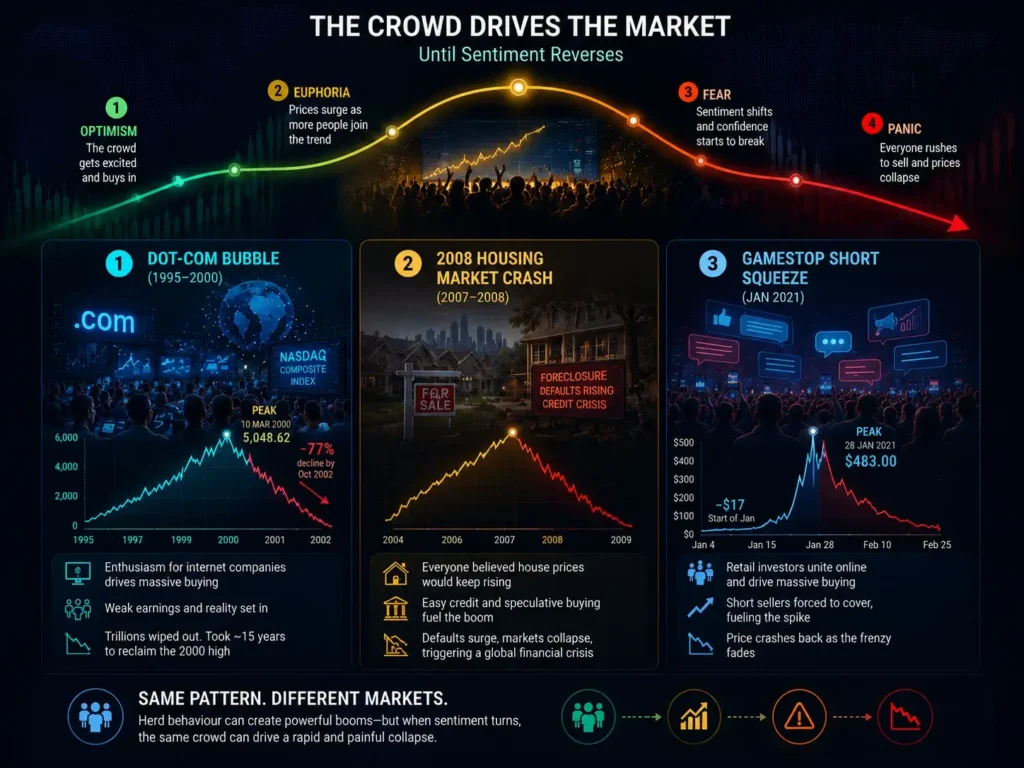
The index peaked at 5,048.62 on 10 March 2000 [2]. As sentiment turned and investors realised many of these companies had weak business models, confidence collapsed. The Nasdaq fell about 77% from its peak by October 2002, wiping out trillions of dollars in market value, and did not reclaim its 2000 high for around 15 years [2].
The pattern was classic herd behaviour: investors bought because others were buying, then sold in unison once the mood shifted.
The 2008 Housing Market Crash (2007–2008)
In the years before 2008, a widespread belief that house prices would keep rising encouraged heavy borrowing and speculative property buying in the United States. Aggressive lending, including subprime mortgages granted with little scrutiny, added fuel.
As demand pushed prices higher, more buyers piled in for fear of missing the gains — a housing-market version of the same herd behaviour. When prices began to fall in 2007, the process reversed: defaults rose, foreclosures spread, and financial institutions holding mortgage-backed securities faced severe losses, helping trigger a global financial crisis.
The GameStop Short Squeeze (2021)
In January 2021, retail investors coordinating on the Reddit forum r/wallstreetbets drove up the share price of the US video-game retailer GameStop, targeting a stock that hedge funds had heavily bet against. The buying forced short sellers to buy back shares to cover their positions, pushing the price even higher in a feedback loop.
GameStop shares climbed from about US$17 at the start of January to an intraday high of US$483 on 28 January 2021, before falling back sharply within weeks as the frenzy faded [3]. The episode showed how social media can now organise herd behaviour at speed, amplifying both the run-up and the reversal.
How Herd Mentality Affects Market Movements
Herd mentality can shape markets in several ways:
- Inflates asset bubbles: When prices rise far above intrinsic value because buyers keep piling in, the gap can eventually close sharply, leading to large losses.
- Creates echo chambers: Investors may seek information that confirms what they already believe, seeing mostly bullish or mostly bearish views and reinforcing the group’s direction. Read our guide on bullish vs bearish to better understand the differences.
- Increases volatility: When large numbers of investors act on the same emotion at the same time, price swings can become exaggerated.
- Builds feedback loops: Rising prices can attract more buyers and falling prices can trigger more selling, pushing prices further from fair value.
Media coverage, policy announcements, and social networks can amplify these dynamics. A single headline, viral post, or major market development can prompt investors to react quickly and collectively.
In April 2025, financial markets provided another example of how shifting sentiment can drive widespread investor reactions.
After the announcement of sweeping US tariff measures, concerns about trade disruption and economic growth triggered a broad risk-off move. The Dow Jones Industrial Average fell 1,679 points (nearly 4%), while the S&P 500 declined 4.8% and the Nasdaq Composite dropped almost 6% in the first trading session following the announcement.
The selling pressure intensified as uncertainty continued, with investors across global markets reducing risk exposure. The Dow later fell more than 2,200 points in another session, while the S&P 500 and Nasdaq experienced further declines as concerns over economic impact grew.
The episode illustrated how shifts in market sentiment can contribute to broad investor reactions and increased market volatility. While these reactions may reflect genuine concerns about economic conditions, rapid collective buying or selling can also amplify price movements — a key feature of herd behaviour in financial markets [5].
How Herd Mentality Affects Individual Trading Decisions
As noted earlier, investors often feel a sense of FOMO when they see others trading the same assets, which can push them to follow the crowd. For an individual, doing so can carry real costs:
- It can hurt portfolio returns: Buying overvalued assets near a peak, or selling in a panic near a low, can lock in poor timing and erode long-term results.
- It can increase dependence on market narratives: Acting on rumours or hype rather than a considered process can make decisions reactive instead of deliberate.
- It can create a false sense of security: When everyone is making similar moves, the collective action may appear safe and rational, which can discourage traders from reviewing their own positions.
Understanding how emotions such as fear, greed, and FUD (fear, uncertainty, and doubt) drive these decisions is a core part of trading psychology.
Strategies to Avoid Falling into the Herd Behaviour Trap
No approach removes market risk, but several habits are commonly used to reduce the influence of the crowd and support more independent decisions.
Conduct Independent Research and Analysis
Many traders review the fundamental and technical aspects of an investment themselves, rather than relying on popular opinion or market hype. Some traders use technical analysis alongside fundamental analysis as part of their research process when assessing markets.
Develop a Disciplined Trading Plan
Some traders set clear goals and define entry and exit criteria in advance, then aim to follow those rules consistently. A written plan can help keep the focus on longer-term objectives rather than on short-term moves driven by the crowd.
Manage Emotions and Cognitive Biases
Staying calm during sudden market moves is easier said than done. Techniques such as mindfulness and stress management are often discussed as part of managing trading emotions. Being aware of biases like the bandwagon effect and confirmation bias may help traders recognise when a decision is being shaped by the group rather than the evidence. Some traders also keep a trading journal to review their reasoning over time.
Diversify and Manage Risk
Diversification and risk and money management are widely used to limit the impact of any single market move. Spreading exposure across different assets, sectors, and regions through diversification can reduce reliance on one position. Risk tools such as stop-loss orders are commonly used to manage downside, although they do not guarantee execution at the set level in fast-moving markets.
Used together, these habits will not remove risk, but they may make it easier to weigh a decision on its merits rather than on what the crowd is doing.
Why Herd Mentality Matters in Financial Markets
Herd mentality is a normal human tendency, but in financial markets it can lead to speculative bubbles, sharp sell-offs, and poorly timed decisions. Recognising when a move is being driven by the crowd rather than the fundamentals is a useful part of understanding market risk.
Contracts for Difference (CFDs) are financial instruments that allow traders to speculate on price movements in underlying assets without owning those assets. CFDs are leveraged products, which means they can magnify both gains and losses, so understanding the risks is essential before trading.
Availability of CFD products varies by jurisdiction and may be subject to local regulation.
Vantage’s Academy provides educational resources covering financial markets, trading concepts and market behaviour.
Frequently Asked Questions (FAQ)
What is herd mentality in finance?
Herd mentality in finance is the tendency for investors to follow the actions of a larger group instead of relying on their own analysis. In practice, it often means buying an asset because others are buying, or selling because others are selling, frequently driven by the fear of missing out. It is studied within behavioural finance as one of several cognitive biases that can affect investment decisions.
What is herd investing?
Herd investing describes making investment decisions based mainly on what the crowd is doing rather than on independent research or a clear plan. It commonly appears during strong rallies, when rising prices attract more buyers, and during sharp declines, when falling prices prompt widespread selling. The risk is that decisions are shaped by emotion and momentum rather than the underlying value of the asset.
What is the difference between herd mentality and herd behaviour?
The two terms are often used interchangeably. “Herd mentality” usually refers to the underlying psychological tendency to conform to a group, while “herd behaviour” refers to the observable actions that result, such as many investors buying or selling the same asset at once. In financial markets, both point to the same core idea: acting with the crowd rather than independently.
What causes herd mentality in the stock market?
Several factors can contribute. Common ones include the fear of missing out on a rising market, incomplete or uneven information, the influence of well-known commentators or social media, and momentum as prices keep moving in one direction. Behavioural finance research also points to “information cascades”, where investors imitate earlier decisions instead of acting on their own information [1].
How can investors avoid following the herd?
No method removes market risk, but several habits are commonly discussed. These include doing independent research, following a written trading plan with predefined rules, being aware of biases such as the bandwagon effect and confirmation bias, and diversifying across different assets and sectors. The aim is to base decisions on evidence rather than on what the crowd is doing.
How do institutional investors try to avoid herding during market downturns?
Institutional investors often rely on documented processes, such as investment committees, predefined mandates, and risk limits, which are designed to reduce the influence of short-term sentiment. During downturns, they may lean on valuation frameworks and diversification rather than reacting to price moves alone. These processes do not eliminate herd behaviour, but they are intended to make decisions more deliberate and less emotional.
RISK WARNING: CFDs are complex financial instruments and carry a high risk of losing money rapidly due to leverage. You should ensure you fully understand the risks involved and carefully consider whether you can afford to take the high risk of losing your money before trading.
Disclaimer: The information is provided for educational purposes only and doesn’t take into account your personal objectives, financial circumstances, or needs. It does not constitute investment advice. We encourage you to seek independent advice if necessary. The information has not been prepared in accordance with legal requirements designed to promote the independence of investment research. No representation or warranty is given as to the accuracy or completeness of any information contained within. This material may contain historical or past performance figures and should not be relied on. Furthermore, estimates, forward-looking statements, and forecasts cannot be guaranteed. The information on this site and the products and services offered are not intended for distribution to any person in any country or jurisdiction where such distribution or use would be contrary to local law or regulation.
References
- “Herd Behavior in Financial Markets – International Monetary Fund (IMF Staff Papers)” https://www.jstor.org/stable/3867589 Accessed 6 July 2026
- “The Late 1990s Dot-Com Bubble Implodes in 2000 – Goldman Sachs” https://www.goldmansachs.com/our-firm/history/moments/2000-dot-com-bubble Accessed 6 July 2026
- “GameStop tumbles 34% as Reddit darling mulls share sale – Reuters” https://finance.yahoo.com/news/gamestop-tumbles-reddit-darling-considers-103820698.html Accessed 6 July 2026
- “The Dow Tumbled Because Trump Restarted the Trade War – Barron’s” https://www.barrons.com/amp/articles/president-donald-trump-tweets-new-tariffs-on-china-and-sinks-the-dow-jones-industrial-average-51564683101 Accessed 6 July 2026