


 Updated
From 2025 to early 2026, gold moved from a defensive allocation to a crowded macro. World Gold Council data showed global physically backed gold exchange-traded funds (ETFs) taking in US$6.6 billion in April 2026 after heavy March outflows1.
That rotation has made gold ETFs vs. gold mining ETFs a practical decision, not a wording exercise. Gold ETFs can potentially offer exposure that’s more directly tied to bullion prices. Meanwhile, gold mining ETFs connect gold price movements with the operating and market dynamics of mining companies.
This guide compares gold ETFs vs. gold mining ETFs to help traders and investors understand how the respective instruments differ in terms of exposure, volatility, and risk profile.
Key Points
- Gold ETFs usually track bullion prices more directly than gold mining ETFs.
- Gold mining ETFs are gold equity ETFs because they hold mining company shares and can add company, cost, jurisdiction, and equity-market risk.
- Leveraged gold ETFs are built for short-term exposure, not buy-and-hold positions.
- The best gold ETF depends on exposure type, time horizon, cost, and risk tolerance.
- ETF CFDs do not give traders and investors ownership of the ETF or any physical gold.
What Is a Gold ETF?
A gold ETF is an exchange-traded fund that gives market exposure to gold or gold-linked assets through an exchange. It can track physical bullion, gold futures, mining equities, or a mixed basket, depending on the fund’s rules.
For traders comparing different types of ETFs, the structure matters more than the name. A physical gold ETF usually aims to reflect the spot price of allocated gold after fees, while an equity-based product behaves more like a stock-sector fund.
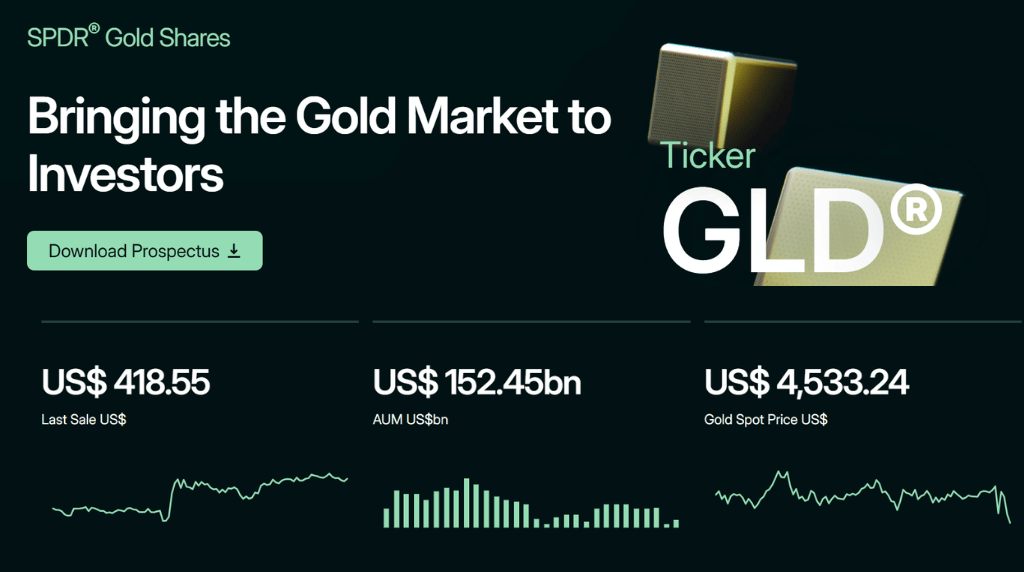
For example, SPDR Gold Shares listed a 0.40% gross expense ratio as of May 20262. That cost looks small, but it still creates a compounding drag if the position is held for multiple years.
What Is a Gold Mining ETF?
A gold mining ETF holds shares of companies involved in gold mining, processing, royalty streams, or related production activity. Readers should take note that a gold mining ETF is a gold equity ETF, not a bullion proxy.
The VanEck Gold Miners ETF (GDX) is one widely followed example. As of 18 May 2026, this gold miners ETF has a total net asset value above USD26 billion and a 0.51% gross expense ratio3.

Gold stocks ETFs can rise when bullion rallies, but miners still have to execute on the ground. Costs, mine grades, corporate debt, tax regimes, environmental permits, labour issues, and management decisions all sit directly between the spot gold price and the stock’s share price.
Pro Tip: It’s best not to treat a gold mining ETF as a clean gold-price tracker. Instead, look at it as an equity trade whose primary driver is the price of gold.
Gold ETFs vs. Gold Mining ETFs: 7 Key Differences at a Glance
The fastest way to compare gold ETFs vs. gold mining ETFs is to separate bullion exposure from equity exposure. Here are seven key differences that traders and investors should take note of:
| Factor | Gold ETFs | Gold Mining ETFs |
| Main Exposure | Physical gold bullion, gold futures, or gold-backed assets | Gold mining company shares |
| Asset Type | Commodity ETF | Equity ETF |
| Return Driver | Spot gold price, fund fees, and tracking quality | Spot gold price, production costs, corporate earnings, and equity market sentiment |
| Volatility | Usually lower than gold miner ETFs | Usually higher than physical gold ETFs |
| Dividends | Usually none for physical gold ETFs | Possible, depending on underlying corporate profitability |
| Main Risks | Gold price risk, tracking error, and custody/counterparty structure | Gold price risk, company operational risk, jurisdictional risk, and equity market risk |
| Common Use Case | Direct gold price exposure and potential portfolio diversification | Higher-risk tactical equity exposure with built-in operational leverage |
Gold ETFs vs. Gold Mining ETFs: Which Tracks the Gold Price More Closely?
Physical gold ETFs, like GLD and IAU, usually track the gold price more closely because their purpose is narrower—the fund simply holds bullion or uses a direct derivative structure designed to mirror spot exposure after fees.
Gold mining ETFs move differently because mining companies carry operational leverage:
- If gold prices rise faster than production costs, corporate margins can expand.
- If operational costs rise faster than gold, the share price can lag even when bullion is firm.
The World Gold Council’s production-cost data tracks all-in sustaining cost (AISC), which aims to show the cost of keeping an existing mine in business, as well as all-in costs (AIC) to reflect long-term exploration and growth4. For a trader, that means miner exposure is partly an operational margin trade, not only a gold trade.
Liquidity also matters. A tight bid-ask spread can help reduce entry friction under normal market conditions, while weak liquidity or fast-moving markets can worsen execution prices and increase trading costs.
Which Is Riskier: Gold ETFs or Gold Mining ETFs?
Gold mining ETFs are generally riskier than physical gold ETFs because they layer equity risk on top of commodity risk. In a market drawdown, that second layer matters significantly.
A bullion ETF can still fall sharply if gold sells off. However, a gold miner ETF can fall because gold sells off, operational costs rise, production misses corporate guidance, financing conditions tightens, or broader equity markets de-rate the entire stock sector.
The main risks for gold mining ETFs usually sit in five distinct categories:
- Operating Risk: Gold mines can face unexpected operational shutdowns, lower ore grades, major equipment failures, and local labour disputes.
- Cost Risk: Surging energy prices, rising wages, and expensive equipment or financing costs can squeeze corporate profit margins.
- Jurisdiction Risk: Local permit delays, unexpected royalty hikes, windfall taxes, and hostile political decisions can negatively rewrite a project’s economics.
- Balance-Sheet Risk: Heavy corporate debt loads can become harder to service when production output disappoints or interest rates rise.
- Market Risk: Regardless of the underlying gold price, mining stocks will trade like traditional equities when global market risk appetite breaks down.
Do Gold Mining ETFs Pay Dividends?
Physical gold ETFs usually don’t pay dividends because gold is a tangible commodity that does not generate underlying cash flow. Gold mining ETFs, however, may distribute regular dividends if their underlying corporate stock holdings pay them.
That said, dividend yield should not be the main reason to trade a gold equity ETF. Interested traders and investors should always bear in mind that mining operations frequently cut or suspend distributions when operational costs spike, production misses guidance, or corporate management chooses to preserve cash for capital exploration projects and debt reduction5.
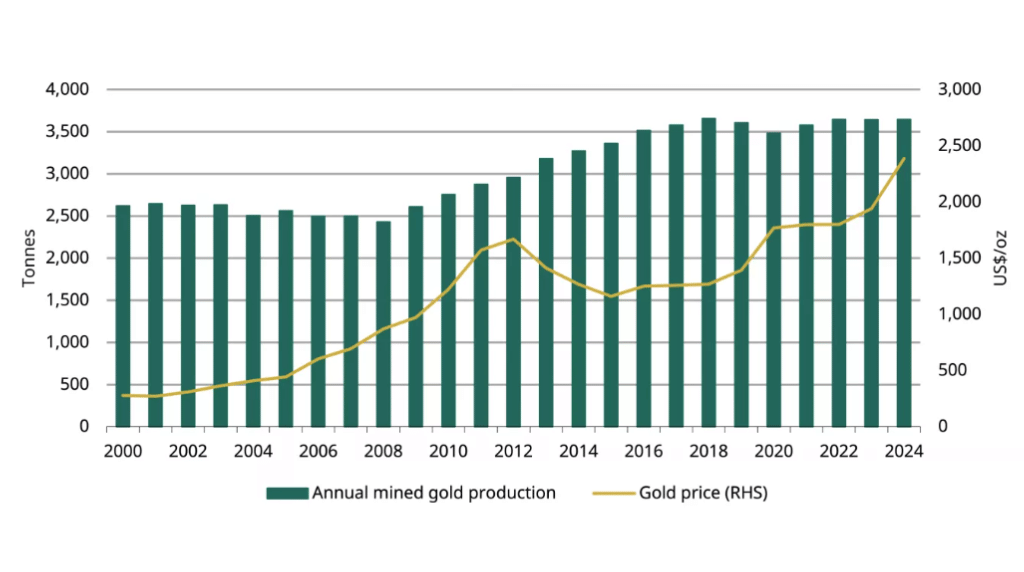
What’s more, global gold production responds slowly to price fluctuations. The World Gold Council reported that full-year 2024 mine production reached 3,661 tonnes6, just around previous cyclical highs, while year-over-year production growth across recent quarters remained tightly bottlenecked7.
What About Gold Leveraged ETFs?
A gold leveraged ETF uses financial derivatives and daily reset mechanics to target a specific multiple of short-term gold or gold-index performance. That multiple can work dramatically both ways.
The U.S. Securities and Exchange Commission (SEC) warns that because most leveraged and inverse ETFs reset their exposure daily, returns over weeks, months, or years can differ significantly from the stated multiple8. The practical implication is clear: time and choppy volatility can erode the trade capital even if the broad, long-term direction looks right.
A 2x product is not just “more gold”. If the market chops sideways, compounding math can leave your position heavily underwater even when the underlying price ends near where it started.
Here’s a brief overview of gold ETFs vs. gold mining ETFs vs. leveraged gold ETFs:
| ETF Type | What It Tracks | Risk Level | Commonly Used For | Key Things to Look Out For |
| Physical Gold ETF | Spot gold prices or physical bullion exposure | Moderate | Direct gold exposure and portfolio diversification | Management fees, tracking error, and custody/vaulting structure |
| Gold Mining ETF | Publicly traded gold mining stocks | High | Equity-linked gold exposure | Company operational risk, cost inflation, and sector volatility |
| Leveraged Gold ETF | A multiple of daily gold index price action (e.g., 2x or 3x) | Very high | Short-term tactical or momentum trades | Daily reset mechanics, volatility decay from compounding, and amplified losses |
In essence, leveraged gold ETFs require tight position sizing, strict stop levels, and continuous, active monitoring. As such, they may not be suitable for every trader and investor.
Related Article: CFD Trading vs. ETF Trading explains the ownership, leverage, and holding-cost differences between ETF positions and CFD positions.
When Might a Gold ETF Be More Suitable?
A gold ETF might be more suitable for traders or investors who want more direct gold price exposure without taking on miner-specific execution risks.
However, that does not make it a low-risk position. Gold can gap aggressively on inflation data prints, central bank policy decisions, shifts in real yields, and major dollar moves. Traders using gold exposure should always clearly define position size, invalidation levels, and risk management techniques before entering.
Pro Tip: For readers who want specific product examples rather than an overview of asset structures, check out Vantage Markets’ guide to the best gold ETFs.
When Might a Gold Mining ETF Be More Suitable?
A gold mining ETF might better suit traders and investors who want higher-risk equity exposure linked to gold producers rather than a close tracking mechanism for physical bullion.
The core upside case here is operating leverage, which can amplify both gains and losses relative to movements in the underlying gold price. Because mining companies operate with heavy, fixed business costs (like machinery and leases), their financial margins can rapidly expand if gold prices rise while business expenses stay flat. This could enable company earnings—and stock prices—to increase significantly faster than the price of the actual metal. However, that amplification works in reverse just as quickly: If gold prices drop, those fixed corporate expenses do not vanish, which can quickly crush a miner’s profitability.
S&P Dow Jones Indices describes the S&P/TSX Global Gold Index as an investable index of global gold securities, explicitly tracking companies that mine or process gold9. That framing matters because it reminds traders that miners are corporate securities first, and gold exposure assets second.

How to Compare Gold ETFs and Gold Mining ETFs Before Trading
Before trading gold ETFs vs. gold mining ETFs, always compare the fund’s underlying structure first and the recent price chart second. A strong momentum chart can potentially disguise the wrong structural exposure. Here’s a core checklist for things to look out for when analysing a fund:
- Underlying Holdings: Check whether the fund holds physical bullion, futures contracts, large-cap miners (like Newmont or Barrick Gold), juniors (like Sprott Gold Miners ETF/SGDM), or mixed exposure.
- Expense Ratio: Higher ongoing management costs raise the profitability hurdle, making them relevant for longer holding periods.
- Asset Under Management (AUM) And Liquidity: Larger, more liquid funds with higher AUM might offer tighter bid-ask spreads and cleaner exits.
- Tracking Method: Confirm whether the product achieves its exposure through physical vault backing, derivative contracts, or an underlying equity index.
- Volatility: Compare historical drawdowns, equity beta, and how the specific ETF historically behaves during broad market sell-offs.
- Dividend Policy: Note that yield distributions are relevant mainly for gold mining ETFs, not physical bullion products.
- Time Horizon: Clearly separate long-term strategic asset allocation from short-term, tactical swing trading.
- Leverage: Do not confuse standard underlying ETFs, daily-reset leveraged ETFs, and leveraged CFD derivatives.
Pro Tip: Always practice risk management with full understanding. For instance, a stop-loss order can help define your exit level, but it does not guarantee a fill at that exact price in fast-moving, gapping markets.
Can You Trade Gold ETF CFDs with Vantage Markets?
With Vantage, eligible clients may trade ETF CFDs, which allow one to speculate on gold price movements without owning the underlying fund shares or any physical gold.
Take note that this is different from buying an ETF on a centralised stock exchange. As CFDs are leveraged derivatives, always keep in mind that they exhibit a double-edged risk profile as leverage can amplify both account gains and losses.
Vantage’s CFD trading versus ETF trading guide noted that CFDs are short-term, leveraged derivative instruments, while conventional ETFs are exchange-traded funds designed to track a specific benchmark index, sector, or asset class. The practical takeaway is that the product structure ultimately determines one’s asset ownership, funding costs, and overall risk exposure.
Traders can use Vantage’s economic calendar and free market analysis resources to monitor macroeconomic events that could potentially impact gold spot prices, mining operations, real yields, and broader risk appetite. Eligible clients interested in ETF CFD trading can learn more about Vantage’s trading products and platform features.
Gold ETFs vs. Gold Mining ETFs: Which Is Better? Here’s the Real Answer
Neither gold ETFs nor gold mining ETFs are automatically better.
- Physical gold ETFs are typically a better fit for more direct bullion exposure, while gold mining ETFs might suit traders keen on higher-risk equity exposure tied to corporate earnings and market sentiment.
- For direct gold exposure, the physical ETF structure is usually easier to understand. For potential equity upside, gold miners ETFs can offer more operational torque—but they can also punish poor market timing just as quickly.
- For short-term, aggressive views, leveraged gold ETFs and ETF CFDs require tighter risk control. Positions can move against you rapidly, especially when market liquidity thins, spreads widen, or intraday volatility jumps.
As such, the best gold ETF or gold miner ETF is not the one with the strongest recent return. Instead, it’s the one whose underlying structure, operational cost, volatility profile, and time horizon align with your specific trade plan.
Frequently Asked Questions (FAQ)
Are Gold ETFs And Gold Mining ETFs The Same?
No. Gold ETFs are designed to track physical bullion or spot gold prices, while gold mining ETFs hold equity shares of publicly traded companies involved in the gold mining industry. This distinction makes miner ETFs more sensitive to corporate earnings, operational costs, and general market sentiment. The difference between gold ETFs and gold mining ETFs shows up clearly when the spot price of gold rises, but mining stocks lag behind because individual operators fail to control their production expenses.
Is A Gold Mining ETF A Gold Equity ETF?
Yes. A gold mining ETF is a gold equity ETF because it holds shares of corporate businesses rather than physical, vaulted bullion. Depending on the specific index the fund tracks, it may include large-cap producers, royalty companies, streaming corporations, or speculative junior explorers. This equity structure means that on-the-ground company execution matters just as much as the global price of the metal.
Are Gold Stocks ETFs Riskier Than Gold ETFs?
Generally, yes. Gold stocks ETFs add company, operating, financing, and equity-market risk directly on top of gold price risk. They can move with much more velocity than physical gold in both directions, particularly when the broader market moves to reprice mining company profit margins.
What Is a Gold Leveraged ETF?
A gold leveraged ETF targets a specific multiple of short-term gold or gold-index price movement, usually through complex financial derivatives. Many leveraged ETFs reset their exposure daily, which can make longer holding periods behave vastly differently from the fund’s headline multiple. The primary risk is not just directional; it’s also highly sensitive to time, market volatility, and compounding decay.
What Is the Best Gold ETF?
A suitable gold ETF depends on the specific market exposure you’re interested in. A physical gold ETF may suit traders seeking more direct bullion exposure, while a gold mining ETF may suit higher-risk equity exposure. For more information, check out Vantage Markets’ guide to the “10 Best Gold ETFs for Global Investors in 2026“.
Can Gold Mining ETFs Outperform Gold?
Yes, but not reliably. Miners can significantly outperform when the price of gold rises and operational costs stay controlled, because their business margins can potentially expand much faster than underlying bullion. However, they can just as easily underperform when operational costs rise, production output disappoints, or broader equity markets sell off.
References
1. “Gold ETF Flows: April 2026 – World Gold Council” https://www.gold.org/goldhub/data/global-gold-backed-etf-holdings-and-flows. Accessed on 28 May 2026.
2. “Bringing the Gold Market to Investors – SPDR® Gold Shares” https://www.spdrgoldshares.com/usa/gld/. Accessed on 28 May 2026.
3. “GDX | VanEck Gold Miners ETF – VanEck” https://www.vaneck.com/us/en/investments/gold-miners-etf-gdx/overview/. Accessed on 28 May 2026.
4. “All-in sustaining costs and all-in costs – World Gold Council” https://www.gold.org/about-gold/gold-supply/responsible-gold/all-in-costs. Accessed on 28 May 2026.
5. “Mining giants squeeze dividends with an eye toward funding growth – Reuters” https://www.reuters.com/business/mining-giants-squeeze-dividends-with-an-eye-toward-funding-growth-2025-08-07/. Accessed on 28 May 2026.
6. “Gold Demand Trends: Full Year 2024 – World Gold Council” https://www.gold.org/goldhub/research/gold-demand-trends/gold-demand-trends-full-year-2024. Accessed on 28 May 2026.
7. “You asked, we answered: Is mined gold production peaking? – World Gold Council” https://www.gold.org/goldhub/gold-focus/2026/01/you-asked-we-answered-mined-gold-production-peaking. Accessed on 28 May 2026.
8. “Updated Investor Bulletin: Leveraged and Inverse ETFs – Investor.gov U.S. Securities and Exchange Commission” https://www.investor.gov/introduction-investing/general-resources/news-alerts/alerts-bulletins/investor-alerts/sec. Accessed on 28 May 2026.
9. “S&P/TSX Global Gold Index Overview – S&P Global” https://www.spglobal.com/spdji/en/indices/equity/sp-tsx-global-gold-index/#overview. Accessed on 28 May 2026.
RISK WARNING: CFDs are complex financial instruments and carry a high risk of losing money rapidly due to leverage. You should ensure you fully understand the risks involved and carefully consider whether you can afford to take the high risk of losing your money before trading.
Disclaimer: The information is provided for educational purposes only and doesn’t take into account your personal objectives, financial circumstances, or needs. It does not constitute investment advice. We encourage you to seek independent advice if necessary. The information has not been prepared in accordance with legal requirements designed to promote the independence of investment research. No representation or warranty is given as to the accuracy or completeness of any information contained within. This material may contain historical or past performance figures and should not be relied on. Furthermore estimates, forward-looking statements, and forecasts cannot be guaranteed. The information on this site and the products and services offered are not intended for distribution to any person in any country or jurisdiction where such distribution or use would be contrary to local law or regulation.