


[DAILY TRADING] Nikkei 225 Analysis 16 June 2026 – Index Breaches 70,000 as BoJ Hikes Rates to 1%

Vantage Editorial Team >
Vantage Editorial Team >
Vantage is a global, multi-asset broker with a team of in-house writers and market analysts who produce educational and insightful trading content for traders of all levels.
 Updated Tue, 2026 June 16 09:01
![[DAILY TRADING] Nikkei 225 Analysis 16 June 2026 – Index Breaches 70,000 as BoJ Hikes Rates to 1%](https://www.vantagemarketsea.com/wp-content/uploads/2026/06/nikkei225_hero_2026-06-09.webp)
The Nikkei 225 index crossed 70,000 for the first time in history on 16 June 2026, with investors reacting to two major developments: the Bank of Japan (BoJ) hiked its policy rate to 1.00%, and a US-Iran interim agreement moved to ease tensions in the Middle East. The Vantage Nikkei 225 CFD was trading near 69,714 as of 07:58 UTC (15:58 GMT+8), having hit a session high of 69,747.
All prices reference the Vantage Nikkei 225 CFD. This is not financial advice.
Key points
- The Nikkei 225 index hit 70,000 intraday on 16 June 2026, a first in the index’s history, after closing at 69,317.50 on 15 June 2026 (+4.99%).[1]
- The BoJ raised its policy rate by 25 basis points to 1.00% on 16 June 2026, the highest since September 1995, in a 7-1 vote.[2]
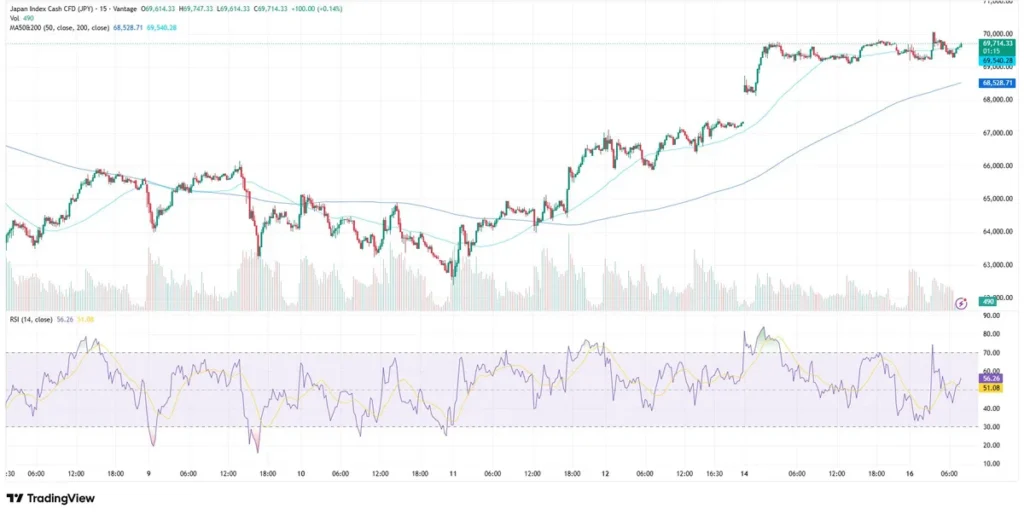
- On the TradingView setup used for this analysis, the 15-period MA sits at 68,528.71, the 200-period MA at 69,540.28, and the RSI reads 56.26 (fast) / 51.08 (signal) as of 07:58 UTC on 16 June 2026.
Nikkei 225 chart: what the 15-minute setup shows
The 15-minute Vantage Nikkei 225 CFD chart shows a sharp dip to the 63,000-64,000 area on 11 June 2026, followed by a consistent run of higher lows through 12 to 15 June 2026. The 50-period MA at 68,528.71 acted as dynamic support throughout the recovery, while the 200-period MA at 69,540.28 was the level the index decisively crossed on 15 June 2026 and has consolidated around in early trading on 16 June.
The RSI on the TradingView setup used for this analysis reads 56.26 and 51.08 on the two lines as of 07:58 UTC – mid-range, clear of the overbought zone above 70 that the indicator touched briefly on 12-13 June 2026.
Two developments behind today’s Nikkei 225 record
BoJ raises rates to 1.00%: the highest in 31 years
The BoJ concluded its 15-16 June policy meeting by raising rates from 0.75% to 1.00%, the first time at this level since September 1995.[2] Board member Toichiro Asada dissented, citing greater downside risks to production and employment. CNBC reported the BoJ noted that consumer inflation had been held below 2% partly due to government measures reducing household energy costs, while the board’s statement indicated underlying inflation could still accelerate above the 2% target.
Despite the rate increase, the Nikkei 225 index gained on the announcement. The move had been widely anticipated, and Japanese bank stocks in particular have tracked the normalisation cycle as rising rates widen net interest margins. The yen strengthened marginally to 160.22 against the dollar following the decision.[3]
US-Iran deal: an energy cost relief story for Japan
The US and Iran confirmed an interim peace agreement over the weekend of 14-15 June, with the formal signing set for 19 June 2026 in Switzerland.[4] Markets have interpreted the agreement as potentially supportive for energy supply stability. Japan imports a significant share of its crude from the Middle East, so any sustained easing of shipping disruptions could reduce pressure on the country’s energy import costs if supply conditions continue to improve.
The Japan Times reported the Nikkei 225 took less than two months to climb from 60,000 (first breached on 23 April) to 70,000.[1] The 15 June rally of 4.99% saw broad-based gains across sectors, not limited to the AI and semiconductor stocks that have led the index’s 30%-plus year-to-date advance. Learn how to start trading indices here.
Key Nikkei 225 levels to watch
| Level / Zone | JPY | Context |
| Psychological resistance / milestone | 70,000 | First-ever intraday breach, 16 June 2026 |
| Session high (16 June) | 69,747 | As of 07:58 UTC, Vantage Nikkei 225 CFD |
| 200-period MA (15-min) | 69,540.28 | TradingView setup used for this analysis |
| Previous close | 69,317.50 | 15 June 2026, up 4.99% |
| 15-period MA (15-min) | 68,528.71 | Dynamic support on current rally |
| Mid-June low | ~63,000 | Intraday dip, 11 June 2026 |
Table 1: Vantage Nikkei 225 CFD reference levels as of 16 June 2026, 07:58 UTC. Sources: TradingView, CNBC, The Japan Times. Indicative only.
What to watch
- US-Iran signing ceremony, 19 June 2026: The full deal text is not yet public. Any revision to terms could reprice geopolitical risk quickly across the Nikkei 225 and yen.
- BoJ press conference, 16 June 2026: Deputy Governor Shinichi Uchida holds the post-meeting briefing in place of Governor Kazuo Ueda.[5] Commentary on the pace of further rate normalisation will move yen pairs and the index.
- Japan CPI, Next release: The BoJ’s own statement flags inflation may exceed 2%. A stronger-than-expected print raises the probability of another hike later in 2026.
The Vantage Nikkei 225 CFD moved over 6,000 points in under two weeks. Intraday range assumptions have widened significantly around this sequence of BoJ policy and geopolitical developments. The 200-period MA at 69,540.28 and the 15-period MA at 68,528.71 are the key reference zones in the current structure. Reviewing Stop Loss placement relative to those levels is relevant, particularly ahead of the peace deal signing on 19 June.
Leverage amplifies both gains and losses; on a headline-driven index, that double-edged nature is especially relevant. Revisiting position sizing relative to account equity before the 19 June signing is worth considering.

RISK WARNING: CFDs are complex financial instruments and carry a high risk of losing money rapidly due to leverage. You should ensure you fully understand the risks involved and carefully consider whether you can afford to take the high risk of losing your money before trading.
Disclaimer: The information is provided for educational purposes only and doesn’t take into account your personal objectives, financial circumstances, or needs. It does not constitute investment advice. We encourage you to seek independent advice if necessary. The information has not been prepared in accordance with legal requirements designed to promote the independence of investment research. No representation or warranty is given as to the accuracy or completeness of any information contained within. This material may contain historical or past performance figures and should not be relied on. Furthermore estimates, forward-looking statements, and forecasts cannot be guaranteed. The information on this site and the products and services offered are not intended for distribution to any person in any country or jurisdiction where such distribution or use would be contrary to local law or regulation.
References
[1] “Nikkei 225 breaks 70,000 on hopes for peace and a stable supply of oil – The Japan Times” https://www.japantimes.co.jp/business/2026/06/16/markets/nikkei-70000-first-time-june/ Accessed on 16 June 2026.
[2] “Bank of Japan hikes rates to 1%, highest since 1995 – CNBC” https://www.cnbc.com/2026/06/16/boj-rate-hike-historic-inflation.html Accessed on 16 June 2026.
[3] “BOJ hikes rates to highest level since 1995 – Nikkei Asia” https://asia.nikkei.com/economy/bank-of-japan/boj-hikes-rates-to-highest-level-since-1995 Accessed on 16 June 2026.
[4] “US and Iran reach deal to end the Mideast war – CNBC” https://www.cnbc.com/2026/06/14/us-iran-war-peace-deal.html Accessed on 16 June 2026.
[5] “Japanese Yen gives up some gains as BoJ hikes rates by 25 bps to 1%, focus on Uchida press conference – FXStreet” https://www.fxstreet.com/news/japanese-yen-gives-up-some-gains-as-boj-hikes-interest-rates-by-25-bps-to-1-as-expected-202606160329 Accessed on 16 June 2026.