


 Updated
Bank stocks remain central to equity markets because banks sit at the core of the financial system. They lend to households and businesses, facilitate payments, support capital markets, and influence credit conditions across the economy. As a result, their earnings tend to respond quickly to shifts in interest rates, economic growth, and market sentiment.
Heading into 2026, the banking sector is entering a transition phase. After a period defined by aggressive rate hikes and inflation volatility, central banks have largely shifted towards stabilisation, with some regions beginning gradual easing. This shift alters the earnings backdrop for banks, particularly as net interest margins, loan growth, and capital markets activity adjust to more balanced conditions.
At the same time, structural forces are reshaping the industry. The implementation of Basel III/3.1 standards, increasing regulatory clarity around digital assets, and accelerating artificial intelligence (AI) adoption are influencing business models and competitive positioning.
Taken together, these factors make 2026 an important year for understanding how different banking institutions may be positioned within a changing macro and regulatory environment.
This article discusses publicly listed banking institutions for general market understanding. Traders may gain exposure to bank share price movements through derivative products such as CFDs, where available.
Key Points
- Bank stocks remain a key focus in 2026 as interest rate normalisation, regulation, and uneven growth shape sector dynamics.
- Large US banks differ in positioning, with outcomes shaped by business mix, balance sheet strength, technology investment, and exposure to capital markets activity.
- Differences in fundamentals, rather than headlines, may influence how individual banks perform.
What are Bank Stocks and Why Do They Matter?
Bank stocks are shares in publicly listed banking institutions, providing exposure to lending activity, capital markets operations, and broader economic conditions. Because banks sit at the centre of the financial system, their earnings often move in response to interest rate changes, credit demand, and market sentiment.
Banks play a fundamental role in the economy. They provide mortgages and consumer loans, extend credit to businesses, finance mergers and acquisitions, and support payment systems. As a result, trends in bank performance can reflect shifts in economic momentum before they become visible in other sectors.
Banking institutions generally fall into three categories:
- Retail Banks: Focus on consumer banking services such as deposits, mortgages, and personal loans.
- Investment Banks: Specialise in trading, underwriting, and advisory services.
- Diversified Banks: Operate across consumer, corporate, and capital markets businesses.
Given their systemic importance, banks are subject to strict capital requirements, stress testing, and regulatory oversight. These safeguards aim to support financial stability while shaping how banks manage risk and allocate capital.
1. JP Morgan Chase
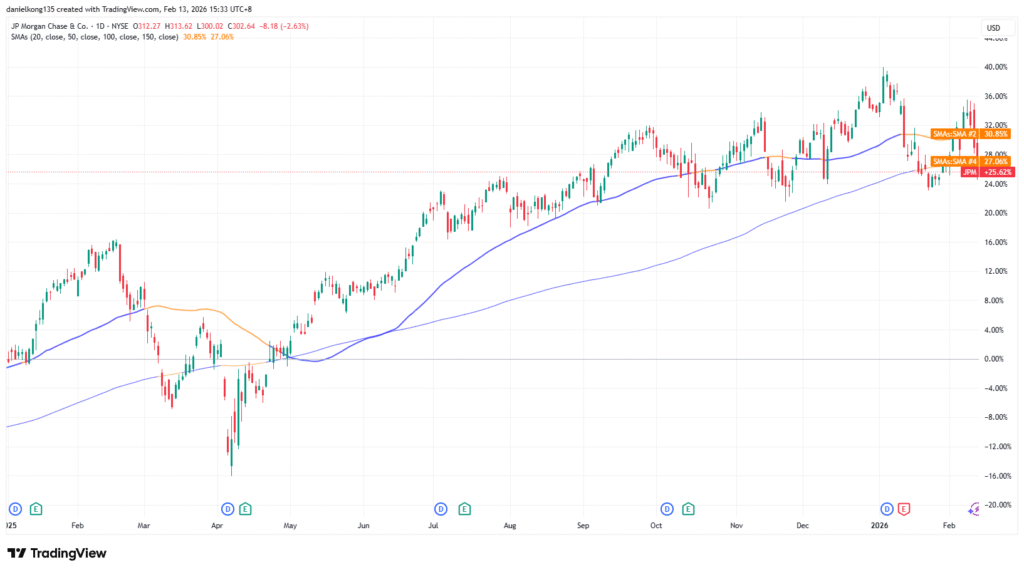
Chart 1: JP Morgan daily stock price from January 2025 to Feb 2026. Source: https://www.tradingview.com/x/hwPRob6W/
JPMorgan Chase & Co. is a leading US bank holding company and global financial services firm headquartered in New York City. It is among the world’s largest banks by assets and market capitalization, offering services in investment banking, commercial banking, asset management, and financial transaction processing.
As of 31 March 2025, the investment bank has a total of USD3.7 trillion in assets under service (AUS) [1]. This is distributed across asset classes including equity, money market, fixed income, multi-asset solutions and alternatives. The stock trades under the ticker symbol JPM.
Technical Analysis for 2025
The screenshot above shows the price chart for JPM from January 2025. Overlaid are the 50-day and 200-day moving averages.
Technical analysis reflects historical price behaviour and does not predict future performance.
In 2025, there was a strong upward trend punctuated by periods of consolidation, reflecting resilience despite shifting rate expectations. During this period, it could be seen that the stock respected its long-term moving averages, with pullbacks finding support at prior breakout levels.
During the second half of the year, the stock recorded higher highs and higher lows, reflecting consistent trading activity. While there was declining volatility toward the year-end, this may reflect market positioning, though technical patterns do not guarantee future outcomes.
Factors Influencing JPMorgan Chase in 2026
With over USD3 trillion in assets distributed across multiple asset classes, JPMorgan Chase’s scale and diversification shape how it responds to shifts in interest rates and broader market conditions. Its operations span consumer banking, corporate lending, asset management, and capital markets, providing exposure to different revenue drivers within the banking sector.
The bank has also invested heavily in enterprise artificial intelligence (AI). In 2025, JPMorgan ranked first on the Evident AI Index for the fourth consecutive year, reflecting continued integration of AI across its business lines [2]. Over time, technology investment may influence operating efficiency, risk management processes, and client engagement, making it a structural theme to monitor heading into 2026.
Key themes for JP Morgan in 2026 [3]
- Prolonged rate normalisation and market volatility
With the Federal Reserve expected to remain in slow rate normalisation mode, interest rate volatility is likely to persist into 2026. This environment favours large, well-diversified banks with strong balance sheet management. For JP Morgan, modest pressure on net interest margins may be offset by opportunities in trading, hedging, and client advisory activity during periods of rate-driven market swings.
- Structural strength over cyclical growth
While overall economic momentum remains uneven, JP Morgan is positioned to benefit from structural rather than cyclical drivers. Its scale in payments, technology investment, and long-term corporate relationships supports earnings even if loan growth remains moderate. Analysts note that this may reduce reliance on sharp economic acceleration for results.
- Balance sheet quality and income resilience
In a market where investors are increasingly focused on income and capital preservation, JP Morgan’s strong capital base is a key advantage. The bank’s exposure to high-quality corporate and consumer borrowers supports consistent earnings, dividends, and share buybacks, reinforcing its appeal as a core holding in a more complex investment environment.
2. Bank of America
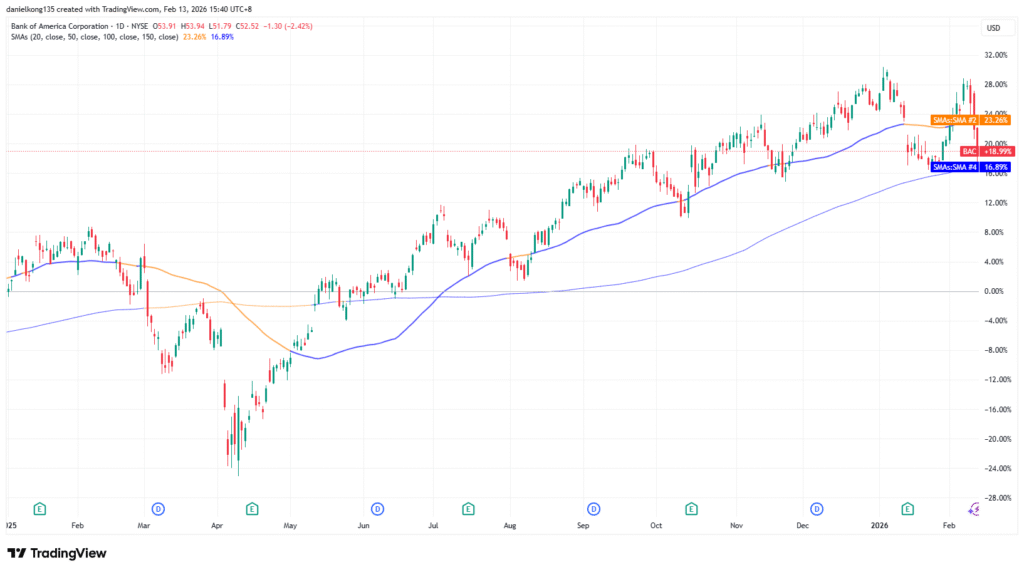
Chart 2: Bank of America daily stock price from January 2025 to Feb 2026. Source: https://www.tradingview.com/x/teBKvAcF/
Bank of America is one of the world’s largest retail and investment banks, providing a broad spectrum of financial services to consumers, small businesses, corporations, and governments. Headquartered in Charlotte, North Carolina, it serves about 70 million US clients and operates in more than 35 countries. Its scale and digital innovation make it a cornerstone of global banking and wealth management.
As of 14 January 2026, Bank of America reported managing approximately USD4.8 trillion in client balances across its wealth management businesses [4]. Its stock trades under the ticker symbol BAC.
Technical Analysis for 2025
The screenshot above shows the stock price performance of BAC in the past 12 months. As shown, price charted a similar pattern to JPM’s; this is not surprising considering Bank of America’s leading status in the US financials sector.
However, BAC is more volatile in comparison, with choppier price action. The 50-day moving average (in light blue) also crossed and briefly stayed under the 200-day moving average in the middle of the year, suggesting slackened confidence.
2025 saw the stock remain largely range-bound before an upward move in Q3, followed by a pullback at the start of 2026. These price movements illustrate historical volatility rather than future performance.
Factors Influencing Bank of America in 2026
Bank of America’s earnings profile remains closely linked to trends in deposit costs and consumer credit demand. In 2025, the bank reported net interest income (NII) growth of 7% year-on-year, reflecting the spread between what it earns on loans and what it pays on deposits [5]. Management has indicated expectations for NII growth of 5% to 7% for FY2026, highlighting the continued importance of interest rate dynamics and funding costs in shaping performance.
Loan growth has also been a notable development. Average loans increased by approximately 8% year-on-year in 2025, suggesting steady credit demand from both consumers and businesses [6]. Whether this momentum persists will depend on broader economic conditions, borrowing appetite, and credit quality trends. As a result, deposit stability, loan growth, and funding costs remain key variables to monitor heading into 2026.
Key Themes for Bank of America in 2026
- Scale and deposit franchise as a strategic advantage
Bank of America enters 2026 with one of the largest and most diversified deposit franchises in the United States. The bank serves tens of millions of consumer and small business clients and operates one of the largest domestic deposit bases – a key factor during a period of rate normalisation. The bank’s deposit base is expected to help stabilise funding costs as interest rates fluctuate, supporting net interest income and balance sheet resilience. For investors, this illustrates how the bank’s earnings may be influenced by changes in interest rate conditions.
- Digital banking and operating efficiency
Digital adoption is a defining structural theme for Bank of America heading into 2026. The bank highlights extensive use of digital platforms across consumer and small business banking, with a large majority of clients engaging through digital channels. This ongoing shift supports lower operating costs, better customer retention, and improved scalability. Additionally, efficiency gains from digital banking helps buffer against margin pressure, sustaining profitability without relying solely on loan growth.
- Diversification across consumer, corporate, and markets
Bank of America’s business mix spans consumer banking, wealth management, corporate banking, and global markets. This diversification is a key theme for 2026, especially given the risk of uneven economic momentum. Consumer banking provides scale and recurring revenue, corporate and commercial banking benefit from resilient US business activity, and markets-related businesses offer upside during periods of volatility. Together, this diversified model positions Bank of America to generate earnings across a range of economic outcomes rather than relying on a single growth driver.
3. Morgan Stanley
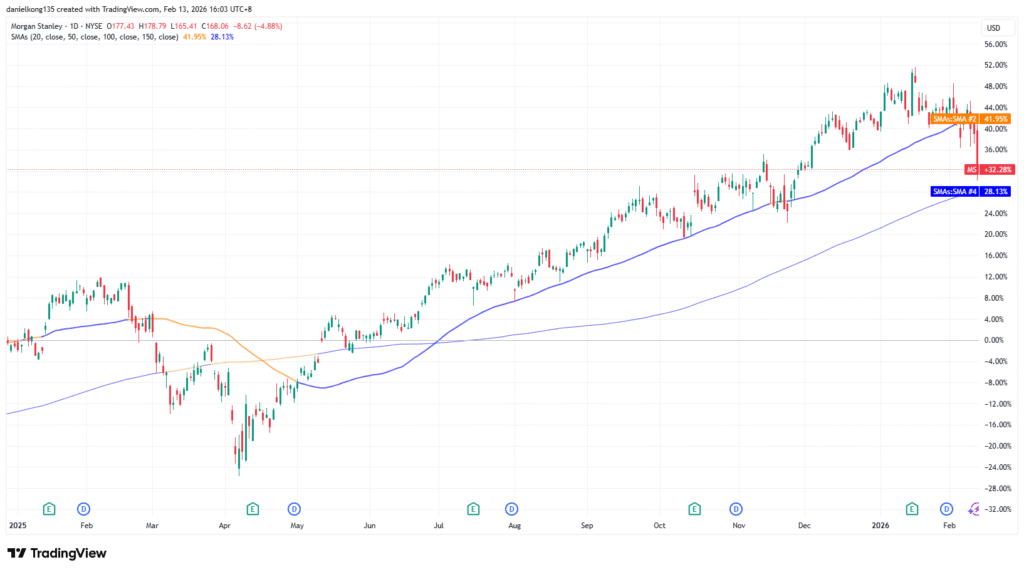
Chart 3: Morgan Stanley daily stock price from January 2025 to Feb 2026. Source: https://www.tradingview.com/x/ZVRe6VcZ/
Founded by Henry S. Morgan and Harold Stanley following the restructuring of J.P. Morgan & Co. to comply with banking reforms, Morgan Stanley quickly rose to become one of the largest investment banks in the United States. Headquartered in New York, the firm maintains major offices in financial centers including London, Hong Kong, Tokyo, and Singapore.
Morgan Stanley operates three main business segments. Its Institutional Securities arm provides investment banking, trading, research, and lending for corporations and governments. Meanwhile, its Wealth Management business offers advisory and financial planning for individuals and smaller institutions, bolstered by acquisitions such as E*TRADE (2020). Finally, its Investment Management unit provides asset management across equities, fixed income, and alternatives. In 2021, this unit was strengthened by the purchase of Eaton Vance.
As of Jan 2026, Morgan Stanley has achieved total assets under management of USD9.3 trillion, closing in on its USD10 trillion goal. This was driven by an increase in AUM to USD1.9 trillion in Morgan Stanley Investment Management in Q4 2025 [7,8].
Technical Analysis for 2025
Morgan Stanley’s stock price succumbed to investor uncertainty in the initial months of 2025, plunging to its lowest point in early April.
The decline reversed shortly after, with the stock showing steady growth from May 2025 onwards, indicating improving market performance during this period. In the second half of the year, the stock traced a near-perfect trajectory, convincingly breaking key resistance levels all along the way.
Notably, MS did not experience the same pullback as some peers at the start of 2026, while remaining sensitive to market volatility.
Factors Influencing Morgan Stanley in 2026
Morgan Stanley’s business model is more heavily weighted towards capital markets and wealth management than traditional retail lending. As a result, its performance is closely linked to trends in deal activity, asset management inflows, and investor engagement across global markets.
Periods of stabilising interest rates and improving corporate confidence can influence equity issuance, debt refinancing, and mergers and acquisitions, which in turn affect advisory and underwriting revenues. This makes capital markets activity an important driver for the firm.
Wealth management remains another structural component of Morgan Stanley’s earnings mix. The firm generates recurring fee income from managing client assets, which can help moderate earnings variability across market cycles. Asset prices, net new inflows, and client activity levels are therefore key indicators to monitor.
In addition, trading and institutional activity tend to respond to shifts in market volatility. While extreme volatility can dampen sentiment, moderate fluctuations often increase hedging, repositioning, and liquidity demand, influencing trading revenues within the firm’s global markets division.
Key themes for Morgan Stanley in 2026
- Broadening global growth and capital flows
Morgan Stanley expects the 2026 macro environment to be shaped by a broader set of economic, geopolitical, and monetary drivers than in recent years. Rather than growth being concentrated in a small number of regions or sectors, opportunities are expected to emerge across multiple geographies and asset classes. Shifts in real interest rates, currency trends, and policy regimes are likely to influence where capital flows and how portfolios are constructed.
For Morgan Stanley, this environment plays to its strengths in global advisory, asset allocation, and cross-border capital markets activity. As investors seek diversification and reassess regional exposures, demand for research, wealth management advice, and institutional solutions may change depending on market conditions.
- Structural investment in technology and AI
Structural investment themes, particularly around artificial intelligence, remain a key driver heading into 2026. Morgan Stanley’s outlook highlights how AI adoption is expanding beyond the technology sector, improving productivity and reshaping business models across industries.
This trend supports multiple areas of Morgan Stanley’s business. Corporate investment in AI often leads to higher advisory activity, including mergers, capital raising, and strategic restructuring. At the same time, thematic investing linked to technology and innovation continues to attract client interest within wealth and asset management, supporting longer-term fee growth.
- Emerging markets and alternative asset demand
Another important theme for 2026 is the growing role of emerging markets and real assets in global portfolios. Morgan Stanley points to improving growth dynamics in parts of Asia and Latin America, driven by manufacturing, exports, and technology adoption, which help narrow the growth gap with developed markets.
Alongside this, investors are showing increased interest in real assets such as infrastructure, commodities, and private markets as they seek income and diversification. For Morgan Stanley, this creates opportunities across private wealth, institutional investing, and cross-border financing, reinforcing its positioning as a global platform rather than a purely US-centric investment bank.
4. Goldman Sachs
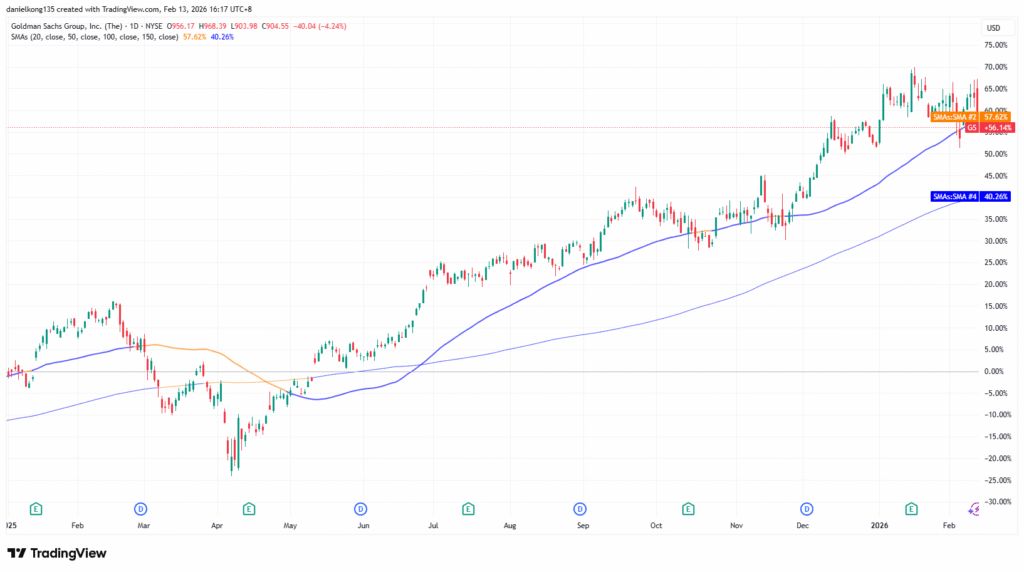
Chart 4: Goldman Sachs daily stock price from January 2025 to Feb 2026. Source: https://www.tradingview.com/x/z6nKYJvr/
A leading US multinational investment bank and financial services firm headquartered in New York City, Goldman Sachs Group, Inc was founded in 1869 – making it one of the oldest investment banks in the world.
The bank has weathered several market crashes and economic crises throughout its history. Even though many of its peers were irreparably damaged in the 2008 Great Financial Crisis, Goldman Sachs has kept its position as a global leader, and remains one of the world’s most influential institutions in global capital markets.
With a portfolio serving corporations, governments, and individuals through investment banking, securities trading, asset management, and consumer finance, Goldman Sachs has accrued USD 3.29 trillion in assets under supervision as at Jun 2025 [9]. The firm is headquartered in New York, but has offices around the world. Its stock trades under the ticker symbol GS.
Technical Analysis for 2025
Much like its peers, Goldman Sachs showed a strong uptrend throughout 2025 – but not before a pullback over the first few months of the year. Once the stock moved above its 50-day moving average (light blue line) in the second quarter, it remained largely supported above this level, signalling sustained upside momentum.
The 200-day moving average (dark blue line) trended steadily higher and was not meaningfully tested during the advance, confirming a healthy long-term trend for bullish stock watchers. In the second half of the year, the stock continued to post higher highs and higher lows, with pullbacks appearing controlled rather than trend-breaking.
Goldman Sachs ended 2025 with rising moving averages and prices above key support levels. This pattern continued into early 2026, based on historical chart data.
Factors Influencing Goldman Sachs in 2026
Goldman Sachs’ earnings profile is closely linked to global capital markets activity. Trends in mergers and acquisitions, equity issuance, debt refinancing, and institutional trading can materially influence its advisory and underwriting revenues. As interest rate expectations stabilise, corporate financing decisions and deal activity remain important variables for the firm.
Unlike retail-focused banks, Goldman generates a significant portion of its revenue from markets, trading, and risk management services. Periods of increased market dispersion and moderate volatility often influence client hedging, repositioning, and liquidity demand, which can affect trading volumes and engagement within its global markets division.
The firm’s asset and wealth management businesses provide an additional source of recurring, fee-based income alongside cyclical investment banking revenues. This diversified revenue mix means Goldman Sachs’ performance is shaped by a combination of capital markets conditions, institutional activity, and broader investor sentiment heading into 2026.
Key Themes for Goldman Sachs in 2026 [10]
- Staying active amid complexity and market dispersion
A central message of Goldman Sach’s 2026 outlook is that markets are entering a more complex and less predictable phase, shaped by shifting central bank paths, fiscal risks, geopolitics, and uneven economic momentum. Rather than a single dominant macro trend, the firm highlights greater dispersion across regions, sectors, and asset classes.
For Goldman Sachs, this environment may be associated with higher levels of capital markets activity. Increased dispersion typically drives higher client demand for trading, hedging, and advisory services as investors reposition portfolios and manage risk. Goldman’s strength in global markets and institutional trading positions it to benefit from periods of volatility and differentiated market outcomes rather than relying on a simple cyclical upswing.
- Revival of dealmaking and capital allocation
The firm identifies dealmaking as a key catalyst for 2026, supported by easing cycles, stabilising interest rates, and improving confidence among corporates and financial sponsors. After a subdued period, Goldman expects momentum to continue building in mergers and acquisitions, equity issuance, and private market transactions.
This theme directly underpins Goldman Sachs’ core investment banking franchise. A sustained recovery in deal activity supports advisory fees, underwriting revenue, and financing demand across both public and private markets. The report also notes that increased M&A activity could revive private equity and private credit flows, areas where Goldman plays a central structuring and distribution role.
- AI investment, innovation, and the search for returns
Artificial intelligence remains a dominant structural theme in the bank’s 2026 outlook, with AI-related capital expenditure continuing to exceed expectations. However, Goldman emphasises that investor focus is beginning to shift from the scale of AI investment to the returns generated from it.
For Goldman Sachs, this creates opportunities on multiple fronts. Corporate investment in AI drives advisory, financing, and capital markets activity, while growing scrutiny around returns increases demand for research, asset allocation, and differentiated investment strategies. At the same time, Goldman’s asset and wealth management businesses benefit from client interest in thematic investing linked to AI, innovation, and infrastructure supporting data and power demand.
5. SoFi Technology
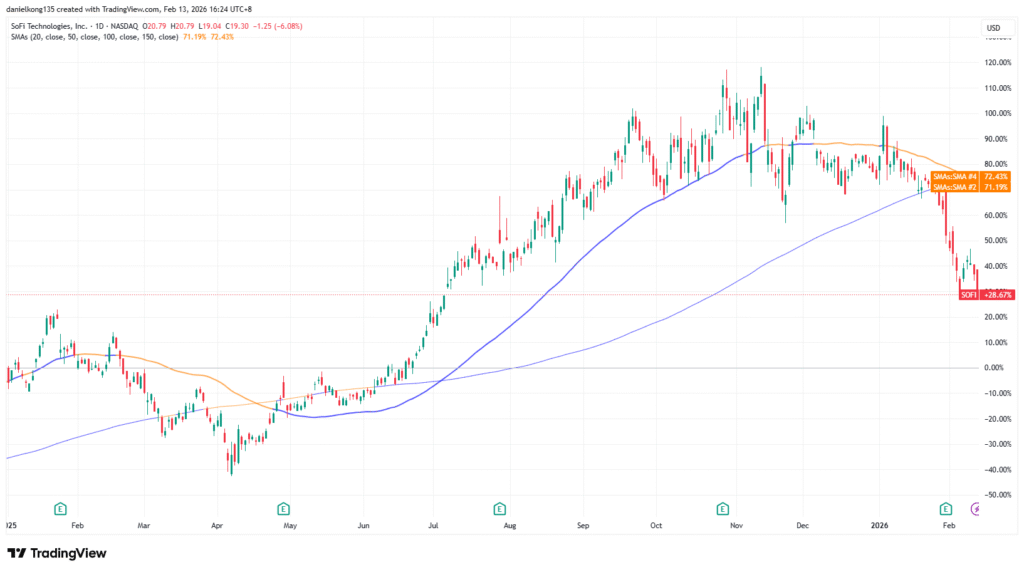
Chart 5: SoFi Technology daily stock price from January 2025 to Feb 2026. Source: https://www.tradingview.com/x/h4K7EHKR/
Founded in 2011, SoFi Technologies is a US-based digital financial services company that operates at the intersection of banking, lending, payments, and investing. Unlike traditional banks, SoFi was built as a mobile-first platform, targeting younger and digitally native customers with an integrated ecosystem of financial products.
While SoFi does not have the long operating history of legacy banks, it has rapidly expanded its footprint across personal loans, student loan refinancing, mortgages, checking and savings accounts, credit cards, investing, and financial planning tools. The company operates as a regulated bank holding company following its bank charter approval, allowing it to fund loans through customer deposits rather than relying solely on capital markets.
As of mid-2025, SoFi reported millions of members on its platform and continued growth in deposits, product adoption, and non-lending revenue streams. The company reported total customer numbers of approximately 12.6 million, a significant increase over the same period last year [11]. The stock trades under the ticker symbol SOFI.
Technical Analysis for 2025
SoFi’s share price displayed a clear shift in trend during 2025, moving from early-year weakness into a strong mid-year rally before consolidating into year-end. The stock initially sold off in the first quarter, but found a durable base around May, setting the stage for a sustained advance through the second-half of the year.
A key technical development was the stock reclaiming and holding above its 50-day moving average (light blue line) around mid-June. From that point onward, the 50-day moving average acted as dynamic support during pullbacks, signalling improving short- to medium-term momentum. The slope of the 50-day average turned decisively higher through the summer, confirming the strength of the uptrend.
The bullish momentum of the stock was further confirmed by the rising long-term average (as marked by the 200-day moving average, dark blue line), suggesting improving underlying trend strength and growing investor confidence. In the second half of 2025, SoFi transitioned from a strong rally into a consolidation phase above the 200-day average, indicating digestion of gains rather than a breakdown in structure.
Overall, SoFi ended 2025 with prices remaining above the 200-day moving average. While volatility was higher than that of large-cap banks, the historical chart indicated a sustained upward pattern. However, investors should watch for greater sensitivity to sentiment and earnings-driven swings.
Factors Influencing SoFi in 2026
SoFi’s business model differs from traditional banks, with a stronger focus on digital banking, online lending, payments, and investing services delivered through a mobile-first platform. This positions the company within the broader shift towards technology-led financial services rather than branch-based retail banking.
As interest rates stabilise and funding conditions evolve, the scalability of SoFi’s digital model remains a key area of focus. Deposit growth, cost of funding, and credit performance are important variables influencing how the firm navigates changing macro conditions.
The company’s integrated ecosystem — spanning banking, lending, investing, and financial tools — supports multiple revenue streams within a single platform. Member growth, cross-product adoption, and engagement levels therefore play a central role in shaping revenue diversification.
Compared with larger, established banks, SoFi’s earnings profile may be more sensitive to market sentiment, growth expectations, and credit trends, making execution and balance sheet management important themes heading into 2026.
Key Themes for SoFi in 2026 [12]
- Continued optimism for markets and technology-led growth
SoFi’s 2026 outlook emphasises that investor appetite –particularly for technology-driven sectors and risk assets – remains strong despite elevated valuations and occasional cautionary signals. The firm’s strategy suggests that market performance for companies tied to innovation will depend on broader economic and financial conditions. Market commentary highlights continued interest in digital banking, payments, and tech-anchored financial platforms, even amid scrutiny on valuations.
- Diversification beyond pure technology and broadening market leadership
SoFi’s outlook also highlights the potential for parts of the market that have been “underloved” to shine in 2026, as growth expectations broaden beyond the biggest tech names. This theme aligns with SoFi’s diversified financial ecosystem – spanning banking, lending, investing, and crypto engagement – allowing the company to benefit if market leadership rotates into areas beyond traditional tech megacaps. A broader market environment could support SoFi’s multiple revenue streams as investors seek exposure outside concentrated groups of stocks.
- Balancing risk and reward amid elevated valuations
While market direction remains uncertain and subject to changing conditions, SoFi acknowledges possible risks tied to elevated price levels and concentrated gains. For the company, this reinforces the importance of demonstrating execution – particularly in driving adoption of its full digital ecosystem and proving sustainable earnings growth. SoFi’s ability to grow revenue and deepen engagement across products may influence its performance amid broader market swings, according to market observers.
Fundamentals vs Headlines in 2026
Bank stocks enter 2026 in a more complex environment shaped by slower growth, interest rate normalisation, and uneven economic momentum. As broad macro tailwinds fade, performance is increasingly influenced by business mix, balance sheet quality, funding structure, and operational execution.
Large, diversified institutions derive income from multiple sources, including lending, markets, advisory, and asset management. Others are more sensitive to capital markets cycles or digital banking trends. This variation highlights the importance of analysing each bank’s revenue drivers rather than viewing the sector as a single theme.
Analysts often emphasise fundamentals such as capital strength, earnings resilience, credit quality, and cost discipline when evaluating bank performance. Evaluating these underlying factors provides a clearer perspective on how different banks are positioned within a changing macro and regulatory landscape.
Frequently asked questions
1. What are bank stocks?
Bank stocks are shares of publicly traded banking institutions, giving investors exposure to lending, financial services, and economic growth.
2. Which are the top bank stocks?
Many investors consider JPMorgan Chase, Bank of America, Wells Fargo, Morgan Stanley, and Goldman Sachs among the leading US bank stocks.
3. Who are the Big 5 in banking?
The “Big 5” commonly refers to the largest and most influential US banking institutions. Based on total assets and market presence as at late 2025, the Big 5 are:
- JP Morgan Chase & Co.
- Bank of America
- Citigroup
- Wells Fargo
- U.S. Bank
- “About Us – J.P.Morgan” https://am.jpmorgan.com/us/en/asset-management/institutional/about-us/ Accessed 13 Feb 2026
- “JPMorganChase continues to lead the world’s top banks in AI maturity – JP Morgan Chase” https://www.jpmorganchase.com/about/technology/news/jpmc-evident-25 Accessed 13 Feb 2026
- “2026 Year-Ahead Investment Outlook – JP Morgan Asset Management” https://am.jpmorgan.com/content/dam/jpm-am-aem/global/en/2026%20Year-Ahead%20Investment%20Outlook.pdf Accessed 13 Feb 2026
- “Bank of America Fast Facts – Bank of America” https://newsroom.bankofamerica.com/content/newsroom/company-overview/bank-of-america-fast-facts.html Accessed 13 Feb 2026
- “BofA profit beats estimates as interest income hits record, trading surges – Reuters” https://www.reuters.com/business/finance/bank-america-profit-climbs-trading-surges-volatile-markets-2026-01-14/ Accessed 13 Feb 2026
- “BofA CEO Brian Moynihan ‘bullish’ on US economy as traders boost quarterly profits – New York Post” https://nypost.com/2026/01/14/business/bofa-ceo-brian-moynihan-bullish-on-us-economy-as-traders-boost-quarterly-profits/?utm_source=chatgpt.com Accessed 13 Feb 2026
- “Morgan Stanley beats profit estimates on dealmaking windfall – Reuters” https://www.reuters.com/business/finance/morgan-stanley-profit-jumps-investment-banking-revival-2026-01-15/ Accessed 13 Feb 2026
- “About Us – Morgan Stanley Investment Management” https://www.morganstanley.com/im/en-us/capital-seeker/about-us/our-business.html Accessed 13 Feb 2026
- “Goldman reports record $3.29 trillion in assets under supervision – Pensions & Investments” https://www.pionline.com/asset-management/pi-goldman-sachs-2025-q2-earnings/ Accessed 13 Feb 2026
- “Investment Outlook 2026 – Goldman Sachs” https://am.gs.com/en-sg/institutions/insights/article/investment-outlook Accessed 13 Feb 2026
- “What’s Behind SoFi Stock’s 101% Surge? – Trefis” https://www.trefis.com/stock/sofi/articles/584670/whats-behind-sofi-stocks-101-surge/2025-12-05 Accessed 13 Feb 2026
- “The 2026 Outlook – SoFi Technologies” https://www.sofi.com/article/investment-strategy/the-2026-outlook/ Accessed 13 Feb 2026