


Brent crude averaged $103 per barrel in March 2026, with the US Energy Information Administration forecasting a peak of $115 in Q2 before easing as production recovers [1]. That kind of price range does not move in a straight line — it swings on OPEC+ decisions, geopolitical flashpoints, and weekly inventory data.
Knowing how to trade crude oil means more than picking a direction. It means understanding the benchmarks, choosing the right instrument, reading the drivers that move prices, and managing risk before volatility arrives — not after.
Key Points
- Crude oil prices are driven by a distinct set of factors — OPEC+ supply decisions, US inventory data, geopolitical events, and US dollar strength — that traders need to understand before entering the market.
- CFDs are the most accessible instrument for retail traders to gain exposure to Brent or WTI crude oil prices without owning physical barrels.
- Sound risk management — including position sizing based on account equity, stop-loss orders, and awareness of rollover mechanics — is essential when trading a market as volatile as crude oil.
Understanding Crude Oil as a Market
Crude oil is a commodity with a defined physical specification, but for most retail traders the focus is not on physical barrels. The market they access is financial, built around benchmark prices and standardised contracts.
The Main Benchmarks
Global oil pricing revolves around two benchmarks that matter most to retail traders.
- Brent Crude is extracted from the North Sea and serves as the pricing reference for roughly two-thirds of global crude sold internationally.
- West Texas Intermediate (WTI) is extracted primarily in Texas and North Dakota and is the leading benchmark for North American oil.
The two grades differ in density and sulphur content, which can affect refining output and market pricing. Brent is slightly heavier and has a higher sulphur content, while WTI is lighter and sweeter.
Prices usually move together, but a spread can exist between them—one that widens or narrows based on regional supply, storage levels, and transport bottlenecks. For a more detailed comparison, read our guide on Brent vs WTI.
A third benchmark, Dubai Crude (Fateh), also plays an important role. Produced in the UAE, it serves as the pricing reference for Middle Eastern exports to Asia and is heavier and more sour than both Brent and WTI.
The table below summarises how all three compare:
| Benchmark | Origin | Density and Sulphur | Primary Use |
| Brent Crude | North Sea (UK / Norway) | Light, low sulphur (sweet) | Pricing reference for most international crude |
| West Texas Intermediate | Texas, North Dakota (US) | Lighter and sweeter than Brent | Main benchmark for North American crude |
| Dubai Crude (Fateh) | United Arab Emirates | Medium density, higher sulphur (sour) | Reference for Middle East exports to Asia |
How to Place Your First Crude Oil Trade
Understanding the market is one thing. Executing a trade with discipline is another.
The steps below apply whether you are trading crude oil through a CFD platform — from choosing a broker to managing an open position.

Step 1: Identify the Right Crude Oil Instrument
Before choosing a broker, it helps to know how crude oil can be traded. Most retail traders do not buy physical barrels of oil. Instead, they usually access crude oil price movements through instruments such as contracts for difference (CFDs), futures, exchange-traded funds (ETFs) or oil-related shares.
Each instrument works differently, so it is important to know what you are trading before opening a position.
Key instruments to know:
- Crude Oil CFDs: Trade oil price movements without owning the underlying asset.
- Futures: Trade standardised oil contracts with expiry dates.
- ETFs: Access listed products that may track oil prices or related assets.
- Oil-Related Shares: Gain exposure through companies in the energy sector.
Step 2: Choose a Regulated Broker
A regulated broker is the foundation of everything that follows. Look for regulation by a recognised authority in your jurisdiction, transparency on spreads and overnight financing rates, platform stability, and responsive customer support.
A broker that is clear about costs and regulation is a better starting point than one competing purely on headline leverage.
Key features to look for:
- Regulation by a recognised financial authority
- Clear disclosure of spreads and overnight financing costs
- Stable, well-documented trading platform
- Accessible customer support
Step 3: Open and Fund an Account
Account opening usually involves identity verification and a short suitability assessment. Funding methods vary by broker and region.
Starting with a smaller deposit while you learn the platform is a sensible approach, and most brokers also provide a demo environment for practice with virtual funds.
Step 4: Choose Your Instrument and Analyse the Market
Decide whether you want exposure to Brent or WTI, and whether you prefer to track spot prices or trade oil CFDs.
Review the chart across multiple timeframes, note recent highs and lows, and check the economic calendar for any scheduled events — such as OPEC+ meetings or EIA inventory releases — that might fall within your intended holding period.
Step 5: Decide Direction and Size
Based on your analysis, decide whether to go long or short. Then determine your position size.
A common approach is to risk a small fixed percentage of account equity on any single trade, typically 1% to 2%, and to let that figure dictate how many contracts or lots you open given your stop-loss distance.
Step 6: Set Stop-Loss and Take-Profit Levels
A stop-loss order closes the position automatically if the market moves against you by a set amount. Placing it at a technically meaningful level, such as beyond a recent swing high or low, is often more useful than placing it at an arbitrary number.
A take-profit order defines where you intend to lock in gains and removes the need to watch the screen constantly.
Step 7: Monitor and Manage the Position
Once the trade is live, the work shifts to management. Track your available margin, watch for scheduled news, and be aware of contract rollover if you are holding a futures-based CFD.
You can adjust your stop to protect gains as price moves in your favour, close the position early if conditions change, or let it run to your original exit.
Trading Strategies Commonly Used by Oil Traders
There is no single strategy that fits every market condition. Most oil traders rotate between a small set of approaches depending on volatility, the news calendar, and the behaviour of price at key levels.
Trend Following
Trend following is a crude oil strategy where traders enter in the direction of an established price move and hold until momentum shows signs of exhaustion. Positions typically last days to weeks.
Oil develops sustained trends when conditions shift structurally — an OPEC+ production cut, a geopolitical disruption, or a demand recovery that outpaces supply. Trend followers look for higher highs and higher lows and use a moving average or trendline to confirm momentum before entering.
Key features:
- Enter in the direction of the established move, not against it
- Moving averages or trendlines used to confirm momentum
- Suits markets with a clear structural driver behind the move
- Requires patience to hold through short-term noise
Range Trading
Range trading is a crude oil strategy where traders buy near established support and sell near established resistance, profiting from price oscillation within a defined band. It works best when the market lacks a clear directional driver.
Between major catalysts, oil can settle into a predictable corridor. Range traders enter near the edges and keep stops just beyond the boundaries. The main risk is a false range that precedes a sharp breakout — tight stops and modest sizing account for that.
Key features:
- Buy near support, sell near resistance within a defined band
- Works best during quieter sessions between major market events
- Stops placed just beyond range boundaries to limit breakout exposure
- Suits traders who prefer defined risk over directional conviction
Breakout Trading
Breakout trading is a crude oil strategy where traders enter when price moves decisively through a key level — the boundary of a range, a consolidation pattern, or a significant prior high or low.
Oil is particularly susceptible to breakouts around scheduled catalysts. Breakout traders wait for a clean move, ideally supported by a spike in volume, and enter in the direction of the break with a stop placed inside the prior range. Waiting for a close beyond the level — rather than an intraday spike — filters out most false moves.
Key features:
- Enter on a decisive move through a key price level
- Volume confirmation reduces the risk of chasing false breakouts
- Stop placed inside the prior range to limit downside on fakeouts
- Best executed around known catalysts with clear support or resistance nearby
News Trading
News trading is a crude oil trading approach built around market-moving updates, such as OPEC+ decisions, Energy Information Administration (EIA) weekly inventory releases, and central bank announcements that may affect the US dollar.
Some traders position ahead of the news based on market expectations, while others wait for the initial price reaction before assessing the follow-through. The second approach can help reduce exposure to sharp first moves, although price swings may still be unpredictable.
Preparation plays an important role. Economic calendars, inventory schedules, and market analysis can help traders identify upcoming events and better understand why oil prices may move before or after a release.
Key features:
- Built around OPEC+ meetings, EIA releases, and US dollar-moving events
- Focuses on scheduled news that can affect crude oil prices
- May involve pre-release positioning or post-release follow-through analysis
- Requires awareness of wider spreads, slippage, and sharp price movements after major news
Recent Market Volatility: A Case Study in Geopolitical Risk
The drivers described above are not theoretical. The 2026 Middle East crisis shows how fast crude oil can move when geopolitical tensions affect key supply routes, especially when the Strait of Hormuz, one of the world’s most important oil transit chokepoints, was disrupted by closures.
Crude oil entered 2026 under pressure. Both benchmarks had fallen close to 20% in 2025, the worst annual performance since 2020 [2]. Brent opened the year near $61 per barrel, WTI near $58.
The shift came fast. By late February, US–Iran tensions pushed analysts to price in a geopolitical risk premium of $4 to $10 per barrel [3]. Then conflict escalated. Brent surged from $72 at the end of February to nearly $120 at its peak — a rise of more than 55% in weeks [4]. March alone recorded a 51% gain, one of the largest single-month moves on record.
April brought whipsaw conditions. A brief Hormuz reopening sent Brent down more than 9% in a single session. Days later, a renewed closure pushed it back above $98 [5]. As of 22 April 2026, Brent trades near $98 and WTI near $93, with Hormuz still largely halted and demand destruction estimated at 4 to 5 million barrels per day [6].
| Date | Event | Brent Price |
| Early January 2026 | Start of year; worst annual performance since 2020 | ~$61 per barrel |
| Late February 2026 | US–Iran tensions build; risk premium added | ~$72 per barrel |
| March 2026 | Conflict escalation; Hormuz disruption fears | Peak near $120 per barrel |
| Mid-April 2026 | Brief Hormuz reopening and ceasefire hopes | Fell more than 9% in a session, below $91 |
| 22 April 2026 | Hormuz shipping halted; talks stalled | Around $98 per barrel |
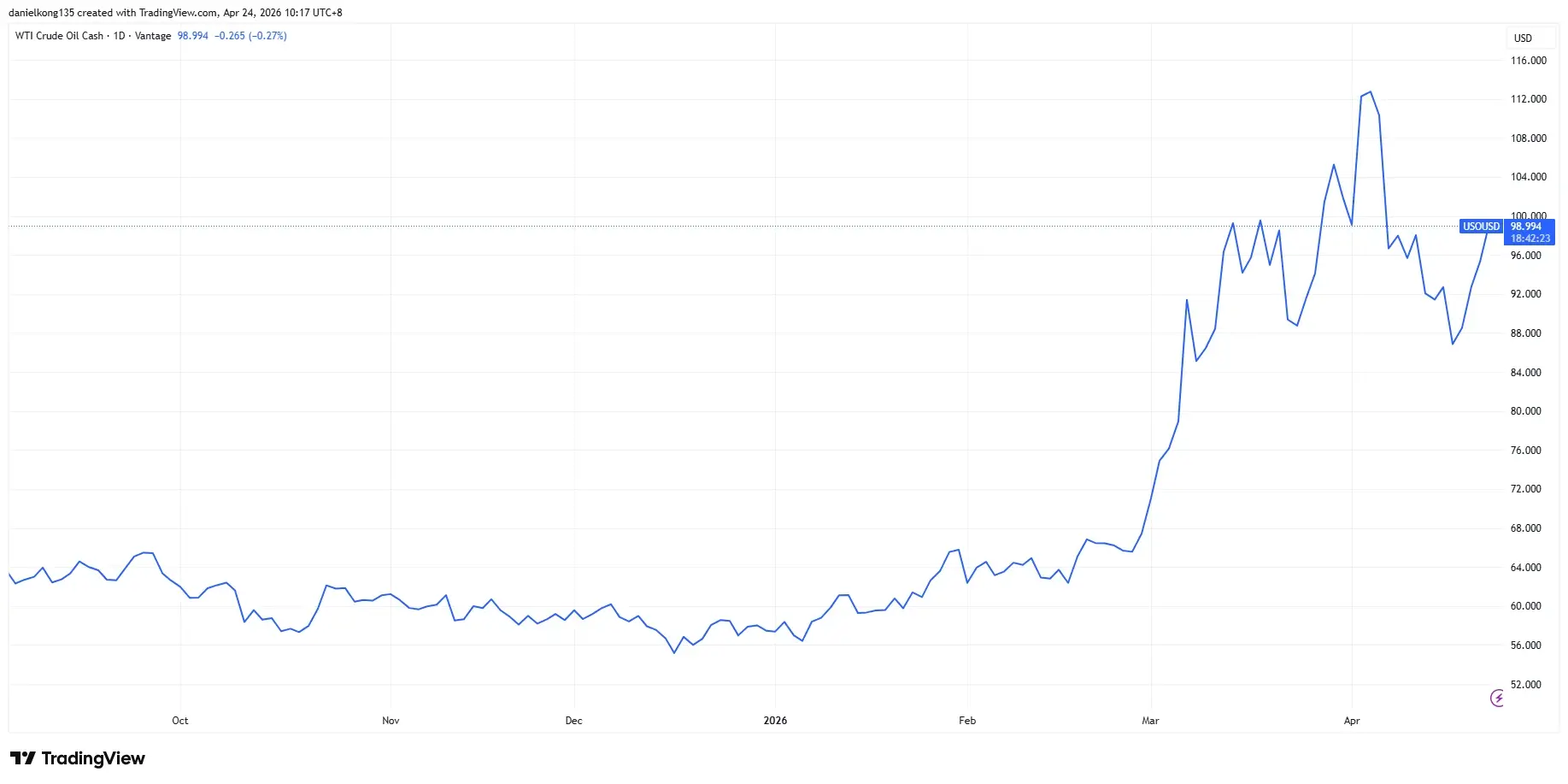
A market that moved 9% in a single session and 55% over a few weeks is a market where position sizing and stop-loss placement are not optional. The same volatility that creates opportunity punishes undisciplined trading severely.
Risk Management and Common Mistakes in Crude Oil Trading
Crude oil can be highly volatile, so risk controls are a central part of managing exposure. Many of the most common trading mistakes also come from weak risk discipline, which is why these points are best considered together.
- Use position sizing carefully: Trade size should reflect your stop-loss distance and the share of account equity you are prepared to risk on one position.
- Set clear stop-loss levels: Stop-loss orders help define downside exposure, especially in a market that can move sharply around news or over weekends.
- Treat leverage with caution: Leverage increases market exposure, but it also magnifies losses when the market moves against the position.
- Watch the calendar: EIA inventory releases, OPEC+ meetings, and geopolitical developments can trigger sudden volatility and wider price swings.
- Know whether you are trading Brent or WTI: The two benchmarks often move together, but their spread can widen due to regional supply and transport factors.
- Avoid chasing headlines: Entering after a sharp move has already happened can lead to poor timing and weaker trade setups.
- Review your trades regularly: A trading journal can help highlight repeated errors, such as oversizing, overtrading, or holding losing positions for too long.
These points do not remove risk, but they can help traders approach crude oil trading with more structure. For a deeper breakdown of practical risk controls, read our guide on 10 risk management techniques traders can use in trading.
Starting Your Crude Oil Trading Journey
Learning how to trade crude oil is a process of layering knowledge. You start with the benchmarks, build an understanding of the price drivers, and finish with the discipline that ties it all together — sizing trades responsibly, placing stops deliberately, and reviewing what you do.
Oil trading offers deep liquidity and frequent trading opportunities, particularly for traders where the market is part of the regional economic backdrop. The opportunity is real, but so is the volatility.
Approaching it with a proper trading plan and a demo account before risking live capital is a sensible first step.
Frequently Asked Questions
What Is the Difference Between Brent and WTI Crude Oil?
Brent is extracted from the North Sea and is used to price most internationally traded crude. WTI is extracted from US oil fields and serves as the main North American benchmark. Brent is slightly heavier and higher in sulphur than WTI. The two usually move in the same direction, but the spread between them varies with regional supply and logistics.
Can I Trade Crude Oil Without Owning Physical Barrels?
Yes. Most retail traders access oil through CFDs, futures, or energy-sector shares and ETFs. These instruments provide exposure to price movements without requiring the trader to take delivery of physical oil.
How Much Money Do I Need to Start Trading Crude Oil?
The minimum depends on the broker and instrument. CFD accounts can often be opened with modest deposits, while oil futures have much larger contract sizes and margin requirements. A demo account allows you to learn the platform and test strategies before committing live capital.
When Is the Best Time to Trade Crude Oil?
There is no single best time to trade crude oil, as the right window depends on the trader’s strategy, risk tolerance, and preferred market conditions. That said, liquidity and volatility are often higher during the overlap between the London and New York sessions, as well as around scheduled events such as weekly Energy Information Administration (EIA) inventory releases and OPEC+ meetings.
Many traders pay closer attention to periods when liquidity, volatility, and relevant news flow are more concentrated. This can help them analyse price movement with better context, rather than focusing on timing alone.
How Does Leverage Work in Oil Trading?
Leverage lets you control a larger notional position with a smaller deposit, known as margin. If the market moves in your favour, the percentage return on your deposit is amplified; if it moves against you, the loss is amplified in the same way. Using the minimum leverage needed for your planned position size is a common risk management principle.
What Are the Main Risks of Trading Crude Oil?
The main risks include price volatility, leverage magnifying losses, overnight gaps around news events, and the mechanical effects of contract rollover for futures-based instruments. Risk can be managed through disciplined sizing, stop-loss orders, and an awareness of the market calendar, but it cannot be eliminated.
RISK WARNING: CFDs are complex financial instruments and carry a high risk of losing money rapidly due to leverage. You should ensure you fully understand the risks involved and carefully consider whether you can afford to take the high risk of losing your money before trading.
Disclaimer: The information is provided for educational purposes only and doesn’t take into account your personal objectives, financial circumstances, or needs. It does not constitute investment advice. We encourage you to seek independent advice if necessary. The information has not been prepared in accordance with legal requirements designed to promote the independence of investment research. No representation or warranty is given as to the accuracy or completeness of any information contained within. This material may contain historical or past performance figures and should not be relied on. Furthermore estimates, forward-looking statements, and forecasts cannot be guaranteed. The information on this site and the products and services offered are not intended for distribution to any person in any country or jurisdiction where such distribution or use would be contrary to local law or regulation.
Reference
- “Short-Term Energy Outlook – EIA” https://www.eia.gov/outlooks/steo/ Accessed 23 April 2026
- “Goldman projects lower oil prices in 2026 as supply swells – Reuters” https://www.reuters.com/business/energy/goldman-projects-lower-oil-prices-2026-supply-swells-2026-01-12/ Accessed 23 April 2026
- “Analysts hike oil outlook on geopolitical risks, oversupply concerns limit upside – Reuters” https://www.reuters.com/business/energy/analysts-hike-oil-outlook-geopolitical-risks-oversupply-concerns-limit-upside-2026-02-27/ Accessed 23 April 2026
- “Brent Hits 30-week High – Trading Economics” https://tradingeconomics.com/commodity/brent-crude-oil/news/528776 Accessed 23 April 2026
- “Oil settles down 9% after Iran declares Strait of Hormuz open – Reuters” https://www.reuters.com/business/energy/oil-falls-prospects-talks-end-iran-war-revive-supply-2026-04-17/ Accessed 23 April 2026
- “Brent crude oil – Trading Economics” https://tradingeconomics.com/commodity/brent-crude-oil Accessed 23 April 2026