


 Updated
The Kuwaiti Dinar is the strongest — or highest-value — currency in the world in 2026, with 1 KWD equivalent to approximately $3.26 USD (around ₹314 at current exchange rates). Measured by exchange rate value against the US Dollar, the world’s highest-value currencies are concentrated in the Middle East, where oil revenues and fixed exchange rate regimes support consistently high nominal values.
However, a high exchange rate does not always mean a currency is the most widely used or the most influential in global markets. Some high-value currencies are supported by currency pegs, controlled monetary policy, or resource-based economies, while major currencies such as the US Dollar and Euro remain more dominant in global trade, reserves, and forex market liquidity.
This guide ranks the top 10 currencies in the world by exchange rate value, explains what drives currency strength, and examines the economic forces behind each major currency’s position.
Key Points
- The Kuwaiti Dinar (KWD) holds the top position in 2026 as the highest currency in the world, with a value of approximately $3.26 USD (around ₹314) per dinar — a result of Kuwait’s oil wealth, managed exchange rate regime, and disciplined monetary policy maintained by the Central Bank of Kuwait.
- Gulf currencies dominate the top three positions: the Kuwaiti Dinar, Bahraini Dinar, and Omani Rial all benefit from fixed or managed US Dollar pegs, substantial oil export revenues, and tight monetary controls that prevent depreciation.
- Currency strength in this context refers to nominal exchange rate value against the USD — this is distinct from global usage or reserve status. The US Dollar remains the world’s most widely held and traded currency, accounting for approximately 56.77% of global foreign exchange reserves, despite ranking at $1.00 by face value.
Top 10 Highest Currency in the World: Full Rankings List (USD & INR)
The list below ranks the highest currency in the world today by exchange rate value against the US Dollar, with approximate Indian Rupee (INR) equivalents included for reference.
| Currency | Symbol | Value vs USD (9 June 2026) | Value vs INR (approx.) |
| Kuwaiti Dinar | KWD | ~$3.23 | ~₹311 |
| Bahraini Dinar | BHD | ~$2.65 | ~₹255 |
| Omani Rial | OMR | ~$2.59 | ~₹249 |
| Jordanian Dinar | JOD | ~$1.41 | ~₹136 |
| British Pound | GBP | ~$1.33 | ~₹128 |
| Swiss Franc | CHF | ~$1.25 | ~₹120 |
| Euro | EUR | ~$1.15 | ~₹111 |
| US Dollar | USD | $1.00 | ₹96.30 |
| Singapore Dollar | SGD | ~$0.77 | ~₹74 |
| Bruneian Dollar | BND | ~$0.77 | ~₹74 |
What Makes a Currency Strong?
A currency’s strength can be assessed in different ways, including its exchange rate value, domestic purchasing power, reserve status, and role in global trade. Factors such as interest rates and inflation, trade balances, economic growth, and central bank policy can influence how a currency performs against other currencies.
For this ranking, the focus is on exchange rate value against the US Dollar, while also explaining the wider economic factors that help support each currency’s position.
Exchange Rate Value vs the US Dollar
Currency strength, as used in standard financial rankings, refers to how much of a given currency can be purchased in exchange for one US Dollar — or more precisely, how many dollars one unit of that currency can buy.
The more dollars it buys, the stronger it is by this measure. The US Dollar serves as the global benchmark because it is the world’s primary reserve currency, underpinning the majority of international trade and financial transactions.
This is a specific and narrow definition. It differs from measuring purchasing power parity (PPP) — what a currency can buy domestically — or from a currency’s global usage, which is determined by trade volumes and reserve holdings.
A currency can rank highly by exchange rate value but be rarely used outside its home market. As the rankings above show, some of the world’s strongest currencies by face value are among the least traded internationally.
Why Gulf Currencies Dominate the Rankings
The Kuwaiti Dinar, Bahraini Dinar, Omani Rial, and Jordanian Dinar occupy the top four positions in currency rankings globally. Several structural factors account for this concentration:
- Oil and gas revenues: Kuwait, Bahrain, and Oman generate substantial foreign exchange income from hydrocarbon exports. These revenues are channelled into sovereign wealth funds and foreign reserves, which underpin the currency’s exchange rate value.The ongoing Middle East conflict has also kept attention on oil supply routes such as the Strait of Hormuz, showing how geopolitical risk can influence hydrocarbon revenues, foreign reserves, and currency stability.
- Fixed or managed exchange rates: Most Gulf currencies are pegged to the US Dollar at controlled rates. The Bahraini Dinar is fixed at approximately USD2.659 per BHD, while the Omani Rial has remained fixed at USD2.6008 per OMR since its last parity change in 1986 [1,2]. These fixed or managed arrangements can reduce exchange rate volatility and help support currency stability, provided central banks have sufficient reserves and policy credibility to maintain them.
- Small populations with high per-capita income: Gulf states distribute oil revenues across relatively small populations, limiting devaluation pressure and supporting domestic economic stability.
- Tight monetary policy: Central banks in these countries maintain strict controls on money supply growth, keeping inflation low and preserving exchange rate stability over the long term.
Strong by Exchange Rate vs Strong by Usage
The strongest currency by exchange rate value is not the same as the most important currency in global markets. The US Dollar — which scores $1.00 against itself by definition in any bilateral ranking — is the world’s dominant reserve currency.
According to the International Monetary Fund (IMF), the Dollar accounted for approximately 56.77&% of global foreign exchange reserves as of Q4 2025 [3]. Central banks hold dollars; most commodity markets price in dollars; the majority of global trade settles in dollars.
The Kuwaiti Dinar, by contrast, is rarely used outside Kuwait. Its high face value is a structural characteristic of Kuwait’s monetary regime — not a reflection of global financial influence. In global forex and CFD markets, the most actively traded major, minor, and exotic currency pairs vary in liquidity and market participation. Major pairs commonly involve currencies such as USD, EUR, GBP, JPY, and CHF.
North American Currencies
North American currencies play an important role in global forex markets, led by the US Dollar’s reserve status and the Canadian Dollar’s link to commodity demand. While they may not rank as the highest-value currencies by face value, they remain widely watched due to their liquidity, economic influence, and role in international trade.
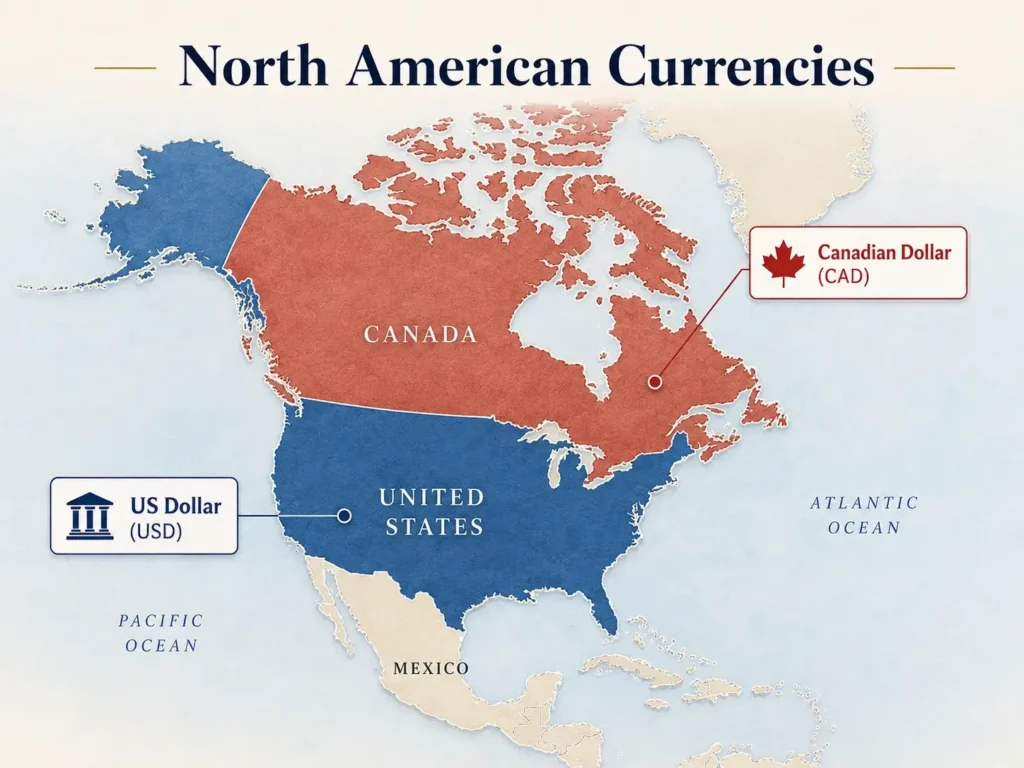
United States Dollar (USD)
The United States Dollar, often referred to as the “greenback,” is the world’s primary reserve currency and the benchmark against which all other currencies are measured. The USD’s position is rooted in the scale of the US economy, political stability, and the dollar’s role in international trade and finance. The Federal Reserve’s role as a global lender of last resort contributes to the dollar’s status as a safe-haven asset during periods of market uncertainty.
In the forex market, the US Dollar serves as the base or quote currency in the majority of traded pairs. Its widespread use and deep liquidity make it the global reference point for evaluating currency values, and its reserve status means that governments and central banks hold large dollar reserves as a buffer against economic shocks.
Canadian Dollar (CAD)
Canada’s resource-rich economy and close ties to the United States make the Canadian Dollar a key player in North American currency markets. The CAD’s performance is closely linked to commodity prices, particularly crude oil prices.
As one of the world’s major oil exporters, Canada’s currency tends to move in tandem with crude oil prices. The stability of Canada’s banking system and its prudent fiscal policies further support the “Loonie,” making the USD/CAD pair an important benchmark for monitoring commodity-linked currency movements.
European Currencies
European currencies remain central to global forex markets due to the region’s economic scale, mature financial systems, and active cross-border trade. While the Euro reflects the collective strength of the Eurozone, the British Pound and Swiss Franc hold distinct positions through the UK’s financial sector and Switzerland’s long-standing reputation for stability.

Euro (EUR)
The Euro represents the collective economic weight of the Eurozone — a monetary union covering 20 member states. Its stability reflects the solid economic performance of major economies including Germany, France, and the Netherlands.
The European Central Bank (ECB) plays a central role in maintaining the Euro’s value through monetary policy, making the EUR/USD currency pair one of the most heavily traded pairs in the forex market.
British Pound (GBP)
The British Pound Sterling is one of the world’s oldest and most recognised currencies. Its strength is tied to the UK’s economic performance, trade relationships, and financial sector prominence.
The Pound has experienced notable volatility in recent years — including periods of uncertainty surrounding Brexit — but its established position as an international reserve currency and the UK’s role as a global financial centre continue to underpin its value.
Swiss Franc (CHF)
Switzerland’s neutrality and strong financial system have long made the Swiss Franc one of the most widely recognised safe-haven currencies. Switzerland’s prudent monetary policies, low inflation, and robust economy contribute to the Franc’s consistent strength.
During periods of geopolitical or economic instability, capital has historically flowed into CHF, reflecting its reputation as a safe-haven currency.
Asian Currencies
Asian currencies reflect a diverse mix of export-led economies, financial hubs, commodity-linked markets, and managed exchange rate systems. While not all rank highly by face value against the US Dollar, several play an important role in global trade, regional investment flows, and major forex pairs.
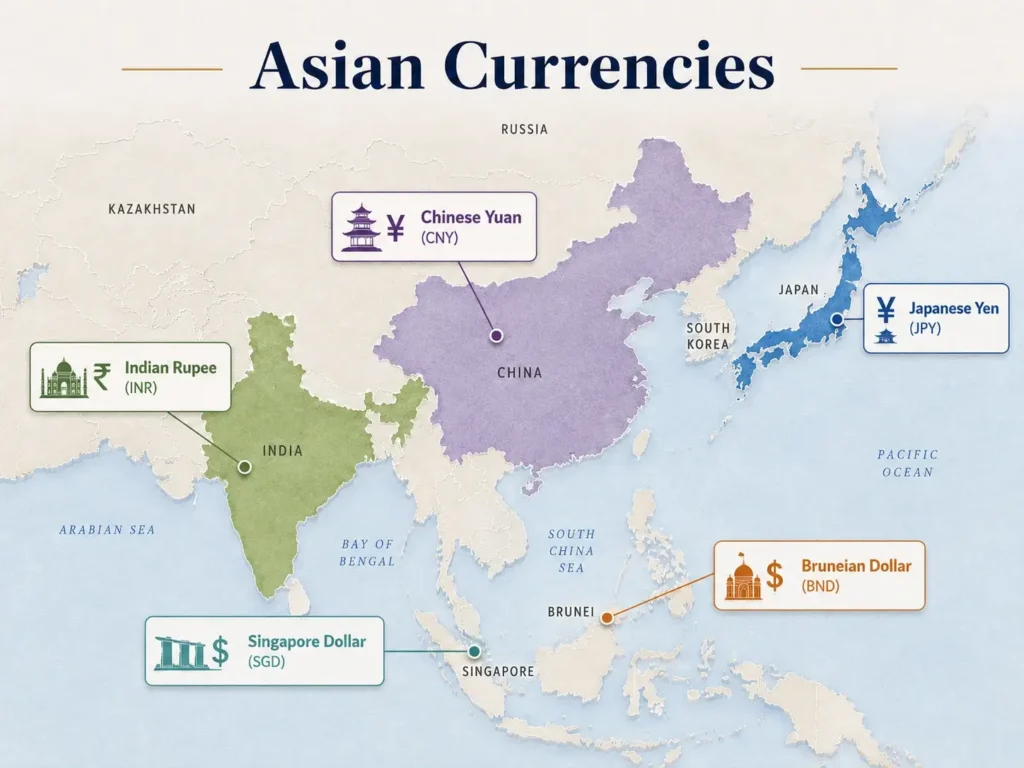
Japanese Yen (JPY)
The Japanese Yen carries significant weight in the forex market, reflecting Japan’s position as the world’s third-largest economy by GDP. Japan’s substantial trade surplus and well-established financial markets underpin the Yen’s resilience.
The Bank of Japan (BoJ) historically maintained an accommodative monetary policy, which contributed to the Yen’s role as a funding currency in carry trades — where traders borrow in lower-yielding currencies to invest in higher-yielding assets.
The BoJ’s gradual shift towards policy normalisation since 2024 has introduced new dynamics to the USD/JPY pair and reduced some of the traditional carry trade appetite for the Yen.
Singapore Dollar (SGD)
Singapore’s national currency is highly regarded across the Asia-Pacific region. Its strength is rooted in Singapore’s diversified economy — a global hub for finance, technology, and trade.
The Monetary Authority of Singapore (MAS) manages the SGD through a basket-based exchange rate framework, adjusting the currency against a weighted selection of trading partners’ currencies rather than targeting interest rates directly.
This approach enhances the SGD’s stability and makes the Singapore Dollar one of the relatively stable currencies in the Asia-Pacific region under its exchange rate framework.
Bruneian Dollar (BND)
The Bruneian Dollar is pegged at parity with the Singapore Dollar, a currency arrangement in place since 1967. This arrangement facilitates trade and investment between Brunei and Singapore, with both nations accepting each other’s currencies as equal in value.
The BND’s strength reflects Brunei’s considerable hydrocarbon wealth — oil and natural gas exports account for the majority of government revenues and provide the economic foundation that supports the currency’s stability.
Chinese Yuan (CNY)
The Chinese Yuan has been gaining international prominence, though it is not yet fully freely convertible on global markets. Its rising status is backed by China’s position as the world’s second-largest economy and its growing role in global trade settlements.
China’s efforts to internationalise the Yuan — including its inclusion in the International Monetary Fund’s (IMF) Special Drawing Rights (SDR) basket — have elevated its standing, and the USD/CNY pair is increasingly watched by global traders as a barometer for US-China economic relations.
As China continues to liberalise its financial markets, the USD/CNY pair remains closely watched by market participants as China’s role in global trade evolves. Its performance serves as a critical indicator of the economic interplay between the world’s two largest economies.
Indian Rupee (INR)
The Indian Rupee (INR) is not among the world’s strongest currencies by face value against the US Dollar, but it remains one of the most important currencies in the Asia-Pacific region, supported by a large domestic market, strong export activity, substantial remittance flows, and a growing role in global services trade.
The Rupee’s performance is influenced by several factors, including central bank policy, inflation trends, capital flows, crude oil prices, and broader risk sentiment. As a major energy importer, higher oil prices can place pressure on the INR by increasing import costs and affecting its trade balance.
Middle Eastern Currencies
Middle Eastern currencies dominate the top of the global rankings by exchange rate value, with several supported by hydrocarbon revenues, strong foreign reserve positions, and tightly managed exchange rate systems.
This region stands out because currency strength is often reinforced by a mix of oil-linked income, fiscal discipline, and long-standing pegs or managed arrangements against the US Dollar.
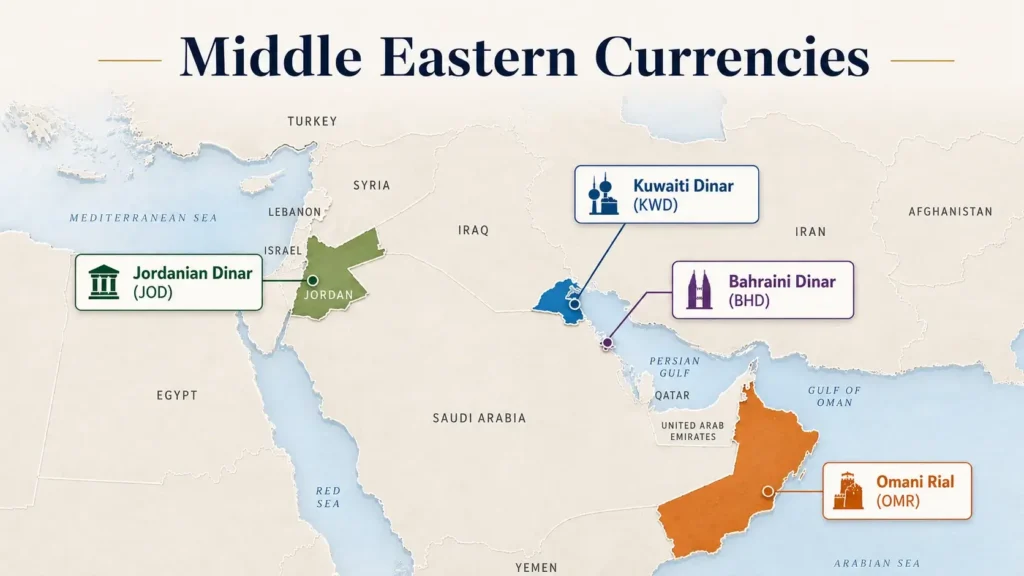
Kuwaiti Dinar (KWD)
The Kuwaiti Dinar is the world’s strongest currency in 2026, with 1 KWD equivalent to approximately $3.26 USD. Kuwait’s substantial oil reserves — among the largest globally — generate the foreign exchange revenues that underpin the dinar’s value.
Kuwait’s conservative fiscal approach, low levels of government debt, and a well-managed sovereign wealth fund operated by the Kuwait Investment Authority (KIA) reinforce the currency’s long-term position. The Central Bank of Kuwait manages the dinar against a basket of major currencies, providing stability without the rigidity of a single-currency peg.
Bahraini Dinar (BHD)
The Bahraini Dinar ranks as the second most valuable currency in the world. Bahrain has diversified its economy beyond oil more than most Gulf states — with financial services, tourism, and aluminium production playing significant roles — and the Central Bank of Bahrain maintains a fixed peg to the US Dollar at 0.376 BHD per USD [4].
This peg has remained stable since 2001, contributing to the dinar’s reliability as a currency with minimal day-to-day exchange rate movement. Bahrain’s economic diversification provides a broader base of support for the peg than a solely oil-dependent economy would.
Omani Rial (OMR)
Oman’s currency has been pegged to the US Dollar at a fixed rate of $2.6008 per OMR since 1986, making the Omani Rial one of the most stable currencies in the world by exchange rate [2].
Like other Gulf currencies, the OMR’s value is supported by oil and gas revenues, prudent monetary controls, and a managed money supply. The Central Bank of Oman closely regulates financial conditions to maintain this peg, and the USD/OMR pair shows minimal volatility as a result of this long-standing arrangement.
Jordanian Dinar (JOD)
The Jordanian Dinar stands out among Middle Eastern currencies because Jordan’s economy is not primarily oil-dependent. The dinar maintains its value through a combination of stable governance, economic diversification — including tourism, remittances, and foreign aid — and a fixed peg to the US Dollar at 1 JOD = 1.41 USD, in place since 1995 [5].
The Central Bank of Jordan’s careful fiscal management has insulated the dinar from regional volatility, preserving its purchasing power over time.
Oceania Currencies
Oceania currencies are often shaped by commodity exports, central bank policy, and global risk sentiment. The Australian Dollar and New Zealand Dollar may not rank among the highest-value currencies by face value, but both remain closely watched in forex markets due to their links with trade, resources, and Asia-Pacific demand.
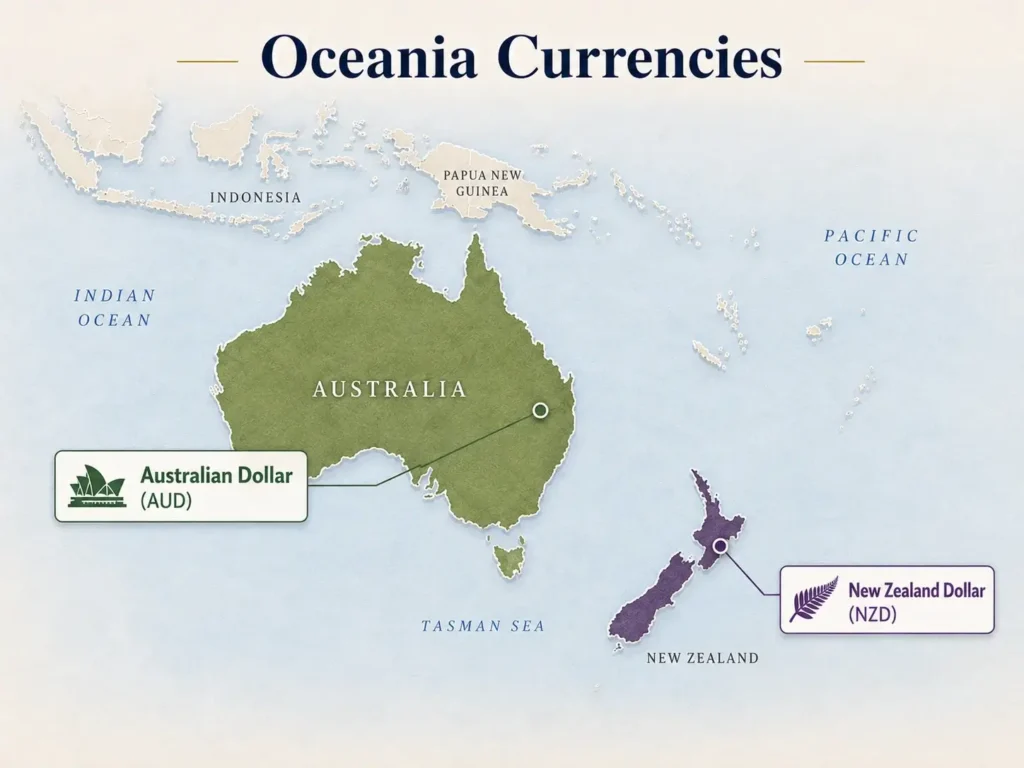
Australian Dollar (AUD)
Australia’s currency, commonly known as the “Aussie,” reflects the country’s resource-rich economic foundation. The Australian Dollar’s performance is closely tied to commodity prices — particularly iron ore, coal, and gold — as Australia is a major global exporter of all three.
The Reserve Bank of Australia (RBA) manages monetary policy to balance inflation and economic growth, and the AUD/USD pair is one of the more actively traded commodity-linked currency pairs in the forex market.
New Zealand Dollar (NZD)
The New Zealand Dollar, known as the “Kiwi,” is anchored by New Zealand’s stable economic foundations and its export-driven economy. Agricultural products — including dairy, meat, and forestry — are the primary drivers of foreign exchange earnings.
The Reserve Bank of New Zealand (RBNZ) manages monetary policy with a focus on price stability, and New Zealand’s political stability and geographic position contribute to the NZD’s reputation as a relatively stable Pacific currency. The NZD/USD pair tracks closely with commodity cycles and global risk sentiment.
Trade Currency CFDs with Vantage
The currencies covered in this guide appear across a range of forex CFD pairs, including EUR/USD, GBP/USD, USD/JPY, USD/CHF, AUD/USD, and USD/SGD. These pairs allow traders to take a view on exchange rate movements without owning the underlying currencies.
Open link
This is different from ranking currencies by face value against the US Dollar. A currency may rank highly by exchange rate value, but that does not always mean it is widely traded or highly liquid in global forex markets. Major pairs involving the US Dollar, Euro, Japanese Yen, British Pound, Swiss Franc, and Australian Dollar tend to attract closer market attention due to their liquidity and global economic relevance.
With Contracts for Difference (CFDs), market participants can gain exposure to price movements in both rising and falling markets without owning the underlying asset.
However, CFDs are leveraged products, which means both potential gains and potential losses can be magnified. Applying appropriate forex risk management measures can help traders define their exposure before entering a position.
Vantage provides access to major, minor, and exotic forex CFD pairs, along with tools such as an economic calendar, market analysis, charting features, and risk management functions. Product availability may vary depending on account type, entity, and jurisdiction.
Frequently Asked Questions
Which Is the Strongest Currency in the World in 2026?
The Kuwaiti Dinar (KWD) is the strongest currency in the world in 2026 by exchange rate value, with 1 KWD equivalent to approximately $3.26 USD. Its strength is the result of Kuwait’s large oil reserves, a managed exchange rate regime, and conservative fiscal policies maintained by the Central Bank of Kuwait.
What Is the Highest Currency in the World?
The highest currency in the world — and the highest currency rate against the US Dollar — belongs to the Kuwaiti Dinar (KWD), followed by the Bahraini Dinar (BHD) and the Omani Rial (OMR). All three are Gulf currencies whose values are supported by oil export revenues and fixed or managed pegs to the USD. The Jordanian Dinar (JOD) is fourth, notable because Jordan’s economy is not primarily oil-dependent.
What Makes a Currency Strong?
Currency strength by exchange rate value is determined by several factors working together: oil and commodity export revenues, which provide consistent foreign exchange income; fixed or managed exchange rate regimes, which prevent depreciation; disciplined monetary policy, which keeps inflation low and limits money supply growth; and broader economic stability, which generates confidence among domestic and international investors. Gulf currencies generally exhibit many of these characteristics, which explains their sustained dominance in exchange rate rankings.
Why Is the Kuwaiti Dinar So Strong?
The Kuwaiti Dinar’s strength comes from Kuwait’s position as one of the world’s largest oil producers, a small population that translates high oil revenues into strong per-capita income, and the Central Bank of Kuwait’s practice of managing the dinar against a basket of major currencies. The government’s conservative fiscal approach — characterised by limited debt, large sovereign wealth fund reserves managed by the Kuwait Investment Authority, and controlled money supply — reinforces long-term confidence in the currency.
What Is the Most Valuable Currency in the World?
By exchange rate value against the USD, the most valuable currency is the Kuwaiti Dinar (KWD) at approximately $3.26 USD per dinar. However, value can also be measured by global usage or purchasing power. By reserve holdings, the US Dollar is the most valuable globally — central banks worldwide hold more dollars than any other currency. By purchasing power parity, currencies in countries with lower price levels may buy more domestically than their exchange rate implies.
What Is the Most Stable Currency in the World?
Stability depends on the measure used. Currencies with fixed pegs — such as the Bahraini Dinar (fixed at 0.376 BHD per USD since 2001) and the Omani Rial (fixed at $2.6008 per OMR since 1986) — show almost no day-to-day exchange rate movement. Among freely floating currencies, the Swiss Franc (CHF) is widely considered the most stable, given Switzerland’s political neutrality, consistently low inflation, and strong institutional framework for monetary governance.
What Is the Difference Between the Strongest and Most Traded Currency?
The strongest currency by exchange rate value and the most traded currency are two different things. The Kuwaiti Dinar is the strongest by face value but is rarely used outside Kuwait and has very low global trading volume.
The US Dollar, which ranks at $1.00 against itself in bilateral rankings, is the world’s most traded currency — involved in approximately 88% of all forex transactions according to the Bank for International Settlements’ (BIS) Triennial Survey. Liquidity, global acceptance, and reserve status drive trading volume, not nominal exchange rate value.
Are the Strongest Currencies Also the Most Traded?
No. The currencies with the highest nominal value are not necessarily the currencies most frequently traded in the foreign exchange market.
For example, the Kuwaiti dinar, Bahraini dinar, and Omani rial have high values per unit, but they are not among the most actively traded global currencies. The US dollar, euro, and Japanese yen are traded more frequently because they are widely used in international trade, financial markets, central-bank reserves, and major currency pairs.
What Is the Highest Currency in Indian Rupees (INR)?
The Kuwaiti dinar (KWD) is generally the highest currency in the world when converted into Indian rupees — worth approximately ₹311 per dinar at current exchange rates. One Kuwaiti dinar is worth substantially more than one Indian rupee, although the exact KWD/INR exchange rate changes according to market conditions. See the full highest currency in the world list, with INR conversions, in the rankings table above.
This comparison refers to the nominal value of one currency unit. It does not necessarily indicate that Kuwait has the world’s largest economy or that the Kuwaiti dinar is the most widely used currency.
Why Is the Kuwaiti Dinar Worth More Than the Indian Rupee?
The Kuwaiti dinar has a higher nominal value than the Indian rupee partly because of Kuwait’s exchange-rate framework, oil-export revenues, and comparatively limited currency supply. The Central Bank of Kuwait manages the dinar against a basket of major international currencies, which can help maintain relative exchange-rate stability.
However, a higher exchange rate does not automatically mean that one economy is stronger than another. Currency values are also affected by monetary policy, inflation, trade flows, economic conditions, and how each currency unit is structured.
RISK WARNING: CFDs are complex financial instruments and carry a high risk of losing money rapidly due to leverage. You should ensure you fully understand the risks involved and carefully consider whether you can afford to take the high risk of losing your money before trading.
Disclaimer: The information is provided for educational purposes only and doesn’t take into account your personal objectives, financial circumstances, or needs. It does not constitute investment advice. We encourage you to seek independent advice if necessary. The information has not been prepared in accordance with legal requirements designed to promote the independence of investment research. No representation or warranty is given as to the accuracy or completeness of any information contained within. This material may contain historical or past performance figures and should not be relied on. Furthermore estimates, forward-looking statements, and forecasts cannot be guaranteed. The information on this site and the products and services offered are not intended for distribution to any person in any country or jurisdiction where such distribution or use would be contrary to local law or regulation.
References
- “Facilities & Interest Rates – Central Bank of Bahrain”. https://www.cbb.gov.bh/facilities-interest-rates/. Accessed 9 June 2026.
- “The Fixed Peg of the RO to the US Dollar – Central Bank of Oman”. https://cbo.gov.om/Pages/FixedPeg.aspx. Accessed 9 June 2026.
- “IMF Data Brief: Currency Composition of Official Foreign Exchange Reserves – International Monetary Fund”. https://data.imf.org/en/news/imf%20data%20brief%20march%2027. Accessed 9 June 2026.
- “Monetary Policy – Central Bank of Bahrain”. https://www.cbb.gov.bh/monetary-policy/. Accessed 9 June 2026.
- “The Jordanian Dinar: One of the World’s Strongest Currencies Explained – Remitly”. https://www.remitly.com/blog/currencies/jordanian-dinar/. Accessed 9 June 2026.