Language
SEARCH
-
AllTradingPlatformsAcademyAnalysisPromotionsAbout
-
Search query too short. Please enter a full word or phrase.
-
Keywords
- Forex Trading
- Vantage Rewards
- Spreads
Popular Search
- Trading Accounts
- MT4
- MT5
- Copy Trading
- Promotions
Discover the power of ETFs, a flexible, cost-efficient way to trade diversified assets like stocks, commodities, and bonds in a single transaction. Whether you’re a beginner or an experienced trader, this guide explains how ETFs work, their key advantages, and how to start trading them effectively.
What Is An ETF?
An exchange-traded fund (ETF) combines the diversification of mutual funds with the flexibility of stock trading. These investment bundles track assets like stocks, commodities, or bonds, allowing you to trade entire markets as easily as a single stock, with lower fees and real-time pricing.
Types of ETFs
ETFs come in various forms, each tailored to specific asset classes, strategies, or market exposures.
Equity ETFs
Equity ETFs are among the most commonly traded ETFs. They invest in a diversified portfolio of stocks and can track broad markets, specific sectors, or themes. They offer investors a convenient way to gain exposure to a basket of equities with reduced individual stock risk.
Bond ETFs
Bond ETFs give investors access to fixed-income assets such as government, corporate, and municipal bonds—all within a single, tradable fund. These ETFs typically generate income by paying periodic dividends, which reflect the interest earned from the underlying bonds. Any capital gains from selling bonds within the fund are usually distributed to investors once a year.
Index ETFs
Index ETFs track the performance of a specific market index, such as the S&P 500, Nasdaq-100, or FTSE 100. Because they are passively managed—simply tracking the index rather than trying to outperform it—index ETFs typically come with lower management fees compared to actively managed funds.
Sector ETFs
Sector ETFs concentrate on specific segments of the economy, such as technology, healthcare, energy, or financial services. By investing in these ETFs, traders can target industries they believe will outperform, or reduce risk by avoiding sectors facing economic headwinds.
Commodity ETFs
Commodity ETFs offer exposure to the price movements of physical assets like gold, silver, crude oil, natural gas, and agricultural products such as wheat or corn. These ETFs offer an alternative means of diversification beyond traditional equities and bonds, and may provide exposure to assets that historically perform differently during periods of inflation or market volatility.
Currency ETFs
Currency ETFs provide exposure to the performance of one or more foreign currencies, such as the US dollar, euro, yen, or emerging market currencies. These ETFs are structured to track the exchange rate between currencies or a basket of currencies, offering a simplified way to participate in the forex market without trading currency pairs directly.
They are commonly used to hedge currency risk or to speculate on macroeconomic developments and interest rate movements.
Inverse ETFs
Inverse ETFs are structured to deliver the opposite performance of a specific index, asset, or benchmark on a daily basis. They use financial derivatives such as futures and swaps to achieve this inverse exposure, making them a tool for traders anticipating short-term market declines.
Emerging Markets ETFs
Emerging Markets ETFs provide exposure to equities in developing countries such as Brazil, India, China, and South Africa, where economies are expanding and undergoing rapid industrialisation. These ETFs allow investors to tap into regions with strong growth potential, rising consumer demand, and improving infrastructure.
However, they also carry higher risks, including political instability, currency fluctuations, regulatory uncertainty, and lower market liquidity compared to developed markets—factors investors should carefully evaluate before adding them to a portfolio.
To explore each ETF type in greater depth and discover how they can fit into your trading strategy, read our article on “Types of ETFs and How to Trade Them”.
How Do ETFs Work?
Exchange-Traded Funds (ETFs) combine the features of mutual funds and stocks to create a flexible investment vehicle. At their core, ETFs are designed to track the performance of specific indices, commodities, or baskets of assets—and are traded on exchanges throughout the day at market prices.
Tracking the Market
ETFs aim to replicate the performance of a benchmark through two primary methods:
- Physical Replication: The ETF holds all (or a representative sample) of the underlying assets in the index it tracks. For example, an S&P 500 ETF like SPY holds shares in all 500 companies that comprise the index.
- Synthetic Replication: The ETF uses derivatives like swaps to mimic the index’s performance without holding the actual assets.
Both methods are designed to deliver returns that closely track the index or match the ETF’s benchmark.
Trading Flexibility
Unlike mutual funds, which are priced once per day, ETFs offer real-time trading during market hours. Investors can use different order types, including market, limit, and stop orders.
This intraday liquidity, along with the involvement of market makers, helps maintain tight bid-ask spreads, particularly for high-volume ETFs. The ability to trade intraday also makes ETFs particularly attractive for active traders.
The Creation/Redemption Process
A unique creation/redemption process helps align the ETF’s market price with their net asset value (NAV).
Authorised Participants (typically large institutions) can create or redeem ETF shares by exchanging them for the underlying assets. This arbitrage mechanism helps keep ETF prices closely tied to their NAV, often with a very narrow range—typically within 0.10% for highly liquid ETFs.
Trader Advantages
ETFs offer several key benefits:
- Lower expense ratios compared to mutual funds, due to passive management.
- Greater tax efficiency, particularly in US markets, due to in-kind transfers.
- Full transparency, with many ETFs disclosing their holdings daily.
- Ease of diversification, allowing exposure to entire markets, sectors, or strategies in a single trade.
Key Features of ETFs
ETFs offer unique advantages that make them popular among both individual and institutional traders. Below, we break down their most valuable features:
Diversification
ETFs provide instant exposure to a basket of assets—such as stocks, bonds or commodities—in a single trade. Instead of buying individual securities, you gain broad market exposure, which can help reduce company-specific risk.
For example:
- A tech sector ETF holds multiple stocks like Apple, Microsoft, and Nvidia.
- A bond ETF spreads risk across hundreds of debt instruments.
- A global ETF offers international exposure without directly trading in foreign markets.
This built-in diversification can help smooth out portfolio volatility while maintaining long-term growth potential.
Liquidity
ETFs combine the trading flexibility of stocks with the stability of funds:
- Trade anytime during market hours (unlike mutual funds).
- High trading volume ensures tighter bid-ask spreads, especially for popular ETFs like SPY or QQQ.
- Authorised Participants (market makers) help keep prices aligned with underlying asset values.
Whether you’re entering or exiting a position, ETFs offer efficient pricing and smooth execution.
Transparency
ETF holdings are disclosed daily—unlike mutual funds, which typically report quarterly. This allows traders to:
- Verify exactly what assets they hold
- Track portfolio composition in real time
- Make informed decisions based on up-to-date data
For example, you can check an ETF’s official website to view its full holdings, sector allocations, and geographic exposure before investing.
Low Cost
ETFs typically have lower fees than traditional mutual funds due to their passive management structure. Instead of employing active managers to select investments and try to outperform the market, most ETFs aim to replicate the performance of a specific index, such as the S&P 500.
By keeping management fees low, this passive approach can help traders and investors preserve more of their returns over the long term, making ETFs an efficient choice for cost-conscious investors.
How to Trade ETFs
-
1
Open a Live Account
Start your trading journey by opening an account with Vantage. Our platform offers seamless access to a wide variety of ETFs, competitive pricing, and powerful trading tools to support your strategies.
-
2
Research and Choose the Right ETF(s)
Explore ETFs that match your investment objectives. Whether you’re targeting specific sectors, indices, or asset classes, Vantage provides the resources and insights you need to make informed choices.
-
3
Analyse Market Trends
Gain a deeper understanding of your selected ETF’s market behaviour. Use Vantage’s advanced charting tools and real-time data to assess the market before going in.
-
4
Execute Your Trade
When you’re ready, place your ETF trade directly through our intuitive trading platforms, including MT4, MT5, or the Vantage App.
-
5
Monitor and Optimise Your Portfolio
Stay in control of your trades with Vantage’s wide array of tools. Track your ETF performance and make adjustments as necessary to ensure your strategy remains aligned with your goals.
Benefits of Trading ETFs CFD with Vantage
ETF contracts for difference (CFDs) allow you to speculate on the price movements of ETFs without owning the underlying assets. Unlike traditional ETF trading (through a stock exchange directly), ETF CFDs offer added flexibility, including the ability to trade with leverage, go long or short, and access global ETF markets all from a single trading account.
Access to Global Markets
With Vantage, you can trade a wide range of ETFs from global exchanges without needing multiple brokerage accounts. Our platform provides seamless access to popular US index ETFs. Examples include SPY and QQQ, European market trackers, and specialised thematic ETFs focused on emerging trends like artificial intelligence and renewable energy.
This global reach enables you to capitalise on opportunities across different regions and sectors as market conditions evolve.
Low Trading Costs
ETF CFDs present a cost-efficient way to gain diversified market exposure. You’ll benefit from tight spreads on major funds, typically starting from just 0.1 points on benchmark ETFs.
Since CFDs don’t involve physical ownership of the underlying assets, you may avoid additional fees like stamp duty, which often apply to traditional ETF purchases in some jurisdictions.
At Vantage, our transparent pricing structure helps you manage your trading expenses more effectively.
Advanced Trading Tools
Vantage equips traders with professional-grade tools to navigate ETF markets confidently. Our platforms offer real-time charting with customisable technical indicators, lightning-fast execution speeds, and robust risk management features.
Whether you’re using MetaTrader for algorithmic strategies or WebTrader for quick and flexible access, you’ll have the capabilities to execute both short-term trades and long-term positions effectively.
Explore More About ETF Trading
-
Why Trade ETF CFDs
Discover why you should diversify your portfolio with ETFs and the top ETFs to watch for.
-
How to Trade ETF CFDs
Learn about popular ETFs and key market drivers and grasp how to trade ETF CFDs.
-
ETF Trading Strategies
Discover various ETF CFD trading strategies that can help improve your trading skills.

Award-Winning Broker
-
Best CFD
BrokerGlobal Brands Magazine
-
Best Multi-
Asset BrokerGlobal Business and Finance Magazine
-
Best CFD
Trading PlatformInternational Business Magazine

Trade ETF CFDS On Different Types Of Trading Platforms
MetaTrader 4
- 30 Built-in technical indicators
- 31 Analytical Charting Tools
- 9 Time-Frames
- 4 Types of trading orders
MetaTrader 5
- 38 Built-in technical indicators
- 44 Analytical Charting Tools
- 21 Time-Frames
- 6 Types of trading orders
TradingView
- 15+ chart types
- 100+ in-built indicators
- 50+ Drawing tools
- 12 alert conditions
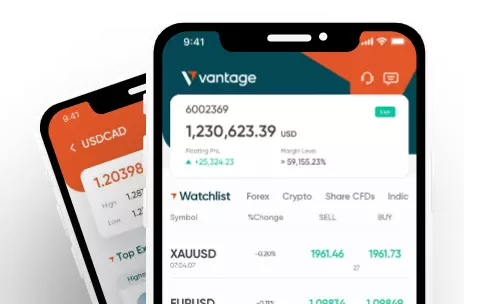
Vantage Mobile App
- 55 Deposit Methods Globally
- 220+ Daily Product Analysis
- 16 TradingView Indicators
- 80,000+ Copy Traders
Choose a Trading Account Based on Your Experience Level
-
1
Beginner Traders
For beginner traders looking for direct market access with no commissions.
- Tight spreads from 1.1 pip.
- No extra commissions on trading volume.
-
2
Experience Traders
Offering seasoned traders razor-sharp spreads, low commissions, and deep liquidity.
- Tight spreads from 0.0 pip.
- Commisssions from USD$3.00 per standard lot, per side.
-
3
Professional Traders
For professional traders and money managers who trade large volumes.
- Tights spreads from 0.0 pip.
- Commissions from USD$1.50 per standard lot, per side.

-
1
Register
Quick and easy account opening process.
-
2
Fund
Fund your trading account with an extensive choice of deposit methods.
-
3
Trade
Trade with spreads starting as low as 0.0 and gain access to over 1,000+ CFD Instruments.
Frequently Asked Questions
-
1
ETFs vs. Mutual Funds: What Is the Difference?
ETFs trade like stocks (e.g., intraday pricing and flexible order types) while mutual funds are priced once daily. ETFs typically have lower expense ratios and greater tax efficiency. For traders, ETFs offer more control over entry and exit timing, along with transparency through daily portfolio disclosures.
-
2
What Are the Fees Associated With ETFs?
Expense Ratio: An annual fee expressed as a percentage of the fund’s assets. It covers operating expenses, such as management, administrative, and other types of costs.
Commissions: Some brokers charge a fee each time you buy or sell an ETF. However, many now offer commission-free ETFs, so it’s worth checking with your broker.
Bid/Ask Spread: This is the difference between the price to buy (ask) and the price to sell (bid) an ETF. The spread can vary depending on the ETF’s trading volume and liquidity.
Other Costs: There may be additional costs incurred, such as taxes on capital gains or dividend distributions, depending on your jurisdiction.
-
3
Why Should I Trade ETFs?
Trading ETFs offers several benefits:
Provides diversification by exposing you to a basket of assets within a single fund, helping to reduce risk.
Generally have lower costs compared to mutual funds, potentially boosting net returns.
Trades on stock exchanges, which allows flexible buying and selling throughout the day.
Tax-efficient in nature, often generating fewer capital gains.
Offers transparency by disclosing holdings daily.
Comes in a wide variety to match different investment strategies and goals.
-
4
What Are the Top 5 ETFs?
While performance varies over time, these are among the most traded and widely held ETFs globally:
1. SPY: Tracks the S&P 500.
2. QQQ: Tracks the Nasdaq-100.
3. VTI: Tracks the total US stock market.
4. GLD: Tracks the price of gold.
5. EEM: Tracks emerging markets equities.